

The world of red wine can sometimes seem vast and complex for the novice. Indeed, its spectrum is particularly rich: from smooth red wine to powerful red wine including oaked red wine, there are a multitude of styles. To top it all off, a great diversity of grape varieties exists, making the overall understanding all the more difficult for beginners.
To shed light on the subject, we will give you in this article all the keys to better understand red wine. We will therefore explain its origins, its production method, and discuss the main styles you will encounter during tastings.
Follow the guide!
The origins of red wine
According to the archaeological evidence we have, the first wines produced by humans were made more than 8,000 years ago in the Caucasus (Georgia, Armenia, Azerbaijan, etc.). Nevertheless, the creation of red wine as we know it today is much more recent.
Indeed, for many centuries, the predominant wines were above all white and rosé. White wines were often more orange-tinted wines, while rosés did not resemble our current Côtes-de-Provence but were rather clairets, a kind of intermediate between rosé and red.
Moreover, depending on the culture, wines were long mixed with plants (thyme, rosemary, etc.), spices, or even honey. In Greek culture, it was even customary to dilute wine with water to control intoxication!
In any case, and although some red wines already existed during Antiquity (notably in Egypt and Greece), it was not until the 13th century that red wine began to be truly appreciated. First in France, by the elites, then, during the 14th century, it spread to the rest of Western Europe.
In the 17th century, a turning point occurred: after centuries during which clairet dominated global wine trade, popular demand (notably from Paris) shifted towards more colorful, tannic, and structured wines. At that time, these were perceived as more nourishing and had the reputation of giving strength to workers. The main producing regions of these wines were then Burgundy, the South-West (Gaillac, Cahors, Pyrenees) and Spain.
Century after century, lightly colored red wines gradually gave way to versions that are more intense both visually and in taste.
Today, the volume consumption of still wines (without bubbles) in France is divided between 46% red wines, 34% white, and 20% rosé : red wine has thus become king. However, it should be noted that its consumption has been declining in recent years in favor of other colors, as consumers are currently seeking more freshness and lightness in their glass... to be continued.
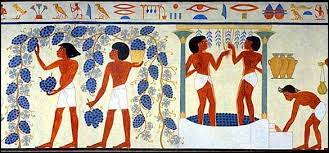
Fresco depicting grape harvest in Ancient Egypt
The production of red wine
Now that the origins of red wine are clearer for you, let's tackle its production. First of all, it is important to understand that red wine owes its color to its berries. It is indeed inside the grape skins that we find the color pigments (anthocyanins) that will give the wine its final color. To go further, here are the main steps in the vinification of a red wine.
Harvesting
This is of course the first step in making any wine. This phase consists of harvesting the grapes when they reach maturity, either manually or mechanically.
Destemming (or de-stalking)
This is the first step in the winemaking process. It consists of separating the berries from their stem (woody and vegetal structure forming the skeleton of the grape bunch).
While this operation is optional, it is very commonly practiced because the stem contains many unpleasant vegetal tannins.
Crushing
The grape berries are then crushed to extract the juice: this is crushing.
Maceration
Once crushed, the grapes are then placed in containers (stainless steel tank, barrel, cask, etc.) so that the juice comes into contact with the skins, thus giving the wine its color: this is maceration. This step generally lasts between 1 and 3 weeks depending on the grape variety and the type of wine the winemaker wishes to produce.
During maceration, punching down or pumping over is also carried out. The solid parts (skins, seeds, etc.) rise to the surface, forming a cap of marc. The winemaker will then set it in motion, either by pumping the juice from the bottom of the tank to the top (pumping over), or by pushing the marc into the tank with a stick called a punch. By this action, the winemaker will promote better extraction of aromas, color, and tannins.
Alcoholic fermentation
This is another key moment in the production of red wine (and of all wines, in fact). Thanks to yeasts naturally present or added by the winemaker, the sugars in the grapes will be converted into alcohol.
This is the moment when grape juice becomes wine! This step takes place during maceration and generally lasts between 4 and 20 days.
Racking and pressing
After fermentation, the tank is emptied, meaning the tanks are emptied to recover the wine produced, which is called "free-run wine".
Then, the solid parts remain (the marc). These skins and seeds also contain juice, so the winemaker will press them gently to avoid extracting too many tannins or less noble aromas. This yields "press wine", more colorful and powerful.
These two wines will then be blended by the winemaker in proportions he or she deems ideal to create the desired wine.
Aging
After blending the press and free-run wines, comes the aging period. This resting period is very important because it is during this time that the wine develops, stabilizes, and becomes more harmonious.
Aging can take place in a wide variety of containers, but the most common remain stainless steel tanks, oak barrels, casks (large wooden containers), and to a lesser extent amphorae.
Aging is a step with a highly variable duration. Indeed, it lasts barely a few weeks for Beaujolais Nouveau, while it can take two to three years for the production of great wines for aging.
Racking and bottling
After aging, the wine is racked: it is transferred from one container to another to remove the lees (dead yeasts) as well as other unwanted deposits undesirable.
Bottling the wine
This brings us to the end of the production process. After a possible filtration carried out to clarify the wine, thus removing the last unwanted solid particles, our wine is finally bottled.
After this "bottling", the winemaker generally keeps the wine in the cellar for a few weeks to stabilize it definitively, then finally puts it officially on sale.
In some appellations, notably in Spain within the DOCa Rioja or the DO Ribera del Duero, the producer may be required to keep the wine in the cellar for a few additional months so that it ages in the bottle before being sold.
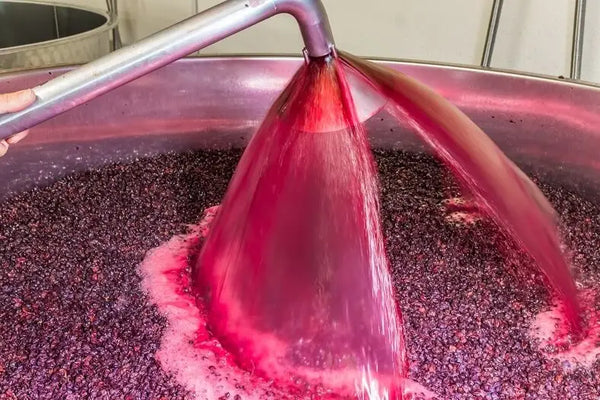
Pumping over operation during the maceration of a red wine
The different categories of red wine
Now that you know the entire process of making red wine perfectly, let's look at its main styles. Indeed, while it is possible to classify wines in many ways (region, appellation, price, grape variety, etc.), we have chosen here to discuss the main categories of red wine you will encounter during your tastings.
Supple wines
Supple wines are characterized by a certain smoothness on the palate as well as a light aspect. They are therefore easy-drinking (easy to drink) and generally have few tannins to precisely promote this approachable side. This type of red wine is ideal as an aperitif and pairs very well, for example, with charcuterie boards or cheeses.
In the supple wine category, one might think of a Gamay from Beaujolais, a Cabernet Franc from Loire or even a Pinot Noir from Burgundy.
Fruity wines
As their name suggests, the aromatic profile of fruity wines develops primarily on...fruity notes. For red wines, aromas of strawberry, raspberry, blackcurrant, cherry, and blackberry are the most common markers. Fruity wines are often supple wines intended to be drunk young for immediate pleasure.
If the wines previously mentioned in the supple wine category are also fruity wines, one can also think here of a young Syrah from the Rhône Valley, a Trousseau from Jura or even a Merlot from Languedoc or the Bordeaux region.
Friendship wines
Friendship wines combine the characteristics of the two previous categories. Thus, they are generally supple, fruity and are to be enjoyed with friends for immediate pleasure.
Languedoc-Roussillon, the Loire, the South-West or even the Rhône Valley can be excellent regions to find this style of wine.
Powerful wines
Powerful wines are the opposite of supple wines. These are cuvées expressing a lot of character as well as a certain strength on the palate. This type of red wine often has imposing tannins and is to be enjoyed during a meal, generally with intense dishes such as meat.
Here we think of Grands Crus from Bordeaux or certain reds from Provence, Languedoc, or Corsica.
Oaked wines
Oaked wines are quite simply wines that have been aged in barrels. This aging will mark the wines by giving them tannins as well as oak aromas but also many spices such as vanilla, cinnamon, clove, or even coconut.
The intensity and style of these spices will be determined by several factors such asthe type of wood used, its age (new wood or barrels several years old), the duration of aging as well as the toasting of the barrel.
While Bordeaux wines are well known for their oaky aromas, this type of cuvée exists in all regions of France and the world.
Wines for aging
Wines for aging are cuvées that can evolve positively in the bottle for several years and sometimes even several decades.
In their youth, a red wine for aging is generally characterized by a certain tannic power as well as good acidity, these two factors greatly contributing to the longevity of the wines. Moreover, prolonged aging in wood (or amphora) promotes the good evolution of certain wines, getting them used to being in contact with oxygen from the beginning of their life.
Although there is no official aging duration to qualify a wine as "for aging", at La Cave Éclairée, we define a cuvée as "for aging" when it can have a shelf life of at least 10 years.
Great wines for aging are found in all regions of France and the world.
Sweet wines
Sweet wines are wines containing residual sugar. In the vast majority of cases, this sugar comes from the harvested grapes. This is the case, for example, with Sauternes in Bordeaux, certain Vouvray in the Loire, or Maury and Banyuls in Languedoc-Roussillon.
An official sweetness scale defines wines ranging from dry to sweet, including off-dry and semi-sweet. If you want more details, feel free to read our article on the difference between a semi-sweet and a sweet wine!
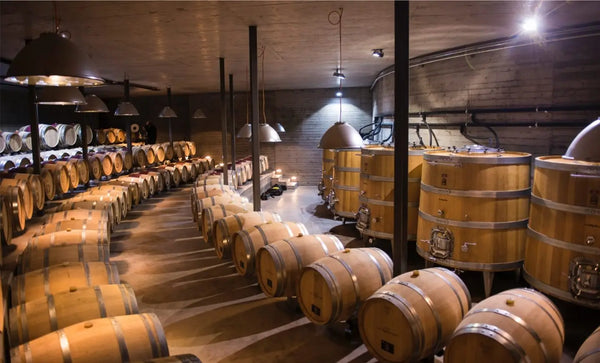
Cellar of an estate containing oak barrels and casks
The best red wines
Although it is complex to provide an exhaustive list of the best red wines, La Cave Éclairée has selected a very wide range for you ranging from friendship wines to great wines for aging. All, however, have one thing in common: their quality! So, visit our website to discover a wealth of new finds!


