



When it comes to wine, there are certain key terms you should know, and the word grape variety is definitely one of them. You'll hear this term very often, especially if you attend a wine fair or visit a vineyard.
So, what exactly is a grape variety? Quite simply, it's a type of vine that produces a specific kind of grape. Some grape varieties are red, others are white, and there are over 6,000 varieties used for winemaking. Luckily, only a handful of these are used to produce the vast majority of wines worldwide.
Single-varietal wines and blends
Depending on the region, the appellation or the estate, a wine can be single-varietal (made from a single grape variety) or a blend (produced with at least two grape varieties).
For example, the Burgundy region is renowned for its tradition of single-varietal wines: white wines are made exclusively from Chardonnay grapes, while red wines are produced with Pinot Noir, with only a few exceptions.
On the other hand, although there are single-varietal wines in Bordeaux, the region is famous for its blending tradition where Merlot, Cabernet Sauvignon and Cabernet Franc take center stage.
As you can see, the grape variety plays a key role in a wine’s identity, giving it its aromas, acidity, a certain alcohol content or tannins.
Of course, grape varieties are shaped by their location. For example, a Pinot Noir from Burgundy will not be the same as a Pinot Noir from the Southwest, as the soils and climate of the two regions are different.
Finally, human expertise also plays a crucial role in winemaking. As a result, wines produced in two neighboring estates from the same grape variety can still be very different if the two winemakers do not share the same philosophy.

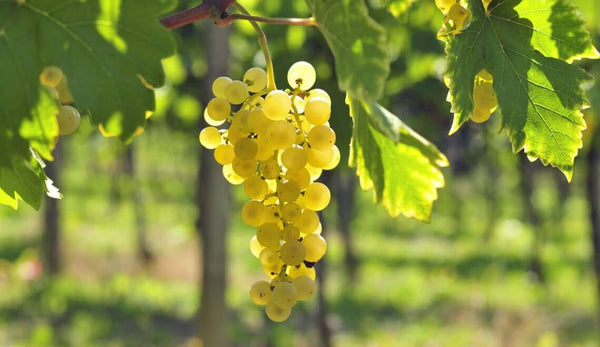
Key white grape varieties
Now that you understand the importance of grape varieties in the world of wine, here are the white varieties you will most often encounter during tastings. If you would like an even more comprehensive understanding of the topic, feel free to read our article on all the essential white grape varieties.
Chardonnay
Originally from Burgundy, Chardonnay is very likely the most famous white grape variety in the world. In fact, it is grown on every continent ! France, Italy, Spain, United States, Australia, Chile, Argentina...it is a true all-terrain grape adapting to almost any climate and terroir, resulting in a wide range of styles.
Indeed, while its character is mineral and citrus-driven when grown in cooler climates such as Chablis, it can also display great roundness and power in warmer regions, as is the case in California.
Sauvignon Blanc
Originally from the Loire Valley, Sauvignon is a highly popular grape variety, loved for its distinctively expressive aromas. With its lively acidity, it develops notes of citrus, peach, apricot, and even tropical fruits.
In France, its preferred region remains the Loire, but it can also be found in the Bordeaux region where it produces dry whites as well as delicious sweet wines (Sauternes) and even in the Southwest. Internationally, it is also widely grown in New Zealand, South Africa, and the United States.
Chenin Blanc
Another major white grape variety in the Loire, Chenin offers a wide range of possibilities. It can be used to produce dry, off-dry, sweet, and even sparkling wines !
Its aromatic profile can therefore be very diverse, but it often reveals notes of quince and citrus fruits.
Note that Chenin is also widely grown in South Africa, where it is known as Steen.
Viognier
Viognier is a grape variety whose preferred region is the Rhône Valley.
Known for its generosity, it has low acidity, a rich texture and reveals aromas of apricot, peach, honey, and white flowers.
Beyond the Rhône Valley, Viognier is also found in Languedoc-Roussillon as well as in Provence.
Key red grape varieties to remember
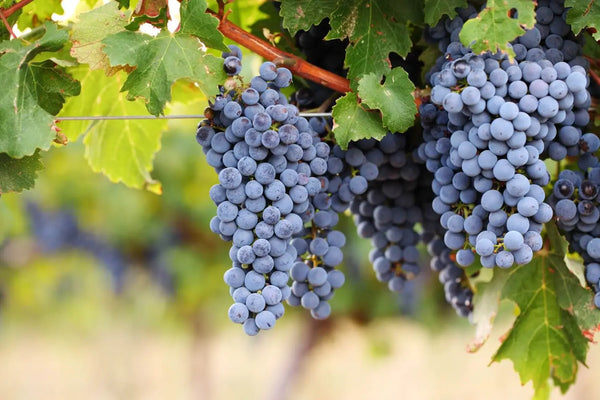
After exploring white grape varieties, let's now discover some red varieties. If you would like to learn more about the topic, feel free to read our article on the main red wine grape varieties to know.
Cabernet Sauvignon
Iconic grape from Bordeaux, Cabernet Sauvignon is a global star, as it is simply the most widely planted grape variety in the world!
It is found in France in various regions (Bordeaux, but also Languedoc-Roussillon, Provence, Loire, and the South-West) as well as internationally, such as in the United States, Australia, Lebanon, Greece, and Chile.
Cabernet Sauvignon is renowned for its ability to produce exceptional red age-worthy wines. It therefore offers a lovely acidity , an important tannic structure and releases aromas of dark fruits and spices. In many cases, it is blended with other varieties and it is rare for it to make up an entire cuvée.
Merlot
A loyal companion to Cabernet Sauvignon in Bordeaux, Merlot is the most widely planted grape in this region and the second most planted variety in the world !
This grape perfectly complements the Cabernets thanks to a generosity that stands out, as well as smooth tannins. Enjoyable even when young, Merlot develops enticing aromas of red and dark fruits. Like its favorite partners, it is mainly used in blends.
Cabernet Franc
Together with Cabernet Sauvignon and Merlot, Cabernet Franc forms a strong trio. These three varieties are often blended, especially in Bordeaux and some South-Western appellations. This fine grape is also found in the Loire Valley, where it is typically vinified on its own (AOC Chinon, Bourgueil, Saint-Nicolas-de-Bourgueil etc.)
Cabernet Franc offers good acidity, with structured tannins and its bouquet develops fruity notes of strawberry, cherry, raspberry, as well as bell pepper (green or red, depending on ripeness).
Pinot Noir
Although it can be challenging to bring out its best, Pinot Noir is one of the most prestigious grape varieties.
At the mere mention of its name, one immediately thinks of Burgundy and its renowned appellations. However, Pinot Noir is also widely grown in Alsace as well as internationally. For example, it can be found in California, New Zealand, Germany, and South Africa.
Wonderfully delicate, it offers a tasting experience with fresh acidity, and light tannins along with elegant notes of cherry, strawberry, and raspberry. It is a grape variety capable of offering delightful wines to enjoy with friends but also, and above all, magnificent, complex, and age-worthy wines.
Syrah
Finally, to complete our overview of red grape varieties, it was absolutely essential to mention Syrah (or Shiraz).
A great grape of the Rhône Valley, this outstanding variety has also spread to other French regions such as Languedoc-Roussillon or Provence as well as internationally (California, Australia, South Africa, Italy, etc.). Nevertheless, it is in its birthplace that it truly shines.
For example, it produces all the wines from the appellations Côte Rôtie, Saint-Joseph, Hermitage or Crozes-Hermitage.
Syrah typically offers a velvety texture, with tannins that are present yet smooth as well as a highly seductive bouquet with notes of violet, morello cherry, blackberry, and even pepper.
In summary
As you can see, the grape variety is one of the key elements that shapes a wine’s identity.It influences its aromas, structure, acidity, texture, and even its aging potential. However, it is not the only factor. The terroir, climate, and the winemaker's expertise also play a key role in the wine's final expression.
Knowing the main grape varieties helps you better understand what you're tasting and gradually refine your preferences. Chardonnay, Sauvignon Blanc, Chenin, Pinot Noir, Syrah, and Cabernet Sauvignon each have their own unique character and offer an incredible diversity of styles.
Ultimately, the best way to improve is to taste and compare. Nothing beats experience when it comes to discovering the characteristics of each grape variety and understanding how they express themselves depending on the region and the winemaker. And that's exactly what makes the world of wine so fascinating.
Take care and see you soon at La Cave Éclairée !






1 comment
merci, j’ai beaucoup appris. BONNE CONTINUATION