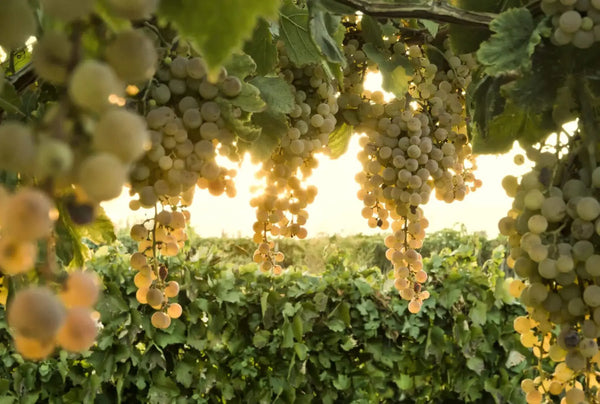
If the Viognier is today a variety firmly established in France as well as internationally, it almost disappeared in the 20th century. In fact, there were only 8 hectares left in 1965! The reasons? Phylloxera, a devastating insect attacking the roots of the vine, which decimated a large part of the European vineyard at the end of the 19th century, but also the First World War which led to a massive abandonment of the vineyards.
Fortunately, Viognier was replanted on a large scale from the 1980s onwards and today covers 2,500 hectares in France. Admittedly, this is little compared to the 112,000 hectares of Merlot, the 80,000 hectares of Syrah or the 58,000 hectares of Chardonnay planted in the country. Nevertheless, Viognier production is now much better established... and is booming!
But then, where does this grape variety come from? In which French regions is it present? Where is it planted abroad? What are its aromas? What should it be paired with at the table and how should it be perfectly served? You will find answers to all these questions in this article.
Welcome to the kingdom of Viognier!
The Rhône Valley: kingdom of Viognier
Let’s cut to the chase: if there is one region to keep in mind when it comes to Viognier, it is definitely the Rhône Valley! Its history is indeed closely linked to this superb wine region and its cultivation dates back to the beginning of our era.
As mentioned in the introduction, it was close to extinction during the 20th century but fortunately, from the 1980s onwards, winemakers in the region, convinced of its great potential as well as its aromatic nobility, began to replant it.
Today, this delicious white grape variety extends over 105 hectares in its flagship appellation Condrieu, located in the north of the Rhône Valley. In addition, Viognier is also present on a few hectares within the Côte Rôtie AOC (where it can be used up to 20% in blends with Syrah) as well as in the single-estate micro-appellation Château Grillet.
Finally, it has also spread to the southern part of the Rhône Valley, such as the AOC Châteauneuf-du-Pape, but also the regional appellation Côtes-du-Rhône where the majority of the vines are concentrated in the south of the Rhône region.
Finally, it has also spread to the southern part of the Rhône Valley, such as the AOC Châteauneuf-du-Pape, but also the regional appellation Côtes-du-Rhône where the majority of the vines are concentrated in the south of the Rhône region.
Still in France, it is also found in Languedoc-Roussillon as well as in Provence and in Corsica. Internationally, it is well established in California, in Australia, in South Africa as well as in European countries such as Italy, Spain and Greece.
So, as you can see, Viognier is extremely popular, and not just within our borders. But what are the qualities of this grape variety that have enabled its revival?
Tasting characteristics of Viognier
If Viognier is a particularly appreciated grape variety, it is notably for its aromatic profile, offering seductive, indulgents and generous white wines.
It indeed has rather low acidity as well as a creamy texture on the palate. Moreover, its typical expression includes stone fruit notes (peach, apricot, mirabelle, pear, etc.), honey, as well as floral aromas (hawthorn, violet, honeysuckle, etc.). In warm climates, an exotic touch may even appear with notes of banana or mango.
It indeed has rather low acidity as well as a creamy texture on the palate. Moreover, its typical expression includes stone fruit notes (peach, apricot, mirabelle, pear, etc.), honey, as well as floral aromas (hawthorn, violet, honeysuckle, etc.). In warm climates, an exotic touch may even appear with notes of banana or mango.
Finally, when this grape variety undergoes oak barrel aging (which is often the case, especially in Condrieu), oak aromas, butter, sweet spices, and vanilla appear in its aromatic profile. Hard to be more indulgent than that, isn’t it?
So, as you can see, Viognier is a delicious and crowd-pleasing grape variety...and that’s exactly why it can appeal just as much to beginners as to seasoned enthusiasts !
What to eat with Viognier?
At the table, Viognier is a superb companion, able to adapt to a wide variety of dishes.
First of all, a Viognier expressing itself with indulgentness and simplicity on fruity notes will be an excellent companion for appetizers, seafood, and cold starters. For example, one can easily imagine delicious pairings with oysters, green asparagus or even fresh goat cheeses with a glass of this wonderful Rhône grape variety.
When the aromatic profile of Viognier becomes richer and more powerful, lobster, salmon as well as shellfish and river fish (crayfish, pike, bream, perch, etc.) pair divinely well with it. One can also think of certain white meats as well as aged cheeses. Finally, spicy and exotic cuisines also pair wonderfully with the richness and indulgentness of Viognier.
As we said, a true all-rounder!
How to properly taste a Viognier (temperature and aging)
The serving temperature of Viognier plays a crucial role in revealing its flavors. Thus, La Cave Éclairée recommends serving between 11-13°C to preserve the wine’s freshness while revealing its aromas.
Moreover, while for many years Viognier was seen as a grape variety that offered its best in its youth, perceptions have since greatly changed... and rightly so!
Indeed, on the finest terroirs and with suitable winemaking, some Viogniers are quite capable of aging for a decade or more ! They will then display sublime aromas reminiscent of gingerbread, candied apricot, or even musk... quite a program! However, not all Viognier wines are suitable for long aging, which is why it is important to seek advice when purchasing.
What are the best Viogniers?
Although it is difficult to draw up an exhaustive list of the best Viogniers, La Cave Éclairée offers you a selection illustrating the quintessence of this grape variety, to be found at the end of the article. From delicate Viognier to powerful and intense Viognier, there is something for everyone!
All that remains is for you to put theory into practice and pour yourself a glass of this wonderful Rhône grape variety! And if you need advice, La Cave Éclairée is of course at your complete disposal!