

Ah, Chenin, here is a noble white grape variety that reminds me of certain tourist trips in the Loire and even a lovely journey to South Africa ! Because yes, we French sometimes tend to think that there isn’t much wine outside of France (or, to be kind, outside of Europe). However, as you will see, Chenin is clear proof of the contrary ! Explanations and a journey around the world.
Chenin, where do you come from ?
White grape variety capable of producing wines ranging from dry to sweet as well as sparkling wines, Chenin is a grape variety well known to Loire wine enthusiasts. In fact, it originates from there and is the main (and very often the only) grape variety used for all white wines from Anjou-Saumur.
Like many varieties, its origin remains uncertain. However, we do have written records attesting to its presence in Anjou as early as the 9th century, thanks to period documents referring to it as "Plant d’Anjou".
We then find it again at the end of the 15th century in Touraine, at the Château de Chenonceau, where it is said to have acclimatized particularly well. Its name may in fact come from this estate, unless it originated from the Mont-Chenin monastery where it was also cultivated at the same time. Immortalized in literature by Rabelais and his famous Gargantua, its success has not waned over the centuries, even though it is a grape variety that is now declining on a global scale.
In any case, one thing is certain: even if genetic analyses do not allow us to precisely date its appearance, they very clearly show that it is a direct descendant of Savagnin (you know, the famous Jura grape variety we mentioned in the article on vin jaune 😉).
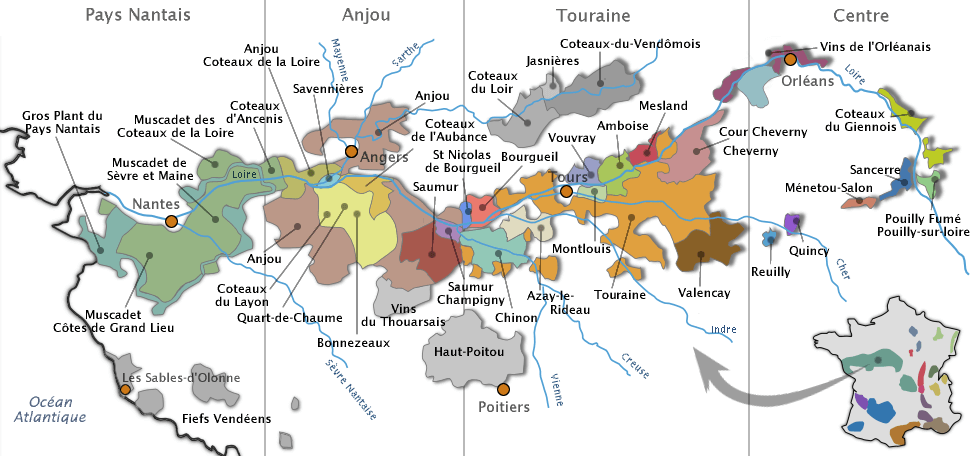 Map of the Loire Valley AOCs
Chenin, where are you ?
Firstly, in France of course and especially in the Loire Valley where its vines cover 9,000 hectares. The grape variety is in fact the basis (often exclusively) for the production of white wines in 27 AOCs of the region including Vouvray, Montlouis, Savennières, and also Quarts-de-Chaume. Still in France, it is also found in the Languedoc, where it is used in the blend for Crémant and Blanquette de Limoux.
Internationally, Chenin is present in the United States (Central Valley, California) and in Argentina (South Mendoza), but it rarely plays the leading role there. In fact, it is a grape variety with a rather surprising geography…
Very little present in Europe outside of France, it is nevertheless one of the few varieties (along with Malbec) to be more widely planted outside its country of origin. And yes, as mentioned earlier, it is in South Africa that Chenin reigns supreme! Arriving in the 17th century with the first Dutch settlers, it experienced significant growth thanks to the arrival of French Huguenots who helped to promote it.Over there, “steen”, as it is called, represents 18% of the national grape varieties and more than 53% of global plantings !
In fact, it has adapted particularly well to the warm climate of the Cape and, although it has been in significant decline for several decades (18 500 hectares today compared to 30,000 in the 1990s), it still continues to thrive there and produces some of the best white wines in the country.
Chenin, what do you taste like ?
In terms of aroma, the excellent “Aromabook of Wine” by Sandrine Audegond lists, among others, the following aromas for it : lemon, lime, peach, pear, apple, linden, acacia, hawthorn, honeysuckle, etc. To this already extensive list, we could also add quince, which is a frequent marker of young Chenin, or even pineapple, mango, or honey for wines with a high sugar concentration, especially when the berries are affected by botrytis cinerea (noble rot). As it ages, it can even develop notes reminiscent of gingerbread !
And what about the difference between a Loire Chenin and a South African Chenin, you may ask me ? (thank you for helping me build this article). Well, since the climates are quite different between Anjou and Africa, a “steen” will display riper (even exotic) fruit aromas as well as a much denser texture on the palate, while a Loire Chenin will seem comparatively fresher and have a more pronounced acidity.In short, a priori, not much in common between the wines of the two countries, but both terroirs share the same love for the same grape variety.
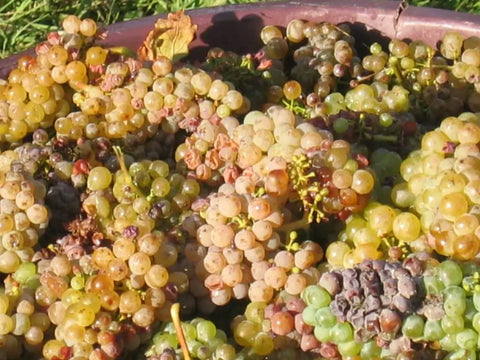 Chenin partially affected by noble rot (botrytis cinerea)
Chenin, what to pair it with ?
Acting as an all-purpose grape variety, Chenin is capable of enhancing your various dishes throughout the meal! As an aperitif, try the lovely sparkling wines from the Vouvray appellation, such as the delicious Brut from Domaine Pinon or even their dry wines.
As a main course, a fine Chenin from the Chinon appellation (often known for its reds but less so for its whites) can in particular pair beautifully with prawns, lobster, river fish, and even certain refined white meats such as veal. For example, consider the Domaine Fabrice Gasnier!
For spicy cuisines that require richer and more concentrated wines, it is advisable to opt for more full-bodied and structured wines containing residual sugars, such as off-dry or sweet wines.
Finally, a sweet wine such as a Coteaux du Layon or a Quarts-de-Chaume will delight you with foie gras or a dessert such as an apricot tart.
As I was saying, a real 4x4 !
Conclusion
As you will have understood, despite its incredible potential as well as its strong presence in the Loire and in South Africa (over 80% of the world’s vineyards), the “Ch’nin” is not very trendy worldwide if we look at the number of hectares planted around the globe.
Yet, it is a noble, rich, and delicate grape variety capable of producing a wide range of wines that every enthusiast should discover ! You have no more excuses, your next glass of white will be a Chenin ! See you soon at La Cave Éclairée !



1 comment
Merci pour cet article très complet ! Le Chenin, un des plus grands cépages de France trop méconnu…