

But what do they actually mean ? Do you know where the sugar in wines comes from ? How are sweet wines produced? Explanations.
A question of vocabulary
First of all, let's talk about dry wines. Please note, this adjective is not used here to describe the style of a wine but simply to indicate the level of residual sugar (or final) contained in a bottle. In this case, a dry wine can contain a maximum of only 4g/L of sugar (which is 3g for a 75cl bottle). At this level, it is generally imperceptible to the taster. A "dry" wine is therefore a wine with little or no residual sugar.
Then come the following categories :
➡️ Off-dry : between 4g and 12g/L
➡️ Medium-sweet : between 12g and 45g/L
➡️ Sweet or luscious : more than 45g/L
A sweet wine is therefore sweeter than a medium-sweet, which is itself sweeter than an off-dry.
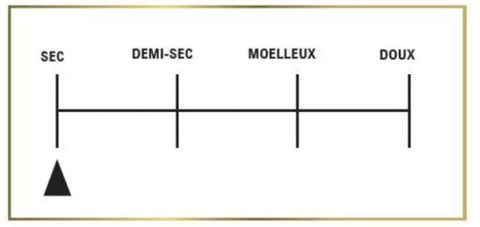 Sweetness scale of still wines
Alcoholic fermentation
Now that these terms are clear, let's look at how our sugar ends up in the final bottle.
As you know, grapes naturally contain sugars (like all fruits). Well, apart from the very specific case of chaptalization, the sugars contained in wines simply come from... grapes ! In fact, once the harvest is over, the winemaker carries out what is called alcoholic fermentation. It is at this moment that the sugar present in the grapes is naturally converted into alcohol by microorganisms called yeasts. This is the moment when grape juice becomes wine.
The winemaker can then decide either to let the fermentation run its course (it stops when the yeasts have no more sugar to consume or when the alcohol content reaches around 15% because they cannot survive beyond that), or to stop it by his own action so that not all the sugar present is converted into alcohol.
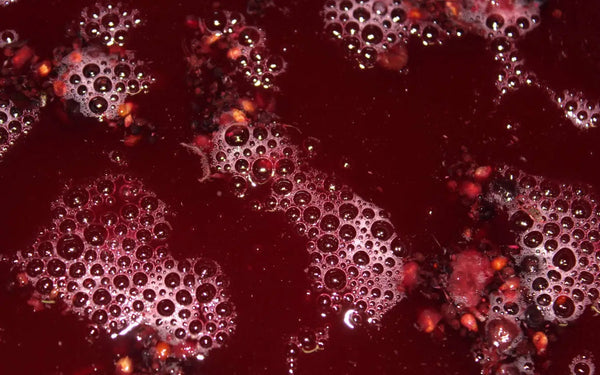
Alcoholic fermentation in progress
For example, in order to produce the Sauternes of Château Haut-Bergeron, the alcoholic fermentation goes to completion. Nevertheless, since the grapes are harvested at over-ripeness and naturally contain a high amount of sugar, not all of it is converted into alcohol and a large part therefore remains in the bottle for our greatest pleasure.
Conversely, natural sweet wines (VDN for insiders) such as those from Mas Amiel in Maury, Ports such as the delicious 10-year-old Tawny from the Kopke house, or even Muscat de Rivesaltes like the one from Domaine des Schistes in Roussillon, have had their alcoholic fermentation deliberately stopped by the addition of a wine spirit, bringing the wine above 15% alcohol, thereby killing all the yeasts and thus leaving the remaining sugar intact.
This addition of alcohol can also take place before fermentation. In this case, all the sugars present in the grapes are preserved. This is the method used for "liqueur wines" such as Macvin from the Jura or Pineau des Charentes. To simplify, these are a blend of grape juice and alcohol.
Finally, other methods such as cooling the wine and filtration can be used to eliminate yeasts. This is, for example, the case when making the delicious Vouvray demi-sec or sweet wines from the François and Julien Pinon estate.
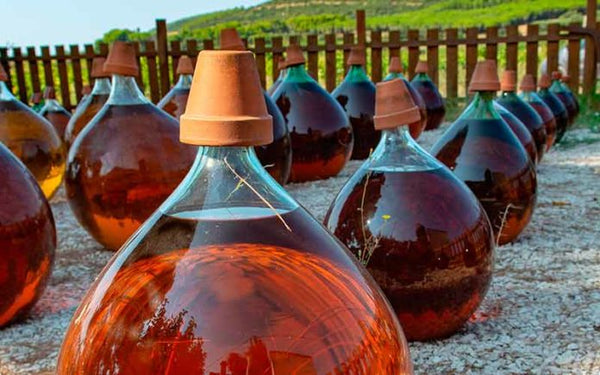
Aged in demijohn of a Vin Doux Naturel
The special case of sparkling wines
For sparkling wines (crémants, proseccos, champagnes etc.), another classification exists to qualify the levels of residual sugars :
➡️ Brut nature : between 0 and 3g/L
➡️ Extra brut : between 0 and 6g/L
➡️ Brut : between 0 and 12g/L
➡️ Extra dry : between 12 and 17g/L
➡️ Dry : between 17g and 32g/L.
➡️ Demi-sec : between 32g and 50g/L. The same term is used for still wines, so be careful not to confuse them!
➡️ Doux : more than 50g/L. Same remark as above.
Besides this semantic difference, the sugar found in the final bottle of sparkling wines does not, for its part, come from the grapes ! In fact, at the time of the final bottling of a crémant or champagne, the winemaker will add to the wine a dosage liqueur (or shipping liqueur). It is this liqueur, made of wine and cane sugar, which, depending on its sugar content, will give our bubbles their designation of Extra Brut, Brut, Demi-sec, etc.
Certain estates such as Veuve Fourny & Fils choose to respect the “ grape universe ” as much as possible and select for their champagnes a dosage liqueur made from grape sugar ! However, this remains rare.
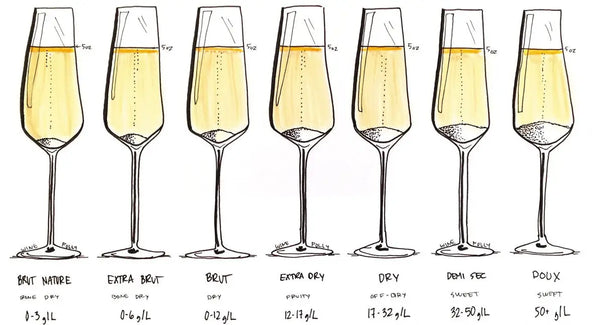
Sugar Scale of sparkling wines
Conclusion
As you will have understood, if the residual sugar present in sparkling wines comes from an external addition and is most often cane sugar, for still wines, the sugar does indeed come (except for chaptalization) from the grapes.
Furthermore, the production of off-dry, mellow, or sweet still wines can be achieved in different ways.Either the wine comes from overripe grapes containing a high sugar content and its fermentation stops naturally when the alcohol level becomes too high, or the winemaker decides to voluntarily stop this fermentation by their own means (cold and filtration, addition of strong alcohol, etc.).
These choices depend on many factors such as AOC regulations, the grape variety, the climate, or even the winemaker's preference.
In conclusion, I would advise you to pay particular attention to the notion of balance in the wine tasted rather than the raw figure expressing the sugar content in it (except for diabetics😉).Indeed, a high level of sweetness can be perfectly balanced by a beautiful acidity as well as an aromatic profile, while a wine that is actually less sweet may seem heavy or even cloying if it is not harmoniously structured. See you soon at La Cave Éclairée!


1 comment
Merci pour ces informations !