The wine region of Bordeaux can sometimes seem intimidating given its wealth of appellations as well as the diversity of wines produced within it. Nevertheless, with some basic knowledge and an understanding of certain key factors, you will be able to make an informed choice and find the Bordeaux wine that suits your needs for every occasion !
In this article, we will therefore explore the different types of wines from the Bordeaux region, the grape varieties present, the sub-regions and wine appellations of Bordeaux, as well as the influence of the vintage.
After reading this, you will have all the keys to choose the Bordeaux bottle of your dreams!
Summary
A Bordeaux wine for every occasion
Before you embark on the frantic search for a Bordeaux wine, it is essential to first determine the occasion during which you will taste it. Is it for an aperitif? A get-together with friends? A barbecue? Or perhaps a dinner with connoisseurs?
While Bordeaux wines can indeed adapt to various situations, you will not choose the same bottle for each of these occasions. However, the Bordeaux region can certainly offer you many options for each of them!
Color and grape varieties of Bordeaux wines
Bordeaux wines come in two main colors: red and white (although rosé and sparkling wines also exist).
Red wines account for nearly 90% of Bordeaux production and are often considered the emblem of the region.Bordeaux wines are generally structured, rather tannic and often aged in oak barrels. Nevertheless, it should be noted that a new wave of winemakers is shaking up the codes! Indeed, in recent years, cuvées with fresh, fruity character without oak aging are multiplying, much to the delight of enthusiasts.
As for grape varieties, Cabernet Sauvignon, Cabernet Franc as well as Merlot form a powerful trio. These are very often blended to create complex and balanced wines. Cabernet Sauvignon brings powerful tannins, Cabernet Franc offers herbal aromas, while Merlot imparts a soft and charming texture to the wines.
Moreover, although white wines represent a smaller share of regional production, they should not be overlooked. Thus, the two main white grape varieties here are Sauvignon Blanc as well as Sémillon. Just like the red grape varieties, these are very often blended.
Sauvignon brings its acidity and aromatic exuberance, while Sémillon provides body and structure to the wines produced. Furthermore, although different styles coexist, the wines will frequently display notes of citrus, white-fleshed fruits, and are often aged in oak barrels, bringing a touch of vanilla and a creamy texture to the whole.
The Bordeaux appellations
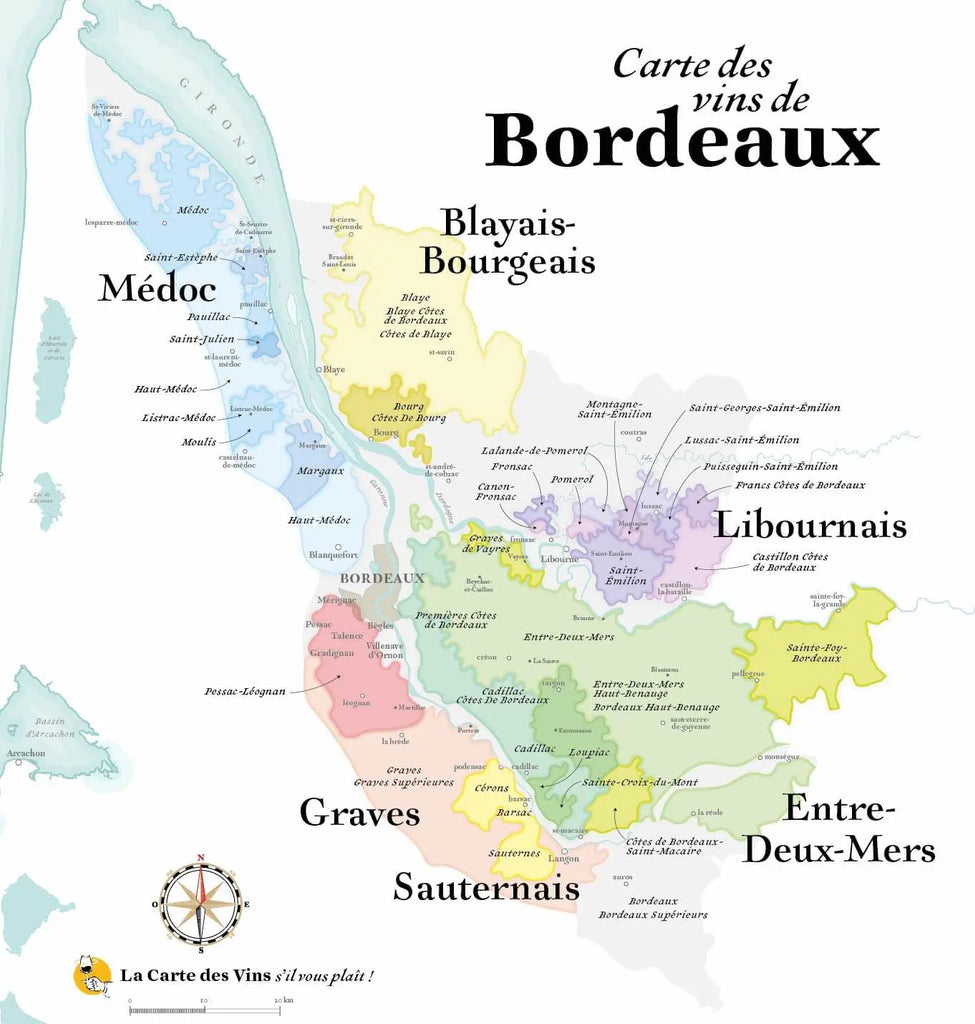
When exploring Bordeaux wines, it is also important to consider the different wine sub-regions available to you. Thus, Bordeaux is divided into 6 sub-groups offering different wine typologies.
The Médoc
This is the most famous sub-region of the Bordeaux vineyard. It is home to many of the region’s most prestigious appellations such as Margaux, Pauillac, Saint-Julien and also Saint-Estèphe. The wines produced here are all red and are mainly made from the Cabernet Sauvignon grape variety.The wines produced are mostly age-worthy wines, thus presenting a beautiful tannic structure. Finally, the Médoc soils are mainly composed of gravel.
Many renowned Classified Growths are present here, such as Châteaux Latour, Montrose, Brane-Cantenac, Calon-Ségur or Gruaud-Larose. Nevertheless, unclassified estates are also present and worth a visit. For example, one might think of the Château Mille Roses in Margaux or Château Saransot-Dupré, Cru Bourgeois Supérieur of AOC Listrac-Médoc.
The Graves region
This area is located south of Bordeaux and is renowned for its elegant red and white wines. For reds, Merlot is predominant, bringing roundness and fruitiness.
Among the most iconic appellations of this sub-region are Pessac-Léognan, renowned for the high quality of its wines, as well as the Graves AOC, which produces more accessible yet refined wines. The soils are mainly gravelly and clay-sandy.
Here too, prestigious names are present, such as Châteaux Smith Haut Lafitte or Château Carbonnieux.
The Libournais
Located on the right bank of Bordeaux, this Bordeaux sub-region is renowned for its powerful and complex red wines. Here too, Merlot is predominant. Nevertheless, Cabernet Franc and Cabernet Sauvignon are also well established. Furthermore, the soils of Libournais are quite diverse but predominantly clay-limestone. Among the most prestigious appellations of the region, we notably find Pomerol as well as Saint-Émilion.
In Pomerol, Châteaux Petrus, La Conseillante, Lafleur and L'Évangile are probably the most renowned names.In Saint-Émilion, monuments such as Ausone, Angelus and Cheval Blanc stand side by side. Nevertheless, many other quality estates also exist. For example, one might think of Château de Valois in Pomerol or Château Trotte Vieille in Saint-Émilion, two estates that perfectly reflect the characteristics of their respective appellations.
Le Blayais-Bourgeais
This part of the Bordeaux vineyard is located to the north of Bordeaux, on the right bank, facing the Médoc. Although less renowned than the previously mentioned regions, it nevertheless has many estates producing quality red and white wines offering excellent value for money. Merlot is predominant there and the soils are mainly clay-limestone.
The Entre-deux-mers
Here is another sub-region to consider in Bordeaux. This area is renowned for its high-quality production of dry, lively, and fresh white wines, perfect for pairing with seafood or summer dishes. Sauvignon Blanc and Sémillon are the leading varieties on this predominantly clay-limestone terroir. Some appellations such as Loupiac or Cadillac also produce sweet white wines within the region.
The estate Cheval Quancard and its famous Cuvée Clémence is a superb example of the region’s white wines.
The Sauternais
Finally, we arrive in the Sauternais, a region renowned for its production of legendary sweet wines made from grapes affected by noble rot, the fungus Botrytis cinerea. This process concentrates the aromas of the grapes and allows winemakers to produce sweet wines with great aromatic richness (notes of honey, butter, apricot, candied fruits, etc.). Sauvignon and Sémillon are sometimes complemented here by a hint of Muscadelle.
Among the most renowned estates in the region are, for example, the famous Château d'Yquem, Château Suduiraut and also Château Climens.Nevertheless, other estates such as Château Haut-Bergeron also offer sublime sweet wines with excellent value for money.
Wine for aging or for immediate enjoyment ?
In addition to the color of the wine and its appellation, it is also important to determine whether you want a wine for aging or for immediate consumption. Wines for aging are cuvées with a more structured and tannic profile, therefore requiring a certain period of maturation in the bottle in order to reach their peak.
On the other hand, wines for immediate consumption are more supple and develop on a fruity and accessible register allowing them to be enjoyed as soon as they are purchased.
If you wish to give a friend a fine Bordeaux wine as a gift with the aim that the person can keep it for a few years, opt for a wine for aging. A wine for immediate consumption, on the other hand, will be perfectly suited for a more immediate and relaxed tasting.
The importance of the vintage in Bordeaux
Finally, one of the key aspects when choosing a good Bordeaux wine is the vintage. Indeed, each year, the weather conditions vary considerably, consequently influencing the quality of the wines produced (aromas, concentration, balance, etc.). Thus, in exceptional vintages, the wines often have intense aromas, ripe tannins, as well as excellent aging potential. Nevertheless, in more modest vintages, the same wines may display lighter profiles and gripping tannins due to being less ripe.
Moreover, it is important to consider that even within the same year, and from one estate to another, the impact of the vintage can vary in significance. Thus, in a vintage considered average or mediocre, one estate may produce truly exceptional wines while the neighboring château may not achieve the same quality. Indeed, it is in years when nature is less generous to man that the winemaker's expertise becomes even more decisive in the quality of the wines produced.
Therefore, do not hesitate to seek advice from La Cave Éclairée and do not be guided by easy summaries with ratings that you find on the internet. These indeed mention a general rule that is valid but not automatic. An in-depth knowledge of the terroirs of each estate and regular tastings of the wines are necessary here to be able to judge the quality of the cuvées produced.
Conclusion
In conclusion, choosing a good Bordeaux wine requires taking several factors into account such as the tasting occasion, the color of the wine, its style, its appellation, or even its vintage. All these elements indeed play an essential role in the quality of the wines and it is therefore essential to take them into consideration.
By following the advice presented in this article, you are now able to choose an excellent Bordeaux wine that will delight your taste buds and enhance your tasting moments. And if you would like to receive advice, do not hesitate to contact us directly at La Cave Éclairée !