

At the end of your reading, you will be able to better understand these classifications, their histories, and assess their real interests and values. In this first part, we will focus solely on the two iconic wine regions of our beautiful country: Burgundy and Bordeaux ! If you wish to view the rest, go directly to the classifications of other wine regions. There you will discover the hierarchies used within the Alsace, Champagne, Loire, and Provence regions.
The Bordeaux Classifications
Numerous classifications bearing the notion of Cru exist within the Bordeaux region, leaving the novice consumer somewhat confused. Nevertheless, one common point unites these hierarchies: they all, without exception, reward estates and not precisely defined plots.
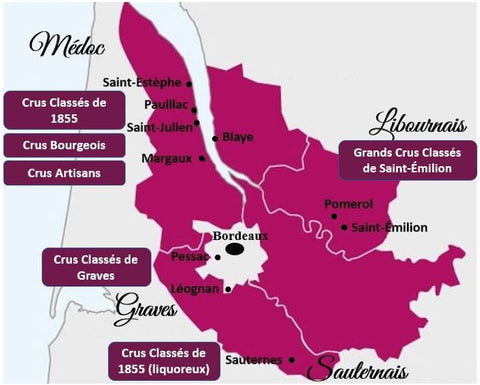
Here is an overview of the 5 key classifications that rank the 118 000 hectares of AOC vineyards in the region.
The 1855 Classification
This is the most renowned of all, the one that brings the great names of the region to mind : Château Margaux, Château Latour, Château Lafite, Château Haut-Brion etc. As its name suggests, it was created in 1855 thanks to Napoleon III, who asked each French wine region to establish a ranking of their best wines for the Universal Exhibition of that same year.
In response to this request, the Bordelais created a 5-level classification for red wines from the Médoc (1st Grand Cru Classé, 2nd Grand Cru Classé, 3rd Grand Cru Classé, etc.) and in 3 levels for sweet whites from Sauternais (Premier Cru Supérieur, Premier Cru, Deuxième Cru) based solely on the reputation and price criteria of the time. This classification today includes a total of 88 châteaux (61 for reds and 27 estates from Sauternais), all more prestigious than the next.
Nevertheless, this classification has been criticized for several decades now. Indeed, what value can we still assign to it knowing that it has (almost) never evolved since its creation and is considered immutable ?!
Today, it is clear that while the 1st Grands Crus and a good portion of the Seconds are hardly contested regarding their superiority, the hierarchy of the lower levels would probably be subject to significant change if it were to be updated! Thus, for example, the Château Pontet-Canet (Pauillac), currently ranked at the 5th and last level, would probably be propelled 2 to 3 ranks higher, while other estates would be downgraded by one or two levels, or even removed from this classification. Similarly, some currently unclassified estates would probably deserve to be included.
Thus, it is preferable to seek advice if you wish to choose a prestigious bottle from one of these estates, especially if the estate is ranked at the 3rd level of the classification or below. You can also consult the Grands Crus of Bordeaux available at La Cave Éclairée to make your choice with confidence!

The Graves Wine Classification
The prestigious 1855 classification did not take into account the estates of the Graves (south of Bordeaux), so a dedicated hierarchy for this area was created in 1953, then completed in 1959, distinguishing without ranking 16 estates, all located in the Pessac-Léognan area (the AOC did not yet exist in the 1950s).
Some châteaux are recognized only for their red wine, others only for their white, and some for both. Among this classification, a few famous names such as Château Smith-Haut-Lafite or Château Carbonnieux.
This hierarchy, although more recent, is also immutable. The same issues arise as for the 1855 classification.
The Grands Crus of Saint-Émilion
The Saint-Emilion AOC is vast : 5,400 hectares. In order to classify this large area, a classification was created as early as 1954 with a division into 3 levels. This hierarchy is still in effect today, but it is evolving compared to the previous fixed classifications.
Thus, in 2022, the latest Saint-Émilion classification placed 2 châteaux at the top of the hierarchy as "Premier Grand Cru Classé A": Château Figeac and Château Pavie. Then, 12 other estates were classified as "Premier Grand Cru Classé" and finally 71 vineyards as "Grand Cru Classé". Let’s admit that our Bordeaux friends could have chosen a different rating scale to avoid semantic confusion with other classifications, but let’s move on...
As mentioned, and unlike neighboring classifications, that of Saint-Émilion is therefore updated every decade. The next classification will therefore take place in 2032 after the one in 2022. While this update seems fairer from the enthusiast’s point of view, it nevertheless results in (very) numerous complications. For a very recent example, the Châteaux Cheval Blanc and Ausone (at the top of the previous 2012 classification) did not wish to participate in the 2022 ranking because the evaluation grid, in their view, moved too far from terroir, quality, and history in favor of secondary elements. That’s unfortunate !
While the evolving nature of this classification therefore allows (in my opinion) greater fairness between estates while remaining a reliable indicator over time for consumers, this same evolving nature is also a source of many frictions within the appellation, leading to a deterioration of the general image of this hierarchy and its credibility.
PS : it is important to not confuse the term “ Grand Cru Classé ” (referring to the classification) with the term “ Saint-Émilion Grand Cru ” (yet another semantic issue) that you may find on some bottles. In fact, the latter simply means that the wine produced comes from the Saint-Émilion Grand Cru AOC, covering exactly the same production area as the simple Saint-Émilion AOC ! The only differences : slightly stricter production conditions (lower yields, minimum 12 months aging, etc.). Once again, one might feel that everything is done to mislead the consumer !

The Crus Bourgeois
The history of the Crus Bourgeois dates back to the 12th century. Nevertheless, in the modern sense, the term "Cru Bourgeois" has only been recognized since 1978. Since then, it has been officially used to highlight Médoc estates not included in the great 1855 classification. The first Crus Bourgeois classification took place in 2003.
There are also recurring legal complications surrounding this label due to the economic stakes. Thus, this first 2003 classification was challenged and then annulled in 2007. Then, after several years of reorganization, it was decided that the "Cru Bourgeois" designation would be reassigned every 5 years to give estates greater commercial flexibility (the hierarchy previously evolved every year).
This classification is divided into 3 levels :
-Cru Bourgeois Exceptionnel (14 estates),
-Cru Bourgeois Supérieur (56),
-Cru Bourgeois (179).
It should be noted that the 249 recognized estates in this hierarchy must come from the 8 Médoc AOCs (Médoc, Haut-Médoc, Saint-Estèphe, Listrac-Médoc, Moulis-en-Médoc, Margaux, Pauillac, and Saint-Julien).
As you can imagine, it is complex to achieve a consistent level of quality with such a large number of estates accounting for about 30% of Médoc production ! However, the selection criteria are well defined : all wines are blind tasted over 5 vintages, and other factors such as environmental practices or overall estate management are also considered.
Some renowned estates still shun this classification and never submit their wine, having more to lose than to gain. Moreover, since some Crus Bourgeois can be found in supermarkets at rather low prices, renowned vineyards absolutely do not want to be associated with this "low cost" image.
In summary, this classification, which enjoys a good reputation, is a good indicator of quality but mainly for the first two levels (Exceptionnel and Supérieur). The simple mention “ Cru Bourgeois ” can bring together fine wines with good value for money alongside other cuvées of little interest. Good knowledge of the estates and vintages will therefore be essential to make the right choices.
La Cave Éclairée for example, recommends the excellent Cru Bourgeois Supérieur from Château Saransot-Dupré.

The Crus Artisans
The designation “ Cru Artisan ” was created in 1989 to highlight the small and medium-sized estates of the Médoc where the estate manager carries out all stages of wine production on the estate (personally managing the vineyard and vinification, aging, and bottling).
36 estates currently benefit from this designation which does not guarantee the quality of the wines and was only created to shine a spotlight on the small producers of the region overlooked by other classifications. The Crus Artisans classification is reviewed every 5 years.
Burgundy: Grands and Premiers Crus
Burgundy is certainly the region where the notion of Cru is the most recognized of all. While this is partly due to the admiration many of us have for its wines, it is also probably linked to its 2 000 years of winegrowing history as well as the great precision of the established hierarchy.
The modern history of the classification of Burgundy crus began at the end of the 15th century, when the notion of “ Climat ” appeared. A climat is a precisely defined vineyard plot with specific geological and climatic characteristics. Then, in 1855, under the impetus of Napoleon III (again !), work was undertaken by Jules Lavalle, a naturalist and botanist, to classify Burgundy’s terroirs. This classification served as the basis for the INAO (National Institute of Appellations of Origin) when the Burgundy AOCs were created in 1935.
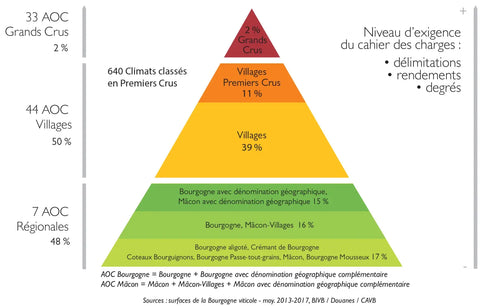
Today, thanks to these studies, more than 1,000 Climats are now mapped, including 33 Grands Crus as well as 640 Premiers Crus. These are so precious that since 2015 they have been listed as UNESCO World Heritage and a museum in Beaune is entirely dedicated to them !
Of the 30 000 hectares of vineyards in the region, only 600 bear the Grand Cru designation (2%) and 3,300 the Premier Cru designation (11%). This is thereforea precise selection of the best plots allowing the production of the very best wines in the world (and the most expensive...).
Of course, as always, the work of the winemaker is decisive in the quality of the wines obtained, so some bottles labeled “ Premier Cru ” may be on par with “ Grand Cru ” bottles, just as some “ Premier Cru ” cuvées may be disappointing compared to some wines from a Village AOC such as Pommard or Gevrey-Chambertin.
Nevertheless, this classification currently represents the best in the wine world and many foreign countries are inspired by it.
If you wish to discover some of these wines, do not hesitate to take a look at the Grands Crus and Premiers Crus of Burgundy carefully selected and available from La Cave Éclairée.
Conclusion
As you will have understood from this reading, the notion of Cru therefore has a different meaning depending on the region in which you are located : while in Bordeaux, it will primarily highlight the estate as a whole, through its winegrowing history and historical reputation, in Burgundy, it will be mainly linked to the land and will highlight plots reputed to produce the best wines.
We hope you are now an expert on the subject ! In the next article, you will discover the wine classifications of other French regions (Alsace, Champagne, Loire, Provence).
See you soon at La Cave Éclairée !


