

Appreciated for its suppleness, its fruitiness as well as its ability to produce wines of great quality, Merlot is one of the most widely planted varieties in the world. It indeed plays a central role in the entire wine industry, especially in Bordeaux where it is regularly blended with the grape varieties Cabernet Sauvignon and Cabernet Franc.
In this article, we will explore together the history of Merlot, its origins, its tasting characteristics, its main production regions, and also the food and wine pairings to consider with it.After reading this, you will know everything about this fabulous grape variety!
Summary
History and origins of Merlot
Although it is likely that Merlot was cultivated in the Bordeaux region earlier, it was only at the end of the 18th century that the grape variety was formally identified in the Libournais.
Although its temporal origins remain uncertain, it is nevertheless now established that Merlot is the result of a crossbreeding between Cabernet Franc and a variety that is now almost extinct: the Magdeleine Noire des Charentes.
Its name is said to echo the blackbirds (or “merleaux”), small birds fond of the berries of this grape and possessing a very dark color, just like the variety.
During the 19th and 20th centuries, Merlot experienced a growing popularity, eventually becoming the leading grape variety of the Bordeaux vineyard.
After the Second World War, its ease of cultivation as well as its ability to adapt to various climates and soils made it a popular choice in many wine regions around the world, notably in Italy, the United States, Australia, New Zealand, and Chile.
Today, with 266,000 hectares, it is the second most widely planted red wine grape variety in the world after Cabernet Sauvignon (341,000 hectares). Quite impressive, isn't it?
Merlot growing regions
With 116,000 hectares, France is the world's leading Merlot vineyard and accounts for nearly 43% of its global surface area.Within our beautiful country, it is mainly found in the Bordeaux region, where 65,000 hectares are planted, thus representing more than 55% of the domestic plantings of the grape variety.
The variety sets the tone in particular in the Libournais appellations such as Canon-Fronsac, Lalande-de-Pomerol, Pomerol as well as Saint-Émilion and its satellite AOCs (Puisseguin, Saint-Georges, Lussac, Montagne, etc.). In the Médoc, on the left bank, it is less present but certain appellations such as Moulis-en-Médoc and Listrac-Médoc have given it a place of choice. Finally, it can also be found in Pessac-Léognan as well as in the Graves, further south in the vineyard.
Still in France, it has also flourished in the South-West such as in Bergerac or, to a lesser extent, in Madiran and Cahors where it is used as a complementary grape variety. Merlot is also firmly established in the Languedoc-Roussillon where it covers nearly 30,000 hectares. Finally, the variety is also present in Provence as well as in the Rhône Valley but in much smaller quantities.
Abroad this time, Merlot is grown in almost all major wine regions: Italy, United States, Chile, Argentina as well as Australia and New Zealand...The Libournais grape variety has now conquered the entire planet !
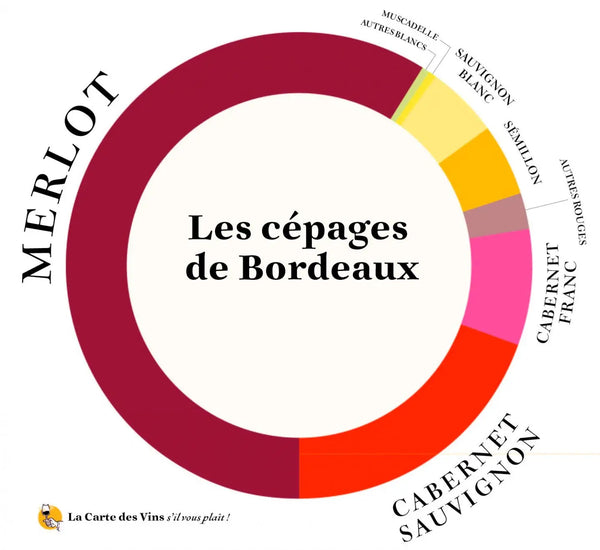
Merlot represents more than half of the Bordeaux vineyard
The characteristics of Merlot
Merlot is an early-ripening grape variety, meaning that it ripens earlier than many other varieties. As a result, it is suitable for relatively cool climates where harvesting can be done before the autumn rains. However, this early ripening also makes it susceptible to spring frosts. Merlot is also susceptible to grey rot as well as other fungal diseases, thus requiring increased attention from winegrowers. Finally, it is on clay-limestone terroirs that it gives its best.
When tasted, Merlot is often described as a grape variety that produces supple, fruity wines, with a velvety texture and tannins that are present but rather round. In addition, its moderate acidity makes its wines enjoyable even when young.
In terms of aromas, the typical markers of Merlot include red and black fruits (strawberry, plum, blackberry, blackcurrant, etc.). As it ages, it can develop more complex notes of truffle, chocolate, leather, and tobacco.
Of course, all of this description is a generalization and does not reflect the great diversity of wines that Merlot is capable of producing! Indeed, depending on the quality of the plant material, the terroir, or the winemaking process, this great grape variety can offer radically different cuvées.
Thus, a Merlot crafted for pleasure and fruitiness will produce a delicious red wine for aperitif, while a Merlot from a prestigious terroir and aged in barrels will produce a great wine with complexity that will only fully reveal itself after a long cellaring! Similarly, a Californian Merlot with jammy aromas and a high alcohol content will leave you with a completely different impression than a French or Italian Merlot!
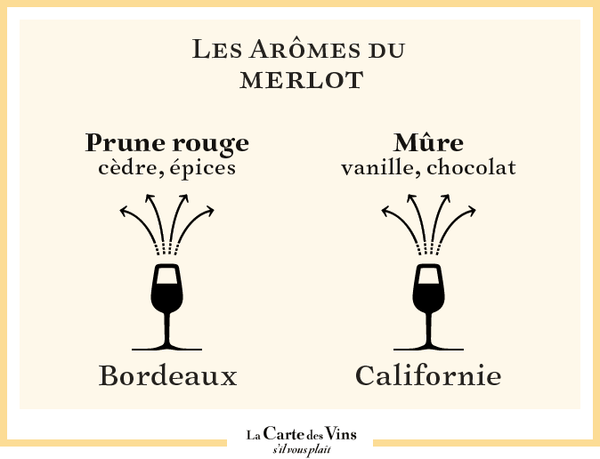
Bordeaux Merlot and Californian Merlot: very different aromatics and balances!
The differences between Merlot and Cabernet Sauvignon
Merlot and Cabernet Sauvignon are often blended to create balanced and harmonious wines.However, the two grape varieties have notable differences.
Firstly, and as already mentioned, Merlot is a rather early-ripening variety and therefore prefers cool climates as well as clay-limestone soils. On the other hand, Cabernet Sauvignon is much more late-ripening and prefers warm climates as well as gravelly soils that retain heat.
From a visual and taste perspective, Merlot also displays a ruby color, a fruity aromatic profile, and pronounced yet rather elegant tannins. Conversely, Cabernet Sauvignon offers a darker violet color, more structured tannins, higher acidity as well as an aromatic profile focused on black fruits but also spices or bell pepper.
In short, there is no need to compare them...if the two varieties are regularly blended, it is precisely because their qualities complement each other perfectly!
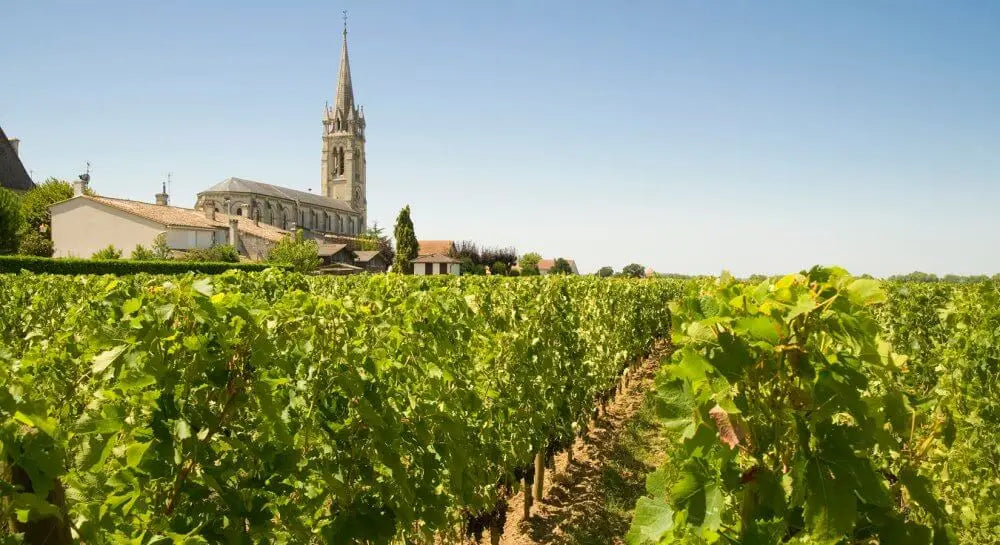
Merlot vines in the Pomerol appellation
Food and wine pairings with Merlot
Merlot lends itself to a wide variety of food and wine pairings. Here are some suggestions to enhance your meals.
- Red meats : the fruitiness, roundness of Merlot, as well as its tannic structure, often balance the powerful flavors of red meats very well. Here, don't hesitate to open a bottle of Merlot blended with Cabernet Sauvignon. The pairing will be ideal with a barbecue, a rib of beef, or lamb chops!
- White meats : thanks to its balance, Merlot pairs very well with roasted poultry (chicken, turkey, etc.) as well as pork-based dishes.
- Cheeses : although cheeses generally pair better with white wines, you can still try a pairing with Merlot and gorgonzola or Brie. In this case, choose a young, fruity, and low-tannin Merlot! For older Merlots, opt for Gruyère or Comté.
- Charcuterie: A red aperitif wine made from Merlot (light, fruity, and low in tannins) will be ideal to accompany a charcuterie board! Dry sausage, Grisons meat, country ham, and rillettes will pair very well with this type of wine!
- Tapas: Small appetizer bites (croquettes, tomato bread, potatoes, etc.) will also find excellent companions in fruity and low-tannin Merlots.
Finally, to fully enjoy a Merlot, it is generally recommended to serve it at a temperature between 16 and 18°C. Younger wines can also be decanted before tasting to reveal their aromas.
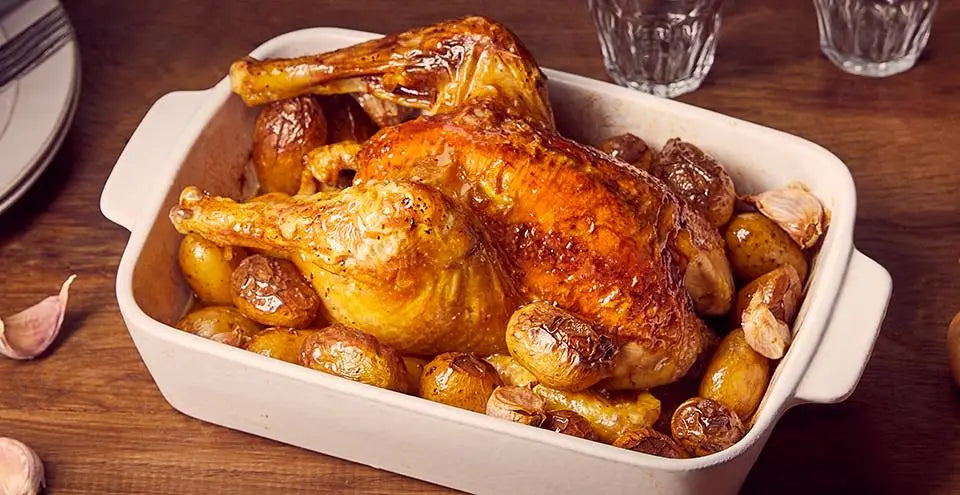
A classic but magical pairing: Merlot and roast chicken
The best Merlots
Although it is very complex to identify the best Merlots, two appellations mainly come to mind when this grape variety is mentioned: Pomerol and Saint-Émilion. These two vineyards indeed give pride of place to this grape variety, and their respective terroirs are ideal for its cultivation.
As such, we recommend the wines from Château de Valois in Pomerol as well as from Château Leydet-Valentin in Saint-Émilion.The two properties belong to the same family (Leydet) and offer great elegant and complex red wines where Merlot is predominant in the blends. The produced cuvées can be enjoyed in their youth but are also capable of long aging... to our greatest delight. Go for it without hesitation, you won't be disappointed!
Finally, we also recommend the Cru Bourgeois from Château Saransot-Dupré in AOC Listrac-Médoc. Here too, Merlot is predominant and allows for the creation of graceful wines that offer immediate pleasure as well as great aging potential.
You are now an expert on the magnificent grape variety that is Merlot! All that remains is to move from theory to practice! Cheers, and feel free to contact La Cave Éclairée for any questions!


2 comments
Concis clair et documenté
Concis clair et documenté