

The Champagne terroir
Now that we know more about the history of our famous sparkling wine, let’s analyze the Champagne terroir.
First of all, in Champagne, the climate is rather cold and the soils are clay-limestone. The chalk is often highlighted here to explain the freshness and minerality of the wines, two key characteristics of our favorite sparkling wine. The latter also allows for fantastic water regulation : when it rains too much, the excess is absorbed and redistributed the following year; when it is too dry, this limestone acts as a sponge and retains water underground.
On these soils, 3 grape varieties make up almost all of the plantings : the Pinot Noir (38% of the vineyard), the Pinot Meunier (32%), as well as the Chardonnay (30%). Other varieties such as Pinot Gris, Arbane or even Pinot Blanc can be used but remain uncommon. Pinot Noir and Pinot Meunier are red grape varieties while Chardonnay is a white grape variety. Thus, if you read “Blanc de blancs” on a bottle, it simply means your champagne is 100% Chardonnay (a white grape producing a white champagne). Conversely, a “Blanc de noirs” will be a champagne made from Pinot Noir and Pinot Meunier (or just one of the two) as these are black-skinned grapes making a white champagne.
And what about Rosé Champagne in all this? Well, the oldest traces of its creation date back to the year 1764 when the Ruinart house produced a maceration rosé (the juice coloring in contact with the black skins of the grapes) called "œil-de-perdrix". Nevertheless, the more common method today of blending a small proportion of red wine with a majority of white wine to create a rosé wine (a process only allowed in Champagne and nowhere else!) was only officially created in 1818 by Nicole Clicquot (Champagne Veuve Clicquot).
The production of Champagne
Let’s now look at the key steps in the production of our bubbles. Champagne is a wine that undergoes two fermentations (you know, this process that converts the sugar in grapes into alcohol). Once the first fermentation is complete, the resulting wines are called “ base wines ” and are around 11% alcohol. At this stage, the bubbles do not yet exist and the acidity of these juices being very high, they are not very pleasant to taste.
In order to bear the mention “ Champagne ”, the base wines must then undergo aging on lees, that is, a period of at least 15 months (for a classic champagne) or at least 36 months (for a vintage champagne) where they are stored in the cellar and in bottles horizontally. And it is during the first weeks of this aging on lees that our effervescence will form ! It is at this moment that the winemaker will add to the base wines “ a tirage liqueur ”, a mixture of wine, sugar (often cane) and yeasts. The latter will then again convert the added sugar into alcohol, while releasing carbon dioxide (CO2) which will this time be trapped in the bottle. It is therefore the second fermentation in the bottle that gives our Champagne its bubbles as well as its final alcohol content around 12.5%.
Beyond the creation of this effervescence (called “ prise de mousse ”), aging on lees is a crucial step to obtain a high-quality champagne : it is thanks to these long months of rest in the bottle that the wines, in contact with the lees (dead yeasts left in the bottle after generating the second fermentation), will mellow and gain in complexity, sometimes giving those indulgent aromas of toasted bread and hazelnut.
Finally, our sparkling wine will be “ disgorged ” (the lees are expelled from the bottle to obtain a clear liquid and to avoid potentially starting a new fermentation) and a “ dosage liqueur ” is added, a mixture of wine and sugar defining the style of the champagne : Brut nature, Extra-brut, Brut, etc. If you want to find all the information about these mentions, feel free to check out this article I wrote about sweet wines where everything is explained.
And there you have it, our champagne is finally ready to be sold and enjoyed in good company !
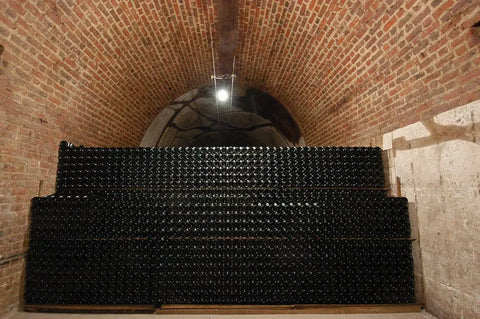 Example of bottles aging on lees
Why is Champagne so expensive ?
First of all, the price of grapes in Champagne varies between €4 and €7/kg depending on the plots and vintages. Knowing that it takes on average 1.2kg of grapes for a bottle, we are already around €8 ! If the raw material is so expensive, it is notably due to the high price of land as well as the fact that each year, the industry players set the authorized yields among themselves in order to adjust production according to global demand (so as not to lower prices too much). Finally, the great power of brands such as Ruinartt, Moët & Chandon, Dom Pérignon or even Roederer is quite unique in the French wine landscape. Champagne is, thanks to these groups (especially LVMH), a particularly well-marketed product and conveys a luxury image from which the entire industry benefits.
Other factors include the mandatory hand harvesting in Champagne or the time required to produce the product, as these long years in the cellar obviously impact the final cost. But these elements are ultimately common to other products. Take the example of Vouvray Brut from Domaine Pinon : its production method is the same as champagne (traditional method), the harvest is also manual here and the aging time in the cellar (aging on lees) is 30 months (the same or even longer than some champagnes). The remaining elements explaining the difference in price between the two products are therefore indeed much higher land value in Champagne, a certain rarity deliberately sought as well as the power of marketing making Champagne a luxury product.
How to properly taste Champagne ?
To conclude, let’s address the tasting part! First of all, most champagnes we buy are meant to be drunk within 3 to 5 years. They are not intended to be aged and while they are not less pleasant at the end of this period, they will not gain in complexity either.
Other cuvées, however, are made for aging. We are talking here about certain vintage champagnes (such as the Blanc des Millénaires from the house of Charles Heidsieck) or other great bottles often sold at high prices. There is no universal rule for when to open these bottles as it will depend on the style of the champagne, its quality, and the vintage.
The best thing to do in this case is to ask your favorite wine merchant for advice (La Cave Éclairée of course ) or directly the winemaker concerned. Nevertheless, although no precise aging duration can be defined in advance, waiting 15 to 20 years will already be a fine show of patience! Beyond that, champagnes often lose much of their effervescence and may develop aromas of honey, undergrowth, and humus. Personally, I love it, but that’s not the case for everyone !
Regarding serving temperature, it is generally agreed to serve our bubbles between 8° and 10°C. Below that, the cold will have a numbing effect on the taste buds and above, the lively and refreshing character of champagnes will be less appreciated.
Finally, (and I know this will be hard to hear) but it is better not to serve champagne in classic flutes or coupes. If that’s all you have at home, don’t throw out all your glassware, but a coupe being by definition very wide, will not be ideal for best appreciating the aromas on the nose and will make the champagne lose its effervescence more quickly once served. As for the flute, it will make the carbon dioxide rise too concentrated, which can sometimes "sting" the nose (this is called this phenomenon “ carbonic prickle ”). Therefore, a wine or champagne glass with an open bottom but a slightly narrowed rim will be perfect !
There you go, you now know almost everything about our national sparkling wine! To celebrate all this new knowledge, all you have to do is open a nice bottle… and you know which region to turn to !
See you soon at La Cave Éclairée !


1 comment
Super intéressant ! Merci pour cet article