

Here is the long-awaited sequel to our first installment, which covered the viticultural classifications within the Bordeaux and Burgundy regions ! In this second chapter, we will now give you all the keys to understand the hierarchies established within the other regions with classifications: Alsace, Champagne, Loire and Provence. Enjoy your reading!
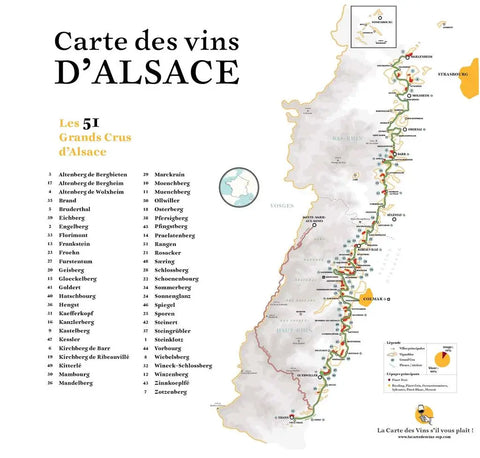
The 51 Alsace Grands Crus
Alsace is an absolutely magnificent wine region but difficult to grasp. Stretching over more than 15,000 hectares between Strasbourg and Mulhouse, the region is a very rich geological patchwork where many grape varieties are grown. Add to this names with Germanic sounds such as “Gloeckelberg”, “Praelatenberg ” and ranges of about twenty cuvées at many winegrowers, and you’ll see why it can be confusing for many!
Thus, in order to better structure the region and establish a hierarchy, 51 lieux-dits (plots ranging from 3 to 80 hectares, reputed to have the best terroirs) were gradually defined between 1975 and 2007 to be promoted as AOC Grand Cru. Of course, the people of Alsace did not wait until the 1970s to take an interest in their soils! Some of these geographical areas were already identified as early as the 9th century, but without any particular mention except for the name of the plot, which is too often unknown to the general public.
These 51 Grands Crus today represent the top 5% of the region’s production and are actually shared by many producers (with the exception of a few monopolies). Obviously, not all wines produced there are equal! Nevertheless, while this hierarchy is not an absolute guarantee of quality (no classification is), it is still recognized that the defined terroirs are capable of producing the very best wines of the region.
It should also be noted that only 4 grape varieties can be grown on these lands: Riesling, Muscat, Pinot Gris as well as Gewürztraminer. The only exception to this rule: Sylvaner can be produced on Grand Cru Zotzenberg. Finally, no blending of grape varieties is allowed except on 2 Grands Crus (Altenberg de Bergheim and Kaefferkopf).
In summary, the notion of Grand Cru in Alsace is therefore a truly good indicator for the consumer even though the wines from these plots are obviously not all at the same level. Just as in Burgundy (see the previous article), it is above all strictly defined geographical areas that are distinguished and often benefit, among other factors, from excellent exposure.
So do not hesitate, for example, to taste the Riesling Grand Cru Hengst from Domaine Barmès-Buecher or the magical Gewurztraminer Grand Cru Steingrubler from the same estate to get an idea of the quality these truly great wines can achieve!
Grand Cru and Premier Cru in Champagne
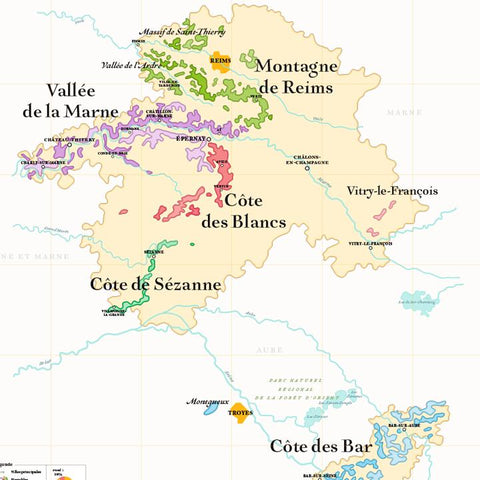
The Champagne wine region covers about 34,300 hectares. From Reims to Epernay via Troyes, 9,000 hectares are distinguished within this area as Premier Cru or Grand Cru, the rest having only a simple "Cru" designation. This hierarchy was created in 1919 (and modified in 1935) to set a framework for supply negotiations between major Champagne houses.
Unlike Alsace or Burgundy, the classification into Cru, Premier Cru, and Grand Cru here applies to entire villages and not to very precisely defined plots. Thus, there are 17 villages classified as "Grand Cru" and 42 others as "Premier Cru". So, if a Champagne is made with grapes from one or more villages classified as "Grand Cru", it can bear this mention on the bottle. The same applies for a Champagne "Premier Cru".
While this system highlights some of the terroirs producing the best grapes, the value of the Cru designation in Champagne does not have the same weight as in Burgundy or Alsace. In fact, Grands and Premiers Crus in Champagne represent nearly 26% of the region’s total area, which is twice as much as in Burgundy ! The tolerance is therefore much broader here, and some plots within Premier or Grand Cru villages probably do not deserve to be classified.
Consequently, while for the consumer these mentions remain a good indicator, it should be kept in mind once again thatthey are not as exclusive as in some other regions.
While this system highlights some of the terroirs producing the best grapes, the value of the Cru designation in Champagne does not have the same weight as in Burgundy or Alsace. In fact, Grands and Premiers Crus in Champagne represent nearly 26% of the region’s total area, which is twice as much as in Burgundy ! The tolerance is therefore much broader here, and some plots within Premier or Grand Cru villages probably do not deserve to be classified.
Consequently, while for the consumer these mentions remain a good indicator, it should be kept in mind once again thatthey are not as exclusive as in some other regions.
La Cave Éclairée can once again help you make your choice thanks to its careful selection of Grand Cru Champagnes !
The Sweet Grands Crus of the Loire
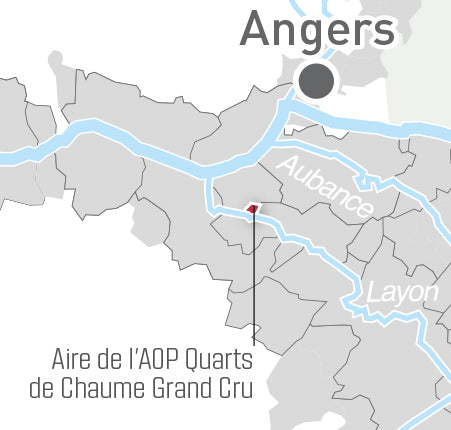
Very recent, the notion of Cru in the Loire is currently present only within two AOCs in Anjou.
The AOC Quarts-de-Chaume thus became in 2011 the AOC Quarts-de-Chaume Grand Cru and the lieu-dit Chaume within the AOC Coteaux-du-Layon became the AOC Coteaux-du-Layon Premier Cru Chaume.
These appellations produce the best sweet white wines of the region, all made from Chenin blanc grapes, harvested overripe and botrytized (noble rot). Representing only 120 hectares, the classification of these terroirs, mainly composed of schist and sandstone and facing due south, was not simple and took nearly 10 years.
Let’s bet that in the coming years, other terroirs will probably emerge within the region to be better promoted, and that the notion of Cru in the Loire will no longer be reserved only for sweet wines!
The AOC Quarts-de-Chaume thus became in 2011 the AOC Quarts-de-Chaume Grand Cru and the lieu-dit Chaume within the AOC Coteaux-du-Layon became the AOC Coteaux-du-Layon Premier Cru Chaume.
These appellations produce the best sweet white wines of the region, all made from Chenin blanc grapes, harvested overripe and botrytized (noble rot). Representing only 120 hectares, the classification of these terroirs, mainly composed of schist and sandstone and facing due south, was not simple and took nearly 10 years.
Let’s bet that in the coming years, other terroirs will probably emerge within the region to be better promoted, and that the notion of Cru in the Loire will no longer be reserved only for sweet wines!
The Grands Crus of Provence
Before 1955, there was no wine classification in Provence. It was only in July of that year that a ministerial decree approved a classification of certain estates in the region.
Thus, in July 1955, 23 estates (out of the 300 listed at the time) received the distinction of “ Cru Classé ” according to 4 criteria : the history of the estate, the obligation to bottle at the property, a minimum release time for the wines, and direct sales. Today, 18 estates continue to claim this mention, 5 of them having since disappeared. Among this list and not exhaustively : Minuty, Château Roubine, Domaine de la Croix, Château Sainte-Marguerite, Clos Cibonne etc.
This classification is not based on any qualitative criteria, so it is highly questionable and contested. Moreover, unlike the 1855 Bordeaux classification, which largely inspired this Provençal classification, all the cuvées from the same estate can bear the mention “ Cru Classé” on their bottle…Admittedly, this may raise questions when it comes to tasting the estate’s entry-level cuvée. Furthermore, as is also the case in Bordeaux, if one of these estates decided to buy new land, the wines produced from these new plots could still bear the mention “ Cru Classé ”, even though no quality control of these terroirs would have been carried out !
Finally, this hierarchy is also not subject to change. Yet an update would be welcome... Indeed, the number of producers in the region has doubled since the creation of the classification (from 300 to 600), and some of these “ new ” estates would very likely have their place among this presumed elite.
So, as you will have understood, this highly debatable classification is not of great interest to the consumer when choosing their wine. Nevertheless, no definitive generalization should be made, and some classified estates still produce some of the best wines in the region. For example, let us mention the superb rosé, white, and red cuvées from Château Sainte-Marguerite.
Thus, in July 1955, 23 estates (out of the 300 listed at the time) received the distinction of “ Cru Classé ” according to 4 criteria : the history of the estate, the obligation to bottle at the property, a minimum release time for the wines, and direct sales. Today, 18 estates continue to claim this mention, 5 of them having since disappeared. Among this list and not exhaustively : Minuty, Château Roubine, Domaine de la Croix, Château Sainte-Marguerite, Clos Cibonne etc.
This classification is not based on any qualitative criteria, so it is highly questionable and contested. Moreover, unlike the 1855 Bordeaux classification, which largely inspired this Provençal classification, all the cuvées from the same estate can bear the mention “ Cru Classé” on their bottle…Admittedly, this may raise questions when it comes to tasting the estate’s entry-level cuvée. Furthermore, as is also the case in Bordeaux, if one of these estates decided to buy new land, the wines produced from these new plots could still bear the mention “ Cru Classé ”, even though no quality control of these terroirs would have been carried out !
Finally, this hierarchy is also not subject to change. Yet an update would be welcome... Indeed, the number of producers in the region has doubled since the creation of the classification (from 300 to 600), and some of these “ new ” estates would very likely have their place among this presumed elite.
So, as you will have understood, this highly debatable classification is not of great interest to the consumer when choosing their wine. Nevertheless, no definitive generalization should be made, and some classified estates still produce some of the best wines in the region. For example, let us mention the superb rosé, white, and red cuvées from Château Sainte-Marguerite.
Conclusion
You now know almost everything about the many wine classifications of our beautiful French regions. All that’s left is to put it into practice so that all your new knowledge does not remain purely theoretical. Visit La Cave Éclairée !


