With 15 600 hectares of vineyards, the Alsace wine region is renowned for its production of exceptional white wines. With its semi-continental climate, its varied soils, and its magnificent vineyard landscapes sheltered by the Vosges Massif, it indeed offers a unique terroir, ideal for the cultivation of many white grape varieties.
Among all the grape varieties in the Alsace vineyard, 4 of them stand out and are considered noble, allowing the creation of the finest wines and being the only ones authorized (with some exceptions) to be planted on the 51 plots in the region classified as Grand Cru.
Riesling
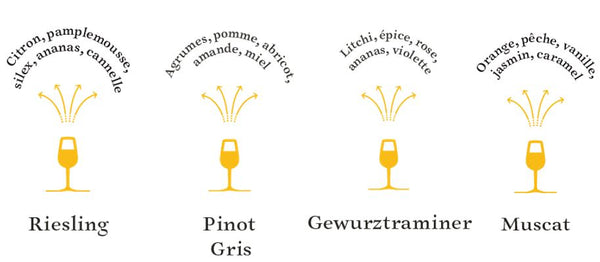
Riesling is without a doubt the most iconic noble grape variety of Alsace. It produces white wines with beautiful acidity and great finesse. Wines made from Riesling regularly display notes of citrus, white flowers, peach, as well as a pronounced mineral character. The preferred terroirs for this grape variety are schist and granite soils, and on the finest of these, it can enjoy a magnificent aging potential. It should also be noted that Riesling alone accounts for 21% of the region's vineyards and has an exceptional ability to reflect its terroir. Furthermore, it is almost exclusively vinified on its own but can also be used in blends in sparkling wines, for example.
If you wish to discover the finest aspects of Riesling, do not hesitate to turn to those from the estates Barmès-Buecher, Mittnacht Frères or Schlumberger, no disappointment possible !
Gewurztraminer
Gewurztraminer is also very present in Alsace as it represents 20% of the vineyard. After Riesling, it is probably the best-known grape variety of the region and is also one of the four noble grape varieties of Alsace.
This one is capable of producing dry wines but also off-dry, mellow, and sweet wines. Its substance exudes opulence and generosity while its aromatic profile is of rare expressiveness. Indeed, it is a variety that is easily identified thanks to markers such as lychee, mango, pineapple, rose, as well as certain sweet spices. The terroirs favorable to Gewurztraminer are generally clay-limestone and marl.
Just like Riesling, this one is capable of long aging when it comes from great terroirs, such as the Gewurztraminer Grand Cru Steingrubler from the Barmès-Buecher estate.
Pinot Gris
Of Burgundian origin, Pinot Gris, formerly known as Tokay (now prohibited since the official recognition of the eponymous Hungarian sweet wines), is a grape variety with beautiful pink berries that can be vinified from dry to sweet. In practice, it often contains residual sugar because it is very receptive to noble rot and benefits from being harvested overripe (Late Harvest, Selection of Noble Berries).
It represents 16% of the Alsatian vineyard and can give rise to wines of incredible richness and power, featuring a full-bodied texture as well as aromas of pear, apricot, honey, and spices.
Muscat
It is the 4th noble grape variety of the region and although it represents only 4% of the Alsatian vineyard, Muscat also holds a prominent place in the region.
Unlike the Muscats from Languedoc-Roussillon or the Rhône Valley, Muscat from Alsace is very largely vinified dry and therefore generally does not have residual sugar. Nevertheless, its aromatic fragrance and roundness is always present : notes of fresh grape, dates, as well as elegant floral aromas make it easily identifiable.
PS : when we talk about Muscat in Alsace, we are actually referring to two varieties : Muscat d’Alsace "à petits grains" and Muscat Ottonel.
In addition to these four noble grape varieties, Alsace also has other interesting varieties.
Pinot Blanc for example offers light and fresh white wines, exuding aromas of green apple and white flowers. It is often used in the region’s crémants and brings roundness. This variety is very present in Alsace as it is as widely planted as Riesling (21% of the vineyard) !
Sylvaner is another white grape variety found in Alsace. Once very widespread, today it represents only 5% of the vineyard. It is a variety allowing the production of dry and light white wines, expressing notes of citrus and fresh herbs.
Finally, although white grape varieties represent the majority of the Alsatian vineyard (90%), the remaining 10% are planted with a red variety : Pinot Noir. In the region, this grape produces light to medium-bodied red wines, featuring delicate aromas of red fruits such as cherry, raspberry, and strawberry, as well as floral and spicy notes.
Other grape varieties such as Pinot Auxerrois, Chasselas, and Klevener de Heiligenstein (Savagnin rose) are also present in the region, contributing to the great viticultural richness of Alsace.
Conclusion
You now know the 4 noble grape varieties of Alsace as well as the other main varieties of the region. All that remains is to put theory into practice ! And for that, do not hesitate to contact La Cave Éclairée who will be happy to guide you in your choices.
Cheers !