

Summary
The red grape varieties of Bordeaux
Red grape varieties make up more than 80% of the plantings in the Bordeaux region. Furthermore, 3 varieties account for 98% of red wine production.
Merlot
It accounts for 66% of red grape plantings and is therefore the star of the Bordeaux vineyards. It stands out for its supple tannins, charming fruitiness, and roundness on the palate. It is particularly fond of clay-limestone soils and is therefore found mainly on the right bank of the Garonne in appellations such as Saint-Émilion (Château Jean Faure), Pomerol (Château de Valois), and Blaye Côtes-de-Bordeaux (Château Bel-Air La Royère). In terms of taste, it expresses notes of red and black fruits such as plum, cherry, and strawberry.
Cabernet Sauvignon
Cabernet Franc
It is the 3rd most important red grape variety and is planted at 9.5% in the region. It brings lovely acidity, rather supple tannins, aromas of raspberry, strawberry, and peony, and sometimes a slight vegetal note characterized by bell pepper. It particularly thrives on the clay-limestone soils of the right bank, notably in Saint-Émilion and Pomerol. It also contributes to the good aging potential of the wines.
All these grape varieties are generally used in blends. In fact, it is rare in Bordeaux for a single grape variety to make up an entire cuvée.
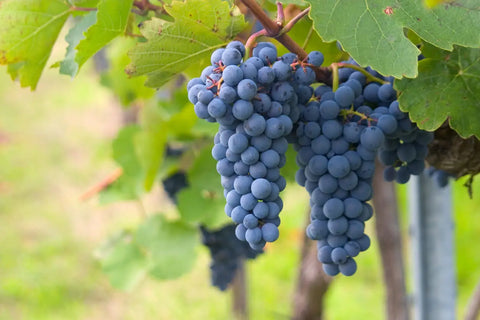
Merlot bunches
The white grape varieties of Bordeaux
White grape varieties represent less than 20% of the Bordeaux vineyard. Within this category, two of them account for nearly 90% of production.
Sémillon
It is the main white grape variety of the region and accounts for 45% of plantings of this color. It brings a lovely rich texture to the wines, as well as aromas of white fruits, white flowers, and honey. It is mainly found in the Sauternais (Château Haut Bergeron), where it is used for the production of sweet wines thanks to its sensitivity to noble rot (Botrytis cinerea). Nevertheless, it is also present in the Graves region (Pessac-Léognan) and in Entre-deux-Mers (Cheval Quancard), where it is used to make dry white wines.
Sauvignon Blanc
It accounts for 43% of white grape plantings. While this grape variety is well known for its presence in the Loire in appellations such as Sancerre or Pouilly-Fumé, it is also very widely planted in Bordeaux. It is appreciated for its lively character and here offers notes of exotic fruits, white fruits, and citrus. Like Sémillon, with which it is almost always blended, it is very present in Pessac-Léognan and in Entre-Deux-Mers.
In addition to these two grape varieties, other less common varieties are also present in Bordeaux. For example, Muscadelle (5% of the white vineyard) is used in small quantities in blends of dry and sweet white wines to bring floral and white-fleshed fruit aromas. Other grape varieties such as Colombard or Ugni Blanc are also present.
It should be noted that Bordeaux is known for its art of blending. Thus, as with red wines, the white grape varieties mentioned above are almost always mixed to complement each other's strengths and combine their aromas.
You now know all the Bordeaux grape varieties ! Thanks to these explanations, you should now be able to select the wines that best match your preferences. If you would like more advice on the Bordeaux region, do not hesitate to contact La Cave Éclairée directly!
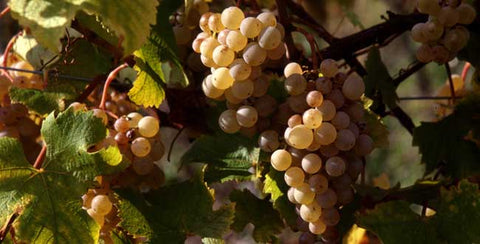
Sémillon bunches


