

Sweetness is one of the most important aspects in the balance of a wine, along with other factors such as acidity, alcohol, or tannins. This can vary considerably from one wine to another, completely changing the tasting experience as well as our appreciation.
So that you can understand the difference between a semi-sweet wine and a sweet wine, here is an overview of the different types of wines, categorized according to their sugar level.
Dry wines
They represent the vast majority of wines produced worldwide. They can be red, white, rosé or orange, it doesn't matter ! The only condition is that they must not exceed 4g/L of residual sugar (that is, 3g in a 75cl bottle). At this level of dosage, it is imperceptible during tasting.
Semi-dry wines
These wines have a slight sweetness on the palate and their sugar content can vary between 4g and 12g/L (3g to 9g in a standard bottle). Generally, this amount of sugar gives the wine a slight roundness and a tender character while maintaining a balanced profile.
The majority of semi-dry wines are whites (Vouvray, Gewurztraminer etc.) but some rosés or red wines (rarer) can also fall into this category.
Semi-sweet wines
Here, the sugar content is even higher : between 12g and 45g/L (9g to 33.75g in a bottle). In terms of taste, the aromas in this type of wine start to turn towards candied fruits or honey and thus express a great roundness.
Once again, all colors are present here, although in practice, semi-sweet white wines are the most common.
Sweet wines or dessert wines
Finally, the category of dessert wines (or sweet wines) sits at the top of this pyramid. Here we find cuvées containing more than 45g/L of residual sugar. Some wines can even reach 200g or even 300g/L !
In France, when we think of sweet wines, Sauternes from Bordeaux immediately comes to mind. Nevertheless, Vendanges Tardives or Sélection de Grains Nobles from Alsace, Vins Doux Naturels from Languedoc-Roussillon (AOC Maury and Banyuls in particular) as well as certain cuvées from appellations such as Pacherenc du Vic-Bilh in the South-West, Muscat de Rivesaltes or even Muscat Beaumes-de-Venise in the Rhône Valley are also part of this category.
Here, roundness and aromatic richness are essential (notes of candied fruits, honey, sweet spices, etc.). As a result, since sugar often dominates in terms of intensity over the dishes served, this type of wine is generally opened at dessert time.
Nevertheless, exotic and spicy cuisines can also pair wonderfully with sweet wines! Finally, foie gras is often mentioned as the ideal pairing. However, since it is generally enjoyed at the beginning of the meal, it is preferable to opt for a semi-dry or semi-sweet wine so as not tooverwhelm the palate with sugar right at the start of the meal!
Conclusion
You will have understood, the difference between a semi-sweet wine and a sweet wine is related to the sugar content present in the wine, a sweet wine being sweeter than a semi-sweet wine.
Nevertheless, since the notion of balance is essential in wine, a sweet wine with good acidity and a complex aromatic profile may seem less sweet on the palate than some less well-constructed semi-sweet wines ! It is therefore important not to generalize and to discover for yourself all the subtleties of these wines. For this, do not hesitate to call on La Cave Éclairée !
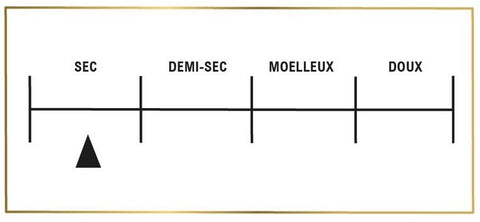
Sweetness scale of wines


