Biodynamics continues to be a source of division. Between passionate advocates fully convinced of the validity of its principles and fierce opponents describing it as a cultivation method with no scientific basis, a middle ground expressing more nuance might allow for a better understanding. Fortunately, that is exactly the purpose of this article!
To shed more light on the subject, let's trace its origins, its principles, its advantages, as well as its shortcomings.
The origins of biodynamics
To understand the origins of biodynamics, one must first take an interest in Rudolf Steiner (1861-1925). Austrian author and philosopher, he is the founder of Anthroposophy, a school of thought aiming to be close to nature and presenting the world as governed by spiritual forces. Anthroposophy notably borrows many concepts such as karma or reincarnation from Indian religions. Already lost? Don’t worry, the rest will be more concrete.
Based on Anthroposophy, Rudolf Steiner developed in the early 1920s several applications derived from these doctrines in the fields of education, medicine, and, as is of interest to us here, agriculture.
Thus, in 1924, he gave a series of eight lectures known as the Course for Farmers. During these interventions, he developed the foundations of an agricultural method highlighting a strong connection between the earth, living beings, and cosmic rhythms. Biodynamics was born.
The principles of biodynamics
The primary and concrete goal of biodynamics is commendable: to stimulate the fertility of ecosystems in order to produce higher quality ingredients (or wine) and to recreate a connection between the earthly, plant, and animal worlds.
To this end, biodynamics therefore prohibits any use of synthetic pesticides (just like organic farming) but, in addition to this, it also carries a spiritual and pseudo-scientific dimension for those who adhere to all its principles.
Thus, a winemaker certified
Demeter or
Biodyvin (the two labels certifying biodynamics) must, for example, take into account
the movements of the planets in order to carry out their work in the vineyard. A
specific lunar calendar establishes, for example, the favorable days for pruning or plowing.
Moreover, several
biodynamic preparations must be used by the farmer. In homeopathic doses, certain herbs (nettle, chamomile, dandelion, etc.) are therefore diluted in water, then the mixture is "dynamized" by a certain number of rotations in order to subsequently treat the vines.To illustrate this point, we most often refer to
preparation 500, also known as
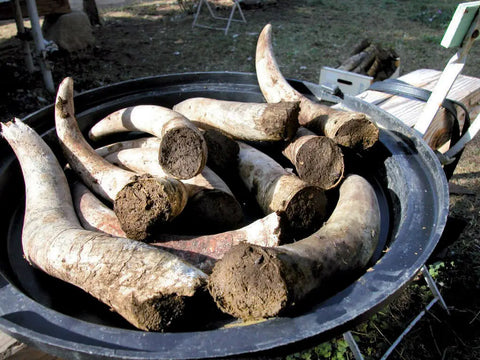
"horn manure" : here, cow horns filled with manure are buried during the six winter months. In the spring, the contents are then stirred in water and used to fertilize the soil.
It should also be noted that biodynamics promotes crop diversity in order not to reduce biodiversity. Moreover, it encourages the soil-animal-plant relationship and this is why our animal friends (sheep, pigs, etc.) sometimes actively participate in the vineyards to fertilize the soil, control weeds, or even limit pests.
In summary, biodynamic agriculture therefore adopts the main principles of organic agriculture but adds to this a spiritual vision that takes into account the movement of celestial bodies, includes certain preparations, and views the environment as an indivisible whole.
To compare conventional and biodynamic agriculture, I often like to use the analogy of Western modern medicine and Chinese medicine. In the first, symptoms are treated after they appear and very often thanks to technology and chemistry (see conventional agriculture). In the second, the aim is to prevent and anticipate needs of the body so that illness never appears, all while using practices closer to humans and nature such as acupuncture, herbs, massage, etc. (seebiodynamic agriculture).
Preparation 500 or "horn manure"
The limits of biodynamics
While the founding principles of biodynamics therefore seem very positive and are focused on the unity between humans and nature, it should nevertheless be emphasized that this movement of thought and agriculture suffers from numerous flaws.
Thus, the founding principles of Steiner for creating his Course for Farmers are not based on absolutely any scientific evidence.The ideas presented during this conference cycle, which was later compiled into a book, are indeed mainly the result of his one and only intuition ! Consequently, one adheres out of pure faith and not on a documented and quantified basis.
Moreover, numerous esoteric and magical considerations undermine the overall credibility of this work. An example: according to Steiner, preparation 501 (based on horn silica) "enhances sunlight and allows for a better relationship with the cosmic periphery as well as with the entire cosmos". Very precise and factual, isn't it?
The most ardent opponents of biodynamics therefore reject all of its principles, arguing that the very foundations of its practice largely lack any common or scientific sense.
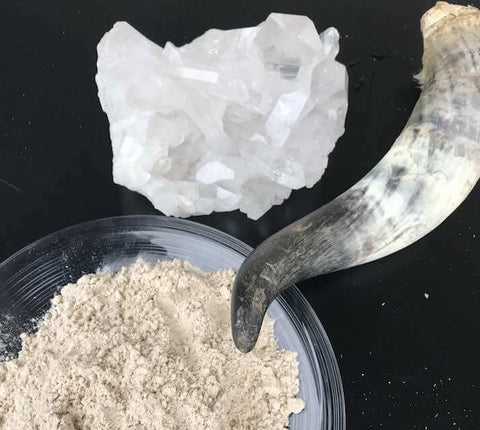
Preparation 501 or "horn silica"
Conclusion
So, is biodynamics organic ++ or a pseudo-scientific cultivation method ?
Two schools coexist among winemakers. On one side,
the purists, like the famous Nicolas Joly, winemaker at La Coulée de Serrant in
Loire, fiercely defending biodynamics as a whole, including its spiritual and esoteric aspects. On the other side,
more pragmatic winemakers, who are the majority, praise the fact that biodynamics allows them to be more attentive and observant in the vineyard. The latter focus on practicing the most concrete biodynamic principles, such as not using synthetic pesticides and using preparations to fertilize the soil.
In any case, it is unfortunate that so few scientific studies are currently dedicated to biodynamics.The implementation of scientific monitoring over several years of its agricultural practices would certainly help to shed light on the effectiveness (or ineffectiveness) of certain methods... and finally settle the debate once and for all? Probably not, but that is also the beauty of wine: a subjective world, of exchanges and sharing, where everyone can detect and appreciate different things.
If you are convinced of the impact of biodynamics on wines, feel free to check out our carefully curated selection dedicated to
biodynamic wines! We also have a wide range of
organic wines and if you are simply attached to taste and quality, go directly to
La Cave Éclairée!