

Ah, sulfites... a word that often makes wine lovers cringe ! You have no doubt already heard lively discussions about them, and perhaps you even avoid them, thinking they are the sole and unique cause of your headaches after a few glasses.
But what are they really? Are they as bad as people claim ? Why are they used ? What roles do they play in wine? La Cave Éclairée guides you to help you understand everything about sulfites !
What are sulfites?
First of all, do not confuse sulfites (or sulfur dioxide) with sulfur itself ! The latter, yellow in color, insoluble, and giving off a rotten egg smell, is in fact never used in winemaking (unless someone is deliberately trying to poison you).
Sulfur dioxide (or sulfites), on the other hand, is composed of one sulfur atom and two oxygen atoms. Its scientific formula is therefore SO2 and it is this compound that winemakers use for various reasons.
Sulfur dioxide can be used at various stages such as at harvest to protect the grapes from oxidation, at the end of fermentation to ensure it does not restart, or at bottling to permanently protect the wine ready for consumption.
You may also be surprised to learn that sulfites are not only added by humans. These compounds also form naturally during the grape fermentation process !
Thus, all wines, whether red, white, rosé, or even sparkling, naturally contain sulfites, even in very small quantities. That is why some bottles display the label “ no added sulfitesadded ”, with the last word taking on its full meaning.
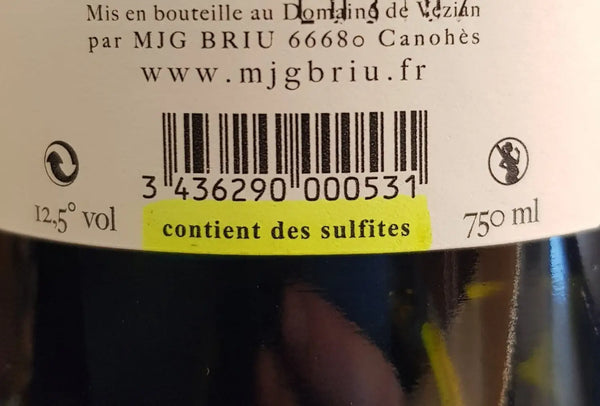
The labeling of the statement “contains sulfites” is mandatory on bottles as soon as the concentration exceeds 10 mg/l
The roles of sulfites in wine
Sulfites have two main functions in oenology :
- They have a function as natural preservatives. Sulfur dioxide actually prevents wine from oxidizing. Without sulfites, your favorite cuvées would lose their freshness more quickly and could change color or, worse still, become maderized.
- They have an antiseptic function. Sulfites actually help prevent the development of unwanted microorganisms such as certain bacteria or yeasts, like the famous Brettanomyces which can give wine stable or horse-like aromas. Not very appetizing, is it?
Consequently, to ensure better preservation of your bottles and allow for some longevity in the cellar, almost all winemakers choose to add sulfites to their wines. However, as we will see, there are different schools of thought…
How to check the sulfite content in wines?
Are you concerned about knowing the sulfite content of the wines you consume? The first step is to carefully read the bottle label.
Since 2005, any wine containing more than 10 mg/L of sulfites must display the statement “ contains sulfites ” to inform consumers. However, this statement will not indicate any precise quantity.
If you come across the statement “ no added sulfites ”, this means that no sulfites have been added by the winemaker to the wine. Nevertheless, as already mentioned, very (very) small amounts will always be naturally present.
And... that's it! Beyond these two statements, there is in fact no way for the end consumer to know the exact sulfite content in a wine. There is indeed a certain opacity in the wine sector regarding the additives used. Ideally, you will need to speak directly with the producer to learn about their practices or with your wine merchant who can advise you.
However, keep in mind that some wines on average have more added sulfites than others. Thus, sweet wines are those potentially containing the most sulfur dioxide. Next come white and rosé wines, then red wines. The latter are actually naturally protected from oxidation by their tannins and therefore require less protection.
If you are particularly sensitive to sulfites, organic, biodynamic, and natural wines can also be a good alternative. These certified wines have stricter criteria regarding the use of SO2. To learn all about this, feel free to read our article on the differences between conventional, organic, biodynamic, and natural wines !
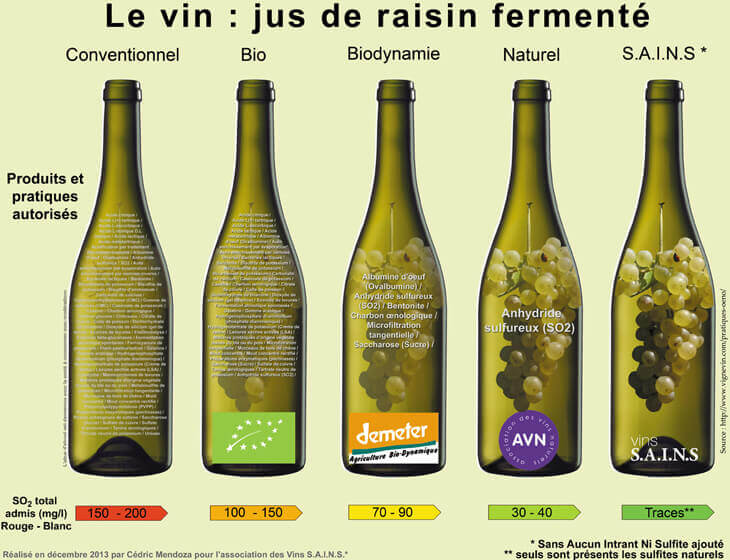
A brief summary of the additives and authorized sulfite doses according to the type of viticulture
What are the health effects of sulfites ?
The issue of sulfites is often linked to health concerns. Some of you may have already experienced symptoms such as headaches, itching, or redness after drinking wine. These reactions may be due to an intolerance or, more rarely, an allergy to sulfites.
However, it is important to note that sulfite intolerances are rare. Only certain people, especially those with asthma, are particularly sensitive to these compounds. For the vast majority of consumers, the sulfites present in wine do not pose serious health risks and the shortcut “ sulfites = headaches ” is made far too often.
In fact, it is essential to understand that headaches are much more often due to dehydration from alcohol consumption than to the presence of sulfites ! Moreover, if in the 70s or 80s, winemakers could sometimes overuse sulfur dioxide, this is no longer the case today and the average doses used in the industry have drastically decreased !
Wines without sulfites, is it possible?
So, is it really possible to drink a wine totally without sulfites? The answer is no ! As mentioned earlier, sulfites form naturally during fermentation. However, it is possible to produce wines with no added sulfites, and more and more winemakers are venturing into this.
For example, one can think of the cuvée “ Les Pouliches ” from domaine Cheveau in AOC Beaujolais-Villages or the delicious Pét’ Nat ” from domaine Albert de Conti in Bergerac.
It is important to note that producing wines with no added sulfites requires a great deal of expertise from the winemaker. Without the safety net that sulfites provide, the wine becomes more vulnerable to imperfections and must be monitored very closely. It is a challenge that some winemakers take up with passion, offering unique wines that faithfully reflect their terroir.
If you are curious to discover wines with little or no added sulfites, or if you want to explore a selection of organic or biodynamic wines, feel free to visit our site lacave-éclairée.fr ! You will find a wide range of carefully selected bottles to suit all your tasting desires. Cheers!


