

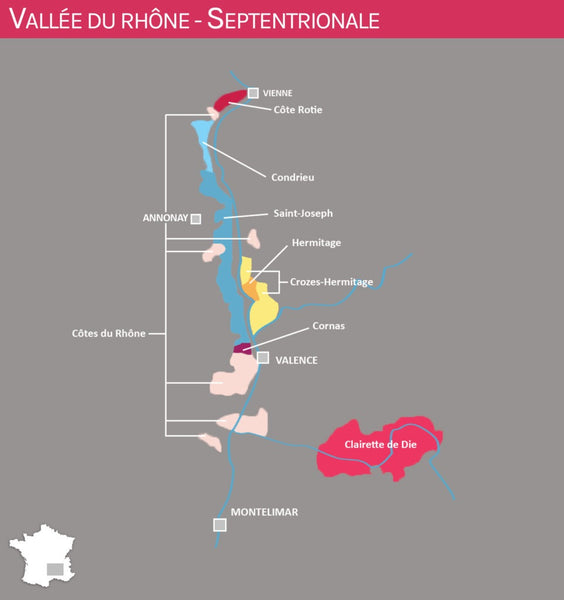
Celebrated for its exceptional red wines, Côte Rôtie is a viticultural gem nestled at the northernmost part of the Rhône Valley, 30km south of Lyon.
The appellation with its steep terrain is indeed considered one of the most beautiful in the French vineyard thanks to the quality of its wines but also for its remarkable vineyard made up of steep slopes overlooking the Rhône. This unique terroir, steeped in history and tradition, gives the wines produced here an inimitable personality.
Through this article, we will therefore dive into the captivating world of Côte Rôtie, where every sip reveals a millennia-old story of passion and expertise. Embark on a delicious journey that will allow you to discover the history of the appellation, its grape varieties, its terroir, and also how to taste and ideally pair the wines of the region.
Summary
Côte Rôtie: one of the oldest vineyards in France
The history of the Côte Rôtie appellation dates back to Antiquity, demonstrating an exceptional longevity as well as a deeply rooted winemaking tradition.
The first traces of vineyards actually date back to the Roman era. Philosophers such as Pliny the Elder or Plutarch then praised in their writings the Viennese wine, a name derived from the French city of Vienne, located a few kilometers south of Lyon. Still during Antiquity, the Romans also contributed to the growth of the vineyard by developing new cultivation techniques as well as the wine trade along the river.
Then, in the 6th century, the first charters concerning Ampuis and its vineyard appeared, gradually defining a more precise area.
In the Middle Ages, Côte Rôtie then gained popularity and the local lords, admiring and appreciating the wines produced on these sunny slopes, encouraged the planting of vines.The steep hillsides indeed promote optimal ripening of the grapes and allow for the production of high-quality fine wines.
Over the centuries, the reputation of Côte Rôtie wines was consolidated, reaching its peak in 1890, a time when 300 hectares of vines were planted. Then, although in 1936 the Côte Rôtie AOC was officially created, the phylloxera crisis, the two world wars as well as the development of arboriculture, which was more profitable at the time, almost caused the vineyard to disappear, reducing it to only 40 hectares at the beginning of the 1950s.
It was not until the 1970s and 1980s that it experienced a revival, notably thanks to the drive of Étienne Guigal.The eponymous estate, still the most renowned of the appellation today, then acts as a driving force for the entire area and revolutionizes winemaking by limiting yields, meticulously sorting the berries, and strictly controlling the aging process.
Little by little, the phoenix rises from its ashes and young winemakers settle in the appellation, thus creating great momentum. Over the years, Côte Rôtie has (re)gained fame in France and internationally thanks to the quality of its wines.
Today, the AOC covers 330 hectares on the right bank of the Rhône within three municipalities: Ampuis, Saint-Cyr-sur-le-Rhône, and Tupin-et-Semons. The vineyard ranges between 180 and 325 meters in altitude and is made up of 75 registered localities.
At the height of its glory, the AOC has once again become a global benchmark in the production of red wines with great aging potential.
Syrah, Côte Blonde and Côte Brune
But then, what are the components of this vineyard that have led it to such success?
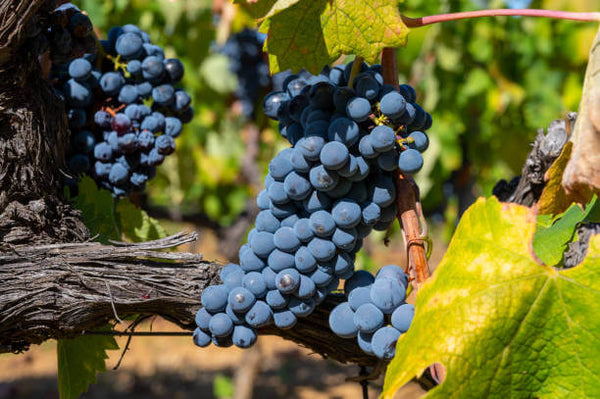
Well, Côte Rôtie is above all a fantastic grape variety: Syrah. This variety here reaches its qualitative peak and produces powerful wines, complex and aromatic with a charming texture, structured yet smooth tannins, as well as great aging potential.
Lesser known fact, the Viognier, a white grape variety star of the neighboring AOC Condrieu can also be included in the blend of wines from the appellation, up to 20%! In practice, it rarely exceeds 5 to 10% in the wines, and it is indeed Syrah that plays the leading role.
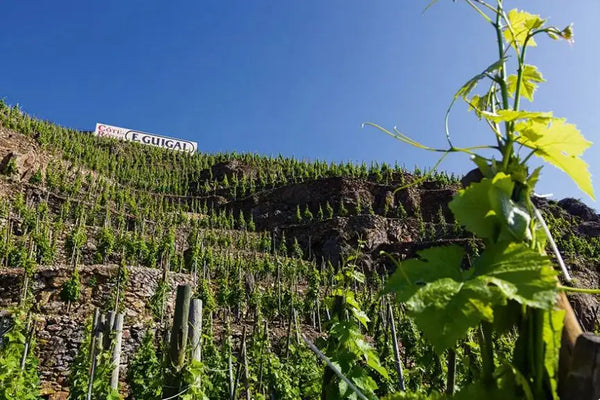
Côte Rôtie is also a matter of terroir. The vines here are planted on steep, sun-drenched slopes that can reach up to 60% incline. It is from this unique landscape that the appellation gets its name: it dates back to the late 17th century and refers to the vines burned and roasted by the sun during the summer period.
This majestic terrain nevertheless requires winegrowers to carry out very demanding manual work throughout the year.Thus, in order to support the land and cultivate the terraced vineyard, they built dry stone walls locally called "chaillées".
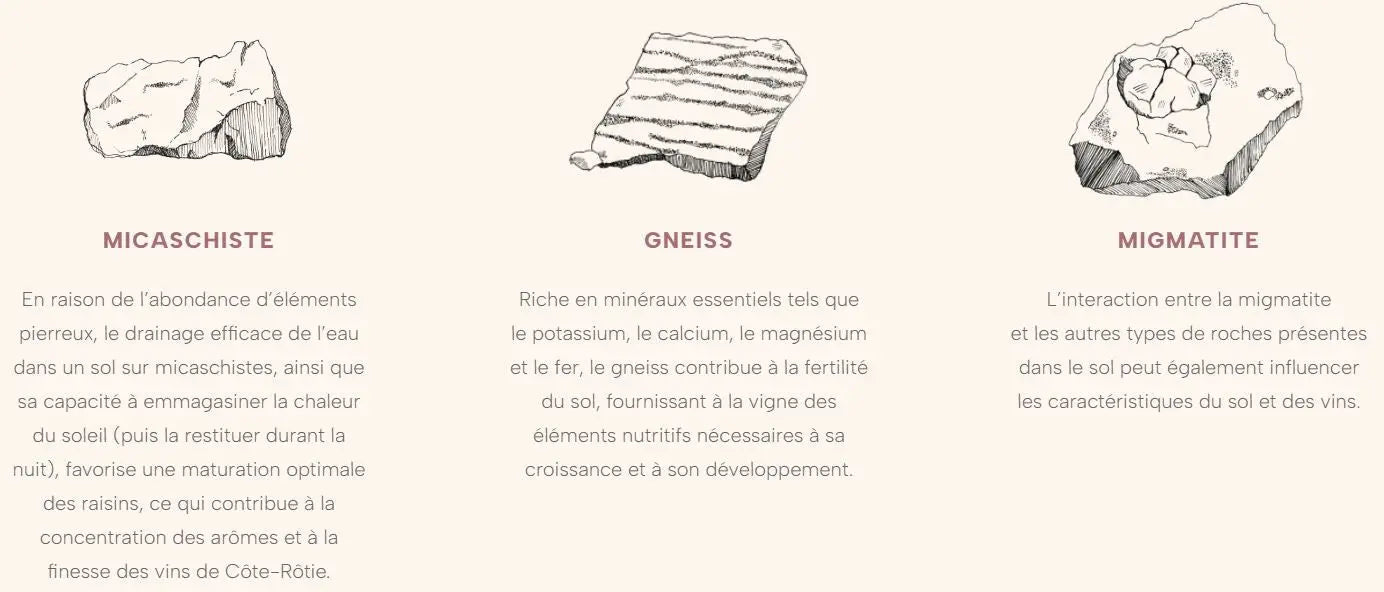
It is also common to divide the appellation into two parts: the Côte Brune in the north, developing on brown-colored soils (iron oxide) and resting on mica schists, and the Côte Blonde in the south, developing on lighter-colored soils and resting on a bedrock of gneiss and migmatites.
Legend has it that in the 16th century, a lord who owned the lands of Côte-Rôtie divided his estate between his two daughters to provide them with good dowries. One was blonde as wheat and the other was dark as jet...Pure invention, certainly, but poetic!
Finally, the climate of the region is semi-continental and benefits from Mediterranean influences. Summers are therefore hot, winters are cool, and rainfall is relatively regular (an average of 800 mm per year). Moreover, the warm southern wind protects the vineyard here against cryptogamic diseases (fungi) and promotes good ripening.
The wines of the AOC Côte Rôtie
So, as you will have understood, the wines of the AOC Côte Rôtie are generally made from the unique Syrah grape variety although some cuvées may sometimes contain a small proportion of Viognier.Therefore, to understand the wines of the appellation, it is necessary to grasp these two grape varieties.
Thus, Syrah is a variety that allows the production of seductive and aromatically rich red wines. The tannins are generally well present on tasting and have a certain roundness that makes them accessible. The variety also often expresses notes of black fruits (cherry, blackberry), violet, as well as pepper and lends itself well to aging in oak barrels. Syrah certainly allows the creation of great wines for aging. If you would like to know more, feel free to read our article The Syrah Grape Variety Guide.
For its part, the white grape Viognier is a variety with low acidity and a rich and generous aromatic profile.This one often develops notes of peach, pear, apricot, and white flowers. A buttery and vanilla aspect is added when the grape variety is aged in barrels. In Côte Rôtie, the use of Viognier aims to soften the tannins of Syrah and to bring an additional aromatic dimension to the wine. If you want to know more, you can also read our article on the Viognier grape variety.
Now that you are more familiar with these varieties, let’s take a closer look at the wines of the Côte Rôtie AOC. Here, Syrah is considered to be at its northern limit (it is often planted in vineyards with even warmer climates).Yet, it is truly here that it reaches its peak: balanced acidity, power, complexity, long aging potential, Côte Rôtie wines are a model of balance and elegance.
That being said, very different cuvées coexist within the appellation. To simplify, it is often said that Côte Brune produces the most powerful and complex wines of the area. Conversely, Côte Blonde produces wines that are feminine and elegant, more focused on finesse.
Furthermore, if we were to give a "classic" aromatic profile of a Côte Rôtie wine, it would be as follows: notes of cherry, wild blackberry, beautiful spices (cinnamon, pepper, clove, cedar, etc.), a pronounced but balanced tannic structure, a touch of violet and sometimes a slightly oaky vanilla note.
However, please note that numerous subtle nuances (soils, yields, plot orientation, winemaker’s vinification, etc.) make this description rather simplistic.
What to eat with a Côte Rôtie ?
What are the best wines from Côte Rôtie ?
Conclusion
As you will have understood, the Côte Rôtie appellation is a magical name that resonates in the ears of all lovers of great red wines. Concentrated in barely a few kilometers, this area produces the best Syrahs in France and dazzles tasters from all over the world.
Thanks to its remarkable terroirs, the leading appellation of the northern Rhône Valley offers gastronomic cuvées with velvety texture and intense aromatics.
Now all you have to do is explore its characteristically steep vineyards to discover all its charms! And if physical effort worries you, there is another way 😉...Cheers!


