

Often associated with its powerful reds from Cahors or Madiran, the South-West nevertheless boasts a remarkable diversity of white wines. From the dry and lively whites of Gascony to the great sweet wines of Jurançon, including the luscious wines of Monbazillac and the more exclusive cuvées of Gaillac, the styles are particularly varied.
This richness is based in particular on emblematic grape varieties such as Colombard, Gros Manseng, Petit Manseng, Mauzac, Len de l’El, and Petit Courbu, complemented by Sauvignon, Sémillon, and Muscadelle in the Bergerac area.
In this article, we focus specifically on South-West white wines : their main regions, grape varieties, styles, and the best pairings. To discover the entire region, including reds, go directly to our South-West wine selection.
Contents
- The major white wine regions of Southwest France
- The main white grape varieties of Southwest France
- What styles of white wine can be found in Southwest France?
- What to eat with white wines from Southwest France?
- At what temperature should Southwest white wines be served?
- A diversity still too little known
The major white wine regions of Southwest France
The vineyards of Southwest France do not form a single, uniform area. They bring together many territories spread across the Aquitaine basin, the Garonne valley, the foothills of the Massif Central, and the Pyrenean piedmont. This geographical diversity largely explains the variety of white wines produced in the region.
The Bergeracois
Located as an extension of the Bordeaux, vineyard, the Bergeracois shares with it several major white grape varieties, notably Sauvignon, Sémillon and Muscadelle.
Dry whites are mainly produced under the Bergerac and Montravel appellations, while the area is also renowned for its sweet and luscious wines, especially Monbazillac and Saussignac.
The Bergeracois thus offers a very broad range, from fruity and floral dry whites to much richer sweet wines, capable of evolving beautifully in the bottle.
Gaillac and the Tarn
Further east, Gaillac stands out for its particularly unique heritage of grape varieties. The Len de l’El, also known as Loin-de-l’Œil, and Mauzac play a central role in the local white wines.
Len de l’El can produce floral and elegant dry wines, but is also used in the making of sweet wines. Mauzac, on the other hand, is found in both dry whites and sweet or sparkling wines, with aromas that can evoke apple, pear, quince, or honey depending on the style.
Gascony
The IGP Côtes de Gascogne is today one of the major French regions for white wine. Colombard and Gros Manseng play a key role here.
Dry white wines here are generally sought after for their freshness, fruity character, and liveliness. They often feature notes of citrus, exotic fruits, and fresh fruits. There are also sweet and mellow versions, notably thanks to Gros Manseng and Petit Manseng.
The Pyrenean foothills
Close to the Pyrenees, the vineyards of Jurançon, Pacherenc du Vic-Bilh, Saint-Mont or Irouléguy produce some of the most distinctive white wines of the South-West.
The Manseng varieties play a key role here. Gros Manseng is particularly well-suited for dry whites, while Petit Manseng, which can retain high acidity despite a significant sugar concentration, is especially valuable for generous and sweet wines.
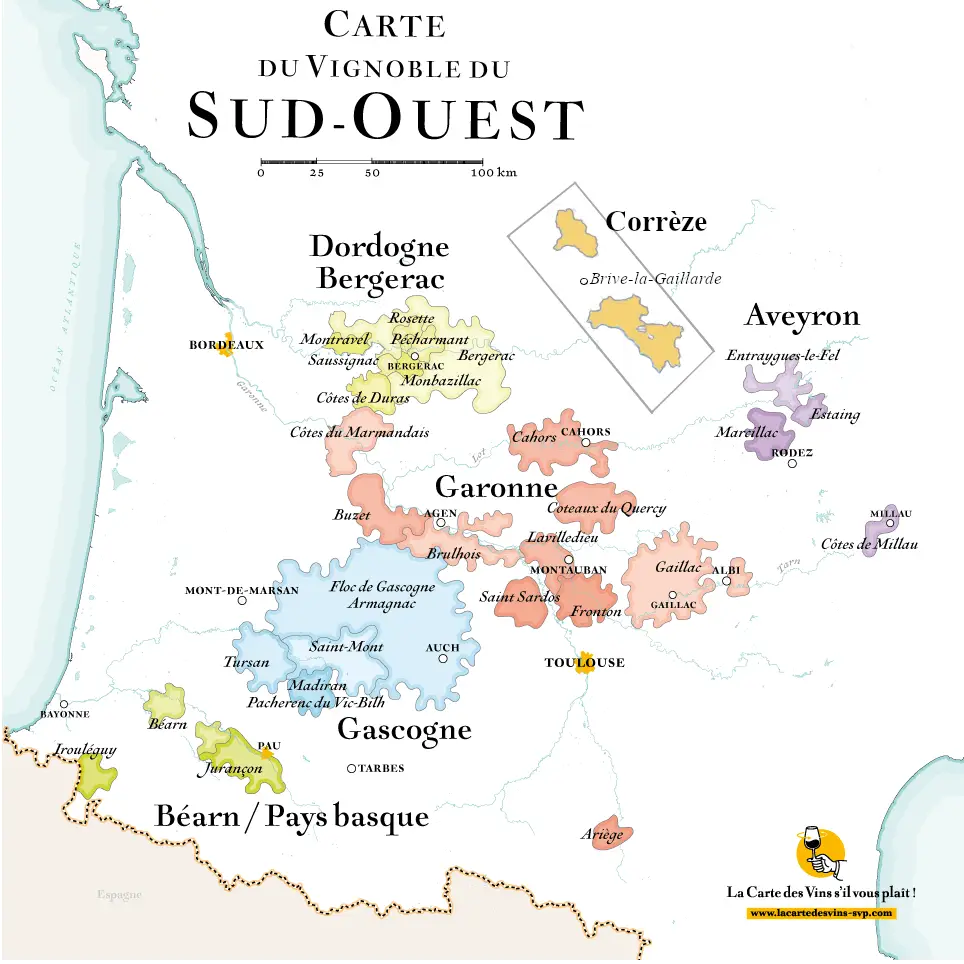
Map of the appellations of the South-West vineyard
The main white grape varieties of the South-West
One of the great strengths of the South-West lies in its heritage of white grape varieties, many of which are closely linked to the region.
Colombard is particularly associated with Gascony. Naturally lively and aromatic, it produces fresh wines, often marked by citrus, flowers, and exotic fruits. It is notably one of the flagship grape varieties of Côtes de Gascogne.
Gros Manseng originates from the foothills of the Pyrenees. It generally brings a lot of freshness and aromatic intensity, and plays a major role in the dry whites of Jurançon, Pacherenc du Vic-Bilh, Saint-Mont, as well as in certain Gascogne blends.
Petit Manseng has small, thick-skinned berries and stands out for its ability to reach high ripeness while maintaining significant acidity. This characteristic allows it to produce sweet and luscious wines that are particularly well-balanced.
Petit Courbu and Courbu also contribute to several appellations in the Pyrenean foothills, notably Jurançon, Pacherenc du Vic-Bilh, and Irouléguy. They can bring freshness, body, and aromatic complexity.
Mauzac and Len de l’El are particularly associated with Gaillac. The first can be used for dry, sweet, or sparkling wines, while the second brings notably floral and elegant expressions.
Other varieties such as Arrufiac, Ondenc, Baroque, or Raffiat de Moncade also contribute to the regional identity. Sauvignon, Sémillon, Muscadelle, Chardonnay, Ugni blanc and Chenin complete this diversity depending on the appellations.
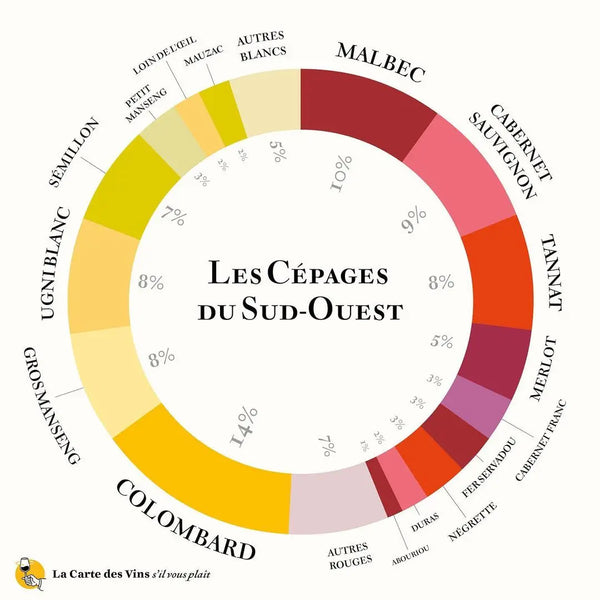
White grape varieties play a key role in the diversity of the South-West vineyard
What styles of white wines can be found in the South-West?
The South-West produces virtually the entire range of white wines: dry and light, fuller and more structured, generous or truly luscious.
Dry Whites from Gascony
The Côtes de Gascogne are among the most approachable and instantly recognizable styles of the region. Blends dominated by Colombard and Gros Manseng typically produce light, fresh, and highly aromatic wines, especially enjoyed as an aperitif.
Today, white wines overwhelmingly dominate IGP production, accounting for around 85% of total volume according to the trade association.
Bergerac: from dry to sweet wines
Dry whites from Bergerac generally combine Sauvignon, Sémillon, and Muscadelle. They can offer profiles ranging from zesty freshness to more generous and fruity expressions.
Nearby, Monbazillac on the other hand represents one of the great sweet wine terroirs of the South-West. Over time, these wines develop notes of ripe or candied fruit, honey, spices, and dried fruits.
Gaillac: the expression of local grape varieties
Gaillac offers the chance to discover both dry and sweet white wines, with a strong presence of local grape varieties. Mauzac and Len de l’El bring a unique aromatic identity, with notes of white fruits, apple, pear, flowers, and, in the sweet wines, quince and honey.
Jurançon: dry and sweet
Jurançon is particularly renowned for its expressive white wines made from Gros Manseng and Petit Manseng. The dry versions can be lively, crisp, and highly aromatic, while the generous Jurançon wines combine richness and freshness thanks to the natural acidity of the Manseng grapes.
The aromas may develop around citrus, exotic fruits, peach, apricot, sweet spices, and honey, depending on the level of ripeness and the desired style.
Pacherenc du Vic-Bilh: from dry to sweet
The AOP Pacherenc du Vic-Bilh is entirely dedicated to still white wines. It produces both dry and sweet versions, mainly from Courbu, Petit Courbu, Petit Manseng, and Gros Manseng.
The dry whites can display notes of citrus, exotic fruits, and white-fleshed fruits, while the sweet versions develop more candied fruits, honey, and dried fruits.The proximity of the Pyrenees and the long late seasons encourage optimal ripening of the grapes.
What to eat with white wines from the South-West?
The choice of pairing depends above all on the style of the wine.
The dry, light and crisp whites from Gascony work particularly well as an aperitif, with oysters, seafood, grilled fish, salads or goat cheeses.
The fuller-bodied dry whites from Bergerac, Jurançon Sec, Irouléguy or Pacherenc du Vic-Bilh can be paired with fish in sauce, scallops, shellfish, poultry or certain matured cheeses.
With sweet wines, the possibilities are very different. Jurançon, Monbazillac or sweet Pacherenc can notably accompany foie gras, blue cheese or certain fruit-based desserts.
A regional pairing such as a sweet wine with a Périgord walnut cake also works very well, provided the dessert is not noticeably sweeter than the wine.
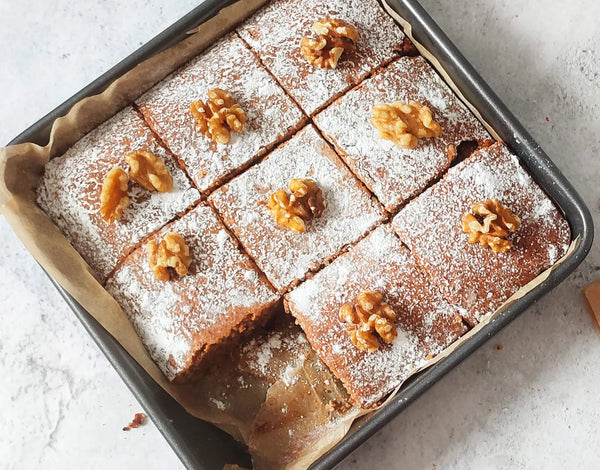
Périgord walnut cake can be paired with some outstanding sweet wines from the South-West
At what temperature should South-West white wines be served?
The serving temperature should be adapted to the style of the bottle.
Light and aromatic dry whites, especially those from Gascony, can be served at around 8 to 10°C. This temperature helps preserve their freshness without masking their aromas.
Richer and more complex dry whites are generally best served slightly less chilled, around 10 to 12°C. Serving them too cold would tend to close off their aromatic range.
Sweet wines can also be served chilled, generally around 8 to 10°C. The cool temperature helps to better balance their generosity and sweetness.
A diversity still too little known
Southwest white wines are therefore not limited to a single style. Colombard and Gros Manseng produce particularly fresh dry whites, while Petit Manseng, Sémillon, or Mauzac are also used to craft sweet and luscious wines of great richness.
This variety is precisely one of the main attractions of the vineyard: from aperitif to dessert, there are South-West white wines suited to very different tastes and occasions.
To discover the bottles we currently offer, check out our selection of South-West wines. And to further explore the region, also read our article Discovering South-West red wines.


