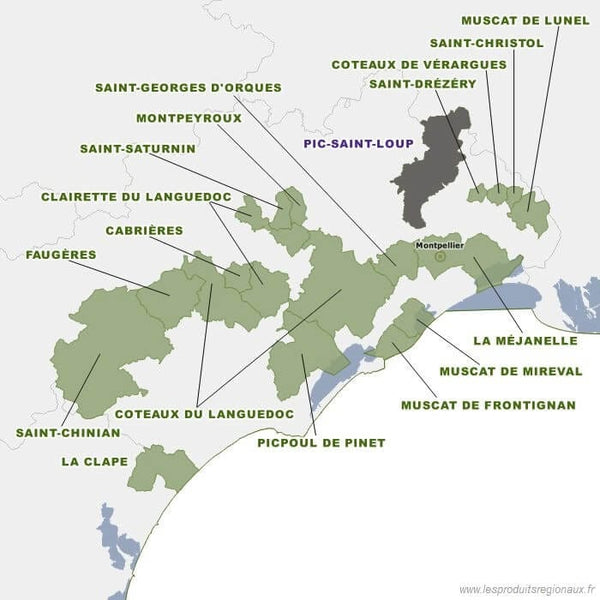
Located within the Languedoc-Roussillon region, the Pic Saint Loup appellation is one of the most renowned in its region and in France. However, although its origins date back to the beginning of our era, its creation as an independent entity is actually very recent.
So, why are its wines so fascinating to enthusiasts ? What are the terroirs and grape varieties of this appellation ? What can you expect during a tasting ? In this article, we will explore all these questions.
Enjoy your reading!
Summary
History of the Pic Saint Loup AOC
Although introduced in France before our era by the Phocaeans, the vine and its cultivation first developed in the Languedoc region thanks to the Roman Empire.Then, after its fall, it was the Monks who helped to partially save the decline of the Languedoc vineyard, and this continued until the Middle Ages.
Finally, it was really only from the 19th century onwards that the monoculture of vines developed significantly in the Pic Saint Loup area. It was also at this time that wines began to be exported to the rest of the region, then throughout France and abroad.
The recent history of Pic Saint Loup therefore begins in 1931 with the creation of the Pic Saint Loup winegrowers' union, which at the time included only 6 municipalities. Then, in 1955, the winegrowing area was recognized as VDQS (Vin de Qualité Supérieure), the forerunner of our current AOC or AOP system. During that year and the following one, 7 additional municipalities were then added to the production area.The story continues in 1960, when 13 VDQS from the region were merged to form just one: the Coteaux-du-Languedoc.
In 1994, Pic Saint Loup then became a geographical designation within the Coteaux-du-Languedoc, consequently having its own specifications for its area. Finally, Pic Saint Loup officially became an independent AOC in 2017, 16 years after submitting the official request!
So, although its history is long, rich, and evolving, Pic Saint Loup has only recently become a full-fledged AOC !
Climate and Terroirs of the Pic-Saint-Loup AOC
Today, the appellation Pic Saint Loup covers 1 300 hectares spread over 17 municipalities.These are located about 15km north of Montpellier and 30km from the Mediterranean coast, thus benefiting from multiple climatological influences.
Indeed, the continental coolness from the North blends here with the Mediterranean warmth from the South. Summers are therefore hot and dry, springs are cool, while autumn and winter are cold and rainy.
This mix of climates gives the vineyard significant temperature variations between day and night, allowing optimal ripening of the grapes : between richness and freshness.
Moreover, due to their proximity to Pic Saint Loup, the vines here experience high rainfall for the region (an average of 1000 mm per year, sometimes half as much just a few kilometers away).Its terroir is therefore the most watered in the entire Languedoc region ! Finally, the vines here are relatively protected from the winds, although the Mistral and Tramontane can sometimes be felt.
From a soil perspective, Pic Saint Loup has particularly limestone-rich terroirs, also composed of dolomites and marls. This type of soil promotes water retention, thus allowing the vine to avoid water stress and to ideally nourish its grapes.
As you will have understood, the climatic and terrestrial characteristics of the region contribute to the uniqueness of Pic Saint Loup wines. These factors directly shape their aromatic expression, and the region therefore has numerous natural advantages for producing exceptional wines.
The wines of the AOC Pic-Saint-Loup
In Pic Saint Loup, nearly 90% of the production is dedicated to red wines, with the remainder being vinified as rosé. The grape varieties Syrah, Grenache and Mourvèdre are the three key components here and must account for at least 90% of the blend in a red wine. The aromatic appeal of Syrah is thus combined with the smoothness of Grenache and the structure and power of Mourvèdre in a highly complementary blend.
Other varieties such as Cinsault, Carignan or Counoise may also be used but must not exceed 10% of the total.
But then, what should you expect during tasting ? Although very different profiles may appear depending on the blend chosen by the winemaker, the quality of the vines, or even their altitude and exposure, the appellation is known for producing red wines with superb aromatic balance oscillating between power and freshness.
As a result, notes of red and black fruits are regularly present (blackberry, blackcurrant, cherry, strawberry, raspberry), accompanied by aromas of garrigue (thyme, rosemary, menthol, bay leaf) – often found around the vineyards – as well as a peppery touch. Depending on the aging method chosen by the winemaker (stainless steel tank, large cask, barrel, etc.), woody notes and vanilla notes may also appear.
Some winemakers are turning to a "traditional" style, offering wines that are rather tannic and focused on power. Others are interested in the purity of the fruit as well as the pursuit of elegance.
Finally, rosé wines from Pic Saint Loup are generally fresh, indulgent and characterized by notes of red fruits.
Which dishes pair with a Pic-Saint-Loup?
The best Pic Saint Loup
- La Chouette du Chai - Pic Saint Loup - Nothing scares me
- La Chouette du Chai - Pic Saint Loup - Nothing scares me MAGNUM
- La Chouette du Chai - Pic Saint Loup - A beautiful novel, a great story
- La Chouette du Chai - Vin de France - Self-portrait
Conclusion
You will therefore have understood, the Pic Saint Loup wine appellation has magnificent assets and that is precisely why its wines often hold a special place in the hearts of red wine enthusiasts.
Between limestone terroirs, climates oscillating between northern coolness and Mediterranean warmth, as well as its highly complementary trio of Syrah-Grenache-Mourvèdre grape varieties, Pic Saint Loup is a fabulous playground allowing the production of wines of remarkable quality.
All that remains is for you to set out to discover it ! For this, and if you need advice, do not hesitate to contact La Cave Éclairée !