

Meursault is a name that resonates with wine lovers all over the world. Renowned for its rich, buttery, and oaky white wines, the Burgundy appellation is actually more rich and diverse than it may seem.
So, why are Meursault wines so highly regarded? What are the grape varieties and terroirs of the appellation? What should you expect during a tasting?
You will discover all this and much more in this article. Happy reading!
Summary
History of wine in Meursault
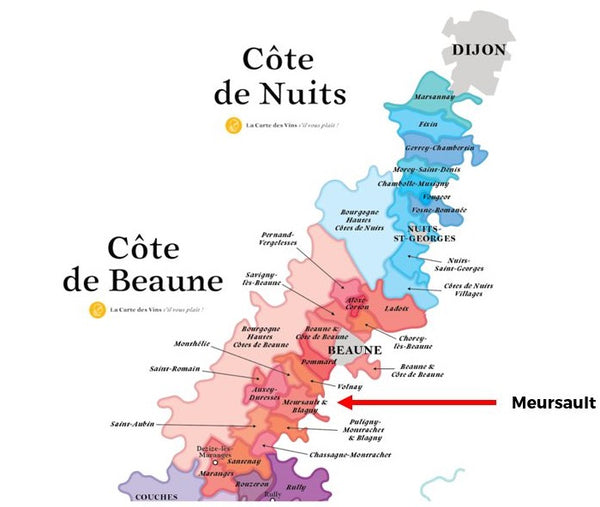
Located in Côte d'Or, just a few kilometers south of Beaune, the Meursault appellation enjoys a beautiful neighborhood : Puligny-Montrachet to the south, Volnay and Monthélie to the north as well as Auxey-Duresses and Saint-Aubin to the west.
The beginning of vine cultivation in the region probably dates back to the 1st century AD. Indeed, we know that in the year 92, the Roman emperor Domitian decreed the uprooting of part of the Burgundy vineyard, in order to avoid any competition with "Italian" production.
Two centuries later, Emperor Probus repealed this decree, thus allowing the inhabitants to redevelop their vineyard little by little.
In the 6th century, the significant rise of Christianity also contributed to the development of the vineyard in Burgundy. Indeed, vine cultivation was then necessary in order to be able to meet the sacred needs of the abbeys.
In 1098, the first mention of the Meursault vineyard appears. Duke Eudes I of Burgundy then donated some of his vines to the newly founded Abbey of Cîteaux (now Château de Cîteaux), located in Meursault. Several donations would follow, allowing the monastery to own a significant vineyard.
From the 13th century onwards, Meursault experienced significant commercial growth thanks to the Parisian markets as well as exports to certain northern countries.
In the 19th century, Meursault wines were then 95% red. In fact, only a few rare plots produced white wine from Chardonnay and Pinot Blanc (the distinction between the two grape varieties not yet being made).
In the 19th century, several crises followed: downy mildew (microscopic fungus) and phylloxera (insect) then decimated the vineyard and radically changed its face. Indeed, beyond the modification of many cultivation practices, it was after these terrible crises that the vineyard was almost entirely replanted with Chardonnay.
Finally, the 20th century would ultimately be the era of triumph for Meursault. The Appellation d'Origine Contrôlée was officially created in 1937 and despite the crises linked to the two world wars, these decades saw commercial development, increasing quality and the international renown of the Meursault name.
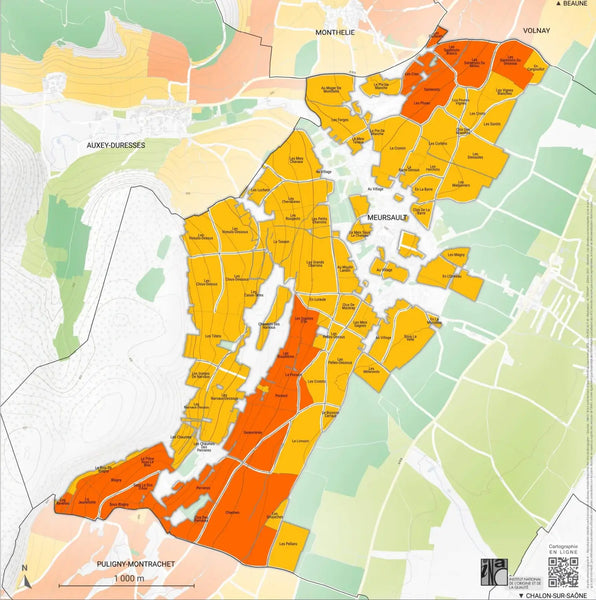
The vineyard of the Meursault AOC
Today, the Meursault appellation covers 391 hectares composed of 97% Chardonnay and 3% Pinot Noir.
Although the vineyard does not have any Grand Cru, 20 climats Premier Cru are identified, representing just under 30% of the total area under vine. Some of these plot names are sure to bring back fond memories for enthusiasts, such as Genevrières, Charmes, Gouttes d'Or or Perrières or Porusot.
From a terroir perspective, the vines are located between 280m and 380m in altitude and the soils of the appellation are clay-limestone. Nevertheless, many nuances exist. Some plots are very calcareous while others have a significant proportion of marl, thus promoting a beautiful diversity of expressions.
Finally, the region enjoys a temperate climate with hot summers and cold winters. The temperature variations are therefore quite pronounced between the two seasons.
Thanks to these different terroir characteristics as well as the know-how of local winemakers, the Meursault appellation enables the creation of some of the finest Chardonnays in the world!
The wines of the Meursault AOC
When you think of Meursault, the image of white wines with a generous texture and notes of butter, hazelnut, and sweet spices immediately comes to mind. While this type of classic and crowd-pleasing cuvée still represents the majority of local production, another school of thought exists.
Indeed, the region's white wines are also capable of offering a lot of finesse and minerality. Based on this, many winemakers, especially those of the new generation, are gradually moving towards more restrained oak aging, allowing the true essence of Chardonnay to shine through with fewer artifices. These two visions coexist, thus offering enthusiasts a wonderful diversity of flavors.
Thus, while some wines display a generous texture as well as a very seductive oaky and vanilla character, others will develop on citrus notes and show a chalky side as well as white flower notes such as hawthorn and linden... all in finesse!
In any case, Meursault wines often require a few years of rest and, for the premiers crus of the appellation, are delicious age-worthy wines.
What dishes pair with a Meursault ?
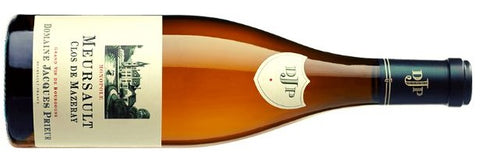
What are the best Meursaults?
You are now very well informed about Meursault and its wines! All that remains is for you to move from theory to practice by pouring yourself a delicious Chardonnay or Pinot Noir, for which this divine appellation is renowned.
Cheers!


