

Among the most iconic grape varieties of France, Gamay certainly stands out thanks to its centuries-old history as well as its delicious taste qualities.
Sometimes criticized (very often due to lack of knowledge or oversimplification), this variety nevertheless has many advantages, able to offer enthusiasts pleasure wines as well as gourmet wines, suitable for both aperitif and during meals.
Thanks to this article, you will discover the fantastic history of Gamay, its main aromatic markers and also how and with what to taste it under ideal conditions.
So, pour yourself a glass...and happy reading!
Summary
History of Gamay
Gamay, or "Gamay noir à jus blanc" (to distinguish it from its cousins), is the result of a crossbreeding between the grape varieties Pinot Noir and Gouais Blanc. While the former is well known to enthusiasts and still today is the pride of the Burgundy vineyards, the latter has nevertheless disappeared. It is also estimated that Gamay is originally from the commune of Saint-Aubin, located in Côte de Beaune, within Burgundy.
Although it is highly probable that its history is older than that, the first written records about it date back to the end of the 14th century.
Indeed, it was in 1395 that Philip the Bold issued an ordinance aiming to banish Gamay from his native land with these words: « this wine of gamay is of such a nature that it is very harmful to men […] several people who previously consumed it have suffered from serious illnesses ; for this wine, which comes from and is made with this grape variety, is by its nature full of a very great and unbearable bitterness […] for it gives off a strong and unpleasant odor »
If the words chosen seem very exaggerated today, it should be kept in mind that at the time, in the winegrowing world, quantity was favored over quality. As a result, and since Gamay is by nature very fertile, the high yields then practiced did not allow the best to be drawn from this otherwise delicious grape variety.
Thus, from the end of the 14th century, Gamay was uprooted and banned from much of Burgundy to be replanted further south, in the Mâconnais as well as in the Beaujolais, where it would adapt perfectly to the climate as well as to the granitic and clay-limestone soils.
During the following centuries, Gamay continued to develop throughout France, eventually covering more than 160,000 hectares (10% of the national vineyard!). Unfortunately, the arrival of phylloxera, the infamous parasite that devastated European vineyards in the 19th century, caused it to disappear from almost all wine-growing regions.

Places of cultivation of Gamay
Even today, it is still within Beaujolais that the majority of Gamay vines are located. Thus, if there are 30,000 hectares of the variety worldwide , more than 50% are planted in Beaujolais. In the region, Gamay even covers 99% of the vineyard!
Moreover, while other wine regions also cultivate it, this is in much smaller proportions.Thus, Burgundy (especially in the Mâconnais) uses it, for example, within its appellations Coteaux Bourguignons, Bourgogne Passe-Tout-Grain or certain Crémants .
Gamay is also found in the Loire to produce certain red wines, in Savoie, in Lorraine (AOC Côtes de Toul), or in Auvergne (AOC Saint-Pourçain, Côte Roannaise, etc.).
Abroad, it is well established in Switzerland, where it is the third most cultivated red grape variety, as well as anecdotally in many countries such as Italy, the United States, South Africa, and Australia.
The characteristics of Gamay
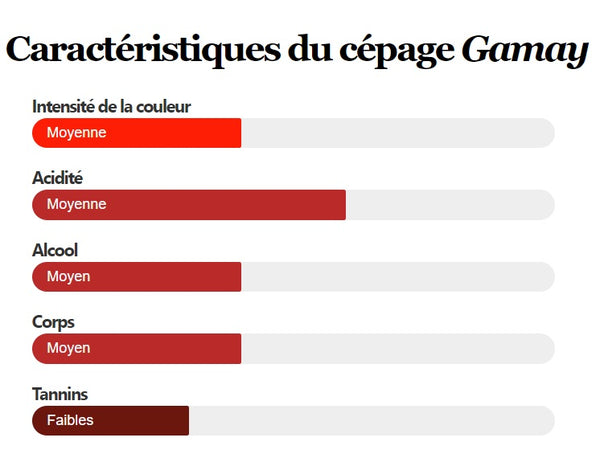
The Gamay is a grape variety primarily known for producing red wines with low tannins, featuring a lovely freshness, and developing aromas of fresh red fruits (raspberry, strawberry, redcurrant, cherry, etc.). Most of the cuvées produced in Beaujolais are also meant to be enjoyed in their youth (within the first 3 to 5 years).
In reality, this image of wines for friends represents only part of the truth and it is important to provide a more nuanced view. Gamay is indeed capable of offering very different wines depending on the quality of the plant material, the age of the vines, the type of soil, the yields, or even the winemaking method chosen by the winemaker. All these parameters indeed have a decisive influence on the quality of the wine you taste.
Thus, if you choose a red wine from AOC Beaujolais or Beaujolais-Villages vinified using carbonic maceration (a typical winemaking method of the region), you will almost certainly have a fresh, colorful, and supple wine, expressing pronounced notes of tangy red fruits. The Beaujolais Nouveau, the first wine of the year marketed every 3rd Thursday of November, is the archetype.
Nevertheless, other Gamay wines exist. Thus, whether this grape variety is vinified using carbonic maceration, semi-carbonic, or traditional methods, it is also quite capable of offering concentrated, powerful wines and sometimes with great aging potential. The aromatics of these Gamays will then tend more towards notes of ripe black fruits (black cherry, blackcurrant, prune), spices (pepper), and will also present a beautiful tannic structure. So be careful with shortcuts!
As you will have understood, between these two extremes, between light wine and powerful wine, Gamay also offers a myriad of possibilities for medium-aging wines (5 to 8 years), offering concentration and aromatic expression (red and black fruits, spices, violet, etc.) while maintaining freshness. Many appellation cuvées such as Saint-Amour, Brouilly or Fleurie perfectly represent this balance.
Food, wine pairings and serving temperature
Given the different wine profiles that can be created from Gamay, many culinary possibilities are available to you depending on the cuvée you choose.
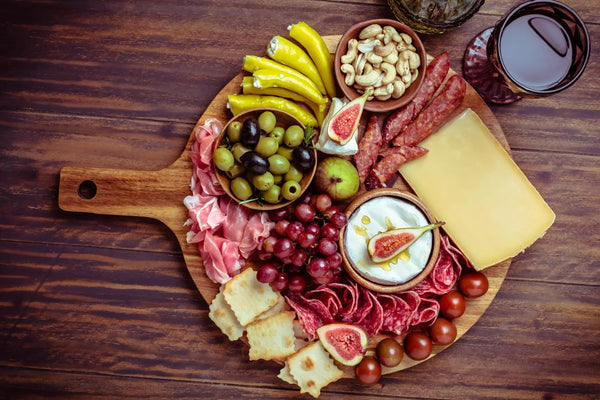
With a light and fresh Gamay, a charcuterie platter is, for example, a must. Thanks to its acidity and suppleness, this type of wine can also easily be paired with cheeses such as Comté, Beaufort or even Brillat-Savarin. Finally, thanks to its low tannin concentration, it can also be combined with fish such as Cod or Sea Bream.
With a medium-bodied Gamay with interesting concentration, you can then move on to pairings with white meat (herb-roasted chicken, roast turkey, veal blanquette, etc.).
Finally, with a powerful and tannic Gamay, red meat then becomes necessary to support the intensity of the wine. Lamb chops, ribeye steak, game, etc. are, for example, excellent choices.
As for the proper serving temperature, this will also vary depending on the wine's profile. Thus, for a fruity, concentrated, and lightly tannic Gamay, a relatively cool serving between 14-16°C will be ideal. It can even go down to between 12-14°C for a Beaujolais Nouveau! However, with a powerful wine made from Gamay, a temperature between 16-18°C will be preferable in order to reveal its aromatic complexity and not tighten its tannins.
The best Gamays
Giving a list of the best Gamays is a very subjective exercise as it mainly depends on the type of wines you enjoy! Nevertheless, whether you like fruity and light red wines, rather round and with a certain intensity, or even powerful and suitable for aging, you will find what you are looking for in the selection of La Cave Éclairée ! Here are some 100% Gamay gems just for you:
- Clos de la Roilette - Fleurie - Cuvée Tardive
- Domaine Cheveau - Saint-Amour - Villa Violettes
- Domaine Georges Descombes - Brouilly
- Vignobles Bodillard - Beaujolais-Villages - 3B
- Vignobles Bodillard - Morgon - Marie-Louise
- Vignobles Bodillard - Morgon - L'Auguste X
So, as you will have understood, Gamay is a versatile grape variety offering delicious tasting experiences.So do not reduce it to Beaujolais Nouveau or to simple light aperitif wines because, although such cuvées from this grape variety are very pleasant, this variety is capable of offering you a very diverse range of wines, thus adapting to almost any occasion. Cheers!


