

Every winter, the Percée du Vin Jaune draws thousands of enthusiasts to the Jura to celebrate one of France’s most unique wines. Rotating between different wine villages in the region, this major event traditionally marks the opening of the new vintage after its exceptionally long aging process.
The event is an opportunity to discover Vin Jaune, but also to explore the broader richness of Jura wines, tasted in the many cellars open for the occasion.
Beyond this tradition, Vin Jaune is especially intriguing for its history, its unique production method, its aging under flor, and its very distinctive aromatic profile. Here are the main keys to understanding this iconic Jura wine, from its production to its tasting.
History of Vin Jaune
The story of Vin Jaune begins with a legend: a winemaker is said to have forgotten a barrel at the back of his cellar, only to find it again several years later and be surprised by the quality of the wine he discovered. This story perfectly illustrates the mysterious character long associated with this wine, even though its exact origin remains difficult to determine.
Historical records are indeed relatively rare. The first known written mention of Vin Jaune dates back to the early 19th century, but its existence is much older: a famous bottle from the 1774 vintage has notably survived through the centuries, and some traditions even trace the origins of this type of aging much further back.
The Percée du Vin Jaune, on the other hand, is much more recent. Created in the 1990s, this wine festival has become one of the major events in the Jura vineyards. Each year, it celebrates the release of a new vintage to the market after several years of aging.
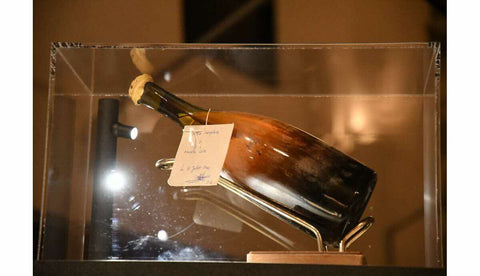 The oldest bottle of Vin Jaune, from the 1774 vintage, sold for over 100 000€ at auction in 2018
Production & winemaking of Vin Jaune
Vin Jaune is produced exclusively in the Jura and can be made within four appellations: Côtes du Jura, L’Étoile, Arbois and Château-Chalon. The latter is, in fact, entirely dedicated to the production of Vin Jaune.
Another key feature: Vin Jaune comes from a single grape variety, the Savagnin. This iconic Jura variety can also be vinified in other styles, notably as topped-up white, but its most famous expression remains Vin Jaune.
After fermentation, the wine is placed in oak barrels and aged for at least six years and 3 months without topping up. Topping up normally involves regularly refilling a barrel to compensate for the natural evaporation of wine and to prevent excessive contact with oxygen.
For Vin Jaune, it’s exactly the opposite: the barrel is not refilled and, over time, a layer of yeast forms on the surface of the wine. This layer limits direct contact with air and gradually transforms its aromatic profile. It’s this unique, lengthy, and delicate aging process that creates the famous “goût de jaune” (yellow wine character).
Once the aging is complete, Vin Jaune is bottled in a very distinctive bottle: the 62 cl clavelin. This size traditionally symbolizes what remains of a liter of wine after several years of evaporation in the barrel.
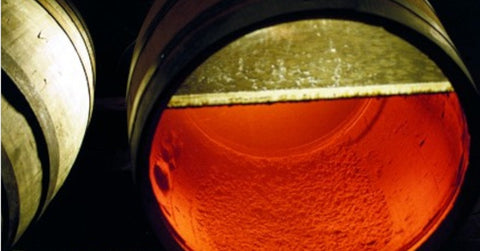 Yeast veil developing in an un-topped barrel
A wine with a unique taste
Vin Jaune is a particularly intense and distinctive dry white wine. Its first tasting can be surprising, especially due to its aromatic profile, which is very different from that of a classic white.
Its most typical markers are dried fruits, especially walnut and almond, but also curry, spices, apple, nutmeg, and cinnamon. On the palate, the wine generally offers great length, power, and a freshness that balances its very pronounced character.
To fully enjoy its aromas, it is best to open the bottle slightly in advance. Allowing it to breathe, or decanting for some younger bottles, can also be beneficial.
The serving temperature also plays an important role: around 14 to 16 °C, Vin Jaune will generally reveal its complexity much better than at a temperature that is too cold or too warm.
At the table, Vin Jaune has a true gastronomic dimension. The iconic pairing is of course with a mature Comté cheese, but it also pairs very well with chicken with morel mushrooms, creamy mushroom dishes, certain shellfish, or even lightly spiced cuisines.
Key points
Vin Jaune is a white wine from Jura made exclusively from the Savagnin grape variety. It undergoes a very long aging process in barrels without topping up, under a layer of yeast, which gives it its characteristic aromas of walnut, spices, curry, and apple.
It is then bottled in a 62 cl clavelin. Its concentration, acidity, and unique production method also give it a remarkable aging potential: some bottles can develop favorably for several decades, or even longer when stored in optimal conditions.
If you would now like to discover other styles of Jura wine: Savagnin ouillé, Chardonnay, Poulsard, Trousseau, Vin de Paille, or Macvin, feel free to browse our selection of Jura wines.
To discover Vin Jaune itself, La Cave Éclairée offers in particular a cuvée from Domaine Jérôme Arnoux, a magnificent example of this unique style.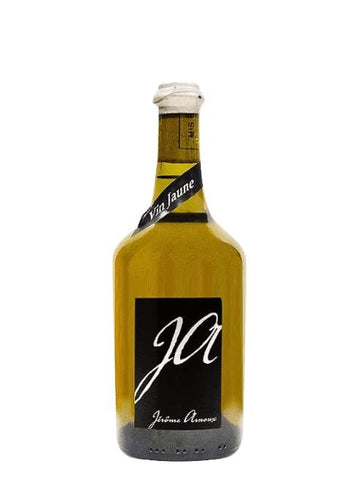


4 comments
Vin de Jura, long en bouche, un élixir pour le palais, lorsque l’on y a gouté nous voulons en avoir en réserve.
Bonjour Hervé,
d’autres cépages permettent également la production de “vins de voile” (Vin Jaune étant une sémantique réservée au Jura) et le savagnin n’est donc pas le seul élu. Pour exemple, le domaine Plageoles dans le Sud-Ouest à Gaillac réalise un vin de voile à partir du cépage Mauzac. En Espagne, et bien que le procédé de fabrication ne soit pas exactement similaire, la région d’Andalousie propose de nombreux vins de voile (Xérès) réalisés avec le cépage Palomino.
Le Jura n’a donc pas de particularité de terroir pour permettre le développement de certaines levures, ce sont simplement le contrôle des températures dans les chais ainsi que le suivi précis du vieillissement des vins qui permettront de réaliser un vin jaune ou un vin de voile.
En espérant avoir répondu à votre question !
À bientôt,
Maxime, La Cave Éclairée
Pourquoi est ce seulement le savagnin du jura qui puisse permettre cet elevage sous voile ?
Est ce que ce vignoble a des particularités dans le developpement de ce type de levure ?
Merci de votre réponse
Très intéressant merci pour cet article !