

Welcome to Gevrey-Chambertin, one of the most renowned appellations of Burgundy and the Côte de Nuits! Here, every plot tells a story and every bottle is an invitation to travel.
Dive in with us as we explore together the history, terroirs, and possible food pairings with the cuvées of this outstanding AOC. From Gevrey-Chambertin village to the Grand Cru found in the village, and through the many Premier Crus of the appellation, you will not be disappointed!
Ready to discover this winegrowing gem? Let’s go!
Summary
History of the Gevrey-Chambertin Appellation
The cultivation of vines in Burgundy dates back to the Roman presence, as early as the 1st century BC. It was indeed the Romans who introduced viticulture to the region, taking advantage of the well-exposed slopes and limestone soils favorable to vines. Although few written records from this period remain about viticulture in Gevrey, it is highly probable that local grape varieties were selected and cultivated here since Antiquity.
From the 6th century onwards, the monks of the abbeys of Burgundy, notably those of Cluny and Cîteaux, played a crucial role in the development of viticulture. Even at that time, they identified and mapped the best terroirs. They also improved cultivation and winemaking techniques, contributing to the growing reputation of Burgundy wines. Gevrey thus became a village recognized for the quality of its vines and wines.
From the 7th century onwards, the wines of Gevrey began to gain royal renown. The "Chambertin" climat, in particular, is known for producing exceptional wines. It is even said that Napoleon Bonaparte was a great enthusiast and requested to be served exclusively with Chambertin wines during his military campaigns !
In 1847, to strengthen the reputation of this exceptional terroir, the village of Gevrey added the name of its most prestigious climat to its own, thus becoming Gevrey-Chambertin.
In 1855, Dr. Jules Lavalle published a classification of Burgundy wines in his work History and Statistics of the Vine and Great Wines of the Côte-d'Or. The most prestigious climats of Gevrey, including Chambertin and Clos de Bèze, were then classified as "first class" wines, equivalent to today’s Grand Crus.
The 19th century was nevertheless very tumultuous for viticulture, with serious crises such as those of powdery mildew and downy mildew (fungi attacking the berries) and especially that of phylloxera, a devastating aphid that ravaged the entire European vineyard at the end of the century.
Fortunately, the 20th century was much more positive, notably with the creation of the Gevrey-Chambertin Appellation d’Origine Contrôlée (AOC) in 1936. This step was a key moment for the village as it marked the definition of strict production criteria, including geographical delimitation, authorized grape varieties, yields, and cultivation practices.
Today, the Gevrey-Chambertin AOC covers nearly 410 hectares entirely dedicated to the Pinot Noir grape variety. 26 climats classified as " Premier Cru " are also distinguished here, and the commune has 9 Grand Crus !
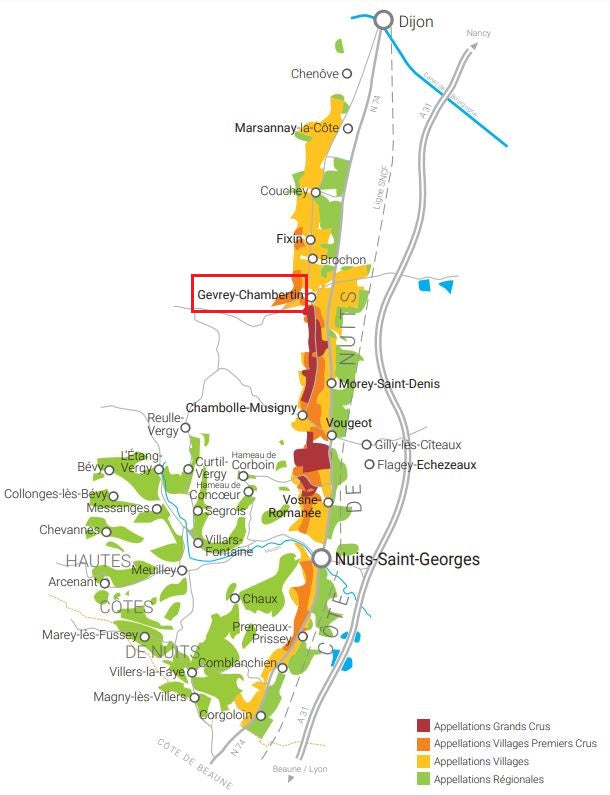
Map of the Côte de Nuits, Burgundy
Soils and Climate of the Gevrey-Chambertin AOC
Nestled in the heart of the prestigious Côte de Nuits and neighboring the AOCs Morey Saint-Denis, Chambolle-Musigny, and a little further south, Vosne-Romanée, the Gevrey-Chambertin appellation extends over the communes of Gevrey-Chambertin and Brochon. The vines here benefit from an altitude between 250m and 380m as well as ideal exposures, ranging from southeast to east, thus maximizing their sunlight.
The soils play a fundamental role here in the quality and typicity of the wines. Thus, the terroirs of Gevrey-Chambertin rest on a complex and varied geology, characteristic of the Côte de Nuits.
The Grand Crus are, for example, mainly located in the middle of the slopes. This area offers soils composed of marl limestones and superb exposures, allowing the production of powerful, structured wines with great longevity.
The Premier Crus are often located on the periphery of the Grand Crus and have more varied soils, mixing limestone and clay. These allow the production of wines balanced between finesse and structure, depending on the location of the plot and the winemaking process.
Finally, at the foot of the slope, on soils richer in clay and silt, are planted the vines that will be used to produce cuvées in the "village" appellation . These wines are often accessible from a young age, offering fruity aromas and a lovely suppleness…but beware of oversimplification !
In terms of climate, the perfect balance between a temperate regime and continental influences favors the vegetative cycle of Pinot Noir, the emblematic grape of the AOC. The hot summers and cool autumns here allow for slow and even ripening, ensuring grapes of optimal quality.
The Wines of the Gevrey-Chambertin Appellation
As you will have understood, the Gevrey-Chambertin AOC is exclusively dedicated to red wines made from the Pinot Noir grape, a symbol of Burgundian elegance. The cuvées of the AOP often captivate tasters with their aromatic richness and unique structure, which give them a place of distinction among the very greatest wines.
When young, Gevrey-Chambertin wines display a brilliant ruby color that evolves over time into deep shades of carmine or black cherry. On the nose, the initial aromas of red and black fruits such as strawberry or blackberry intertwine with floral notes of violet, mignonette, and rose. With age, the bouquet gains complexity, revealing scents of leather, licorice, undergrowth, and slightly gamey accents.
On the palate, these red wines stand out for their power and richness. The tannins, of great finesse, offer a velvety texture and solid structure, without any harshness. Both full-bodied and balanced, they express themselves with generosity and depth, leaving a lasting impression on the palate. Pleasant to enjoy young for their fruitiness, they are also excellent age-worthy wines, and thus reveal their full potential after a few years in the cellar.
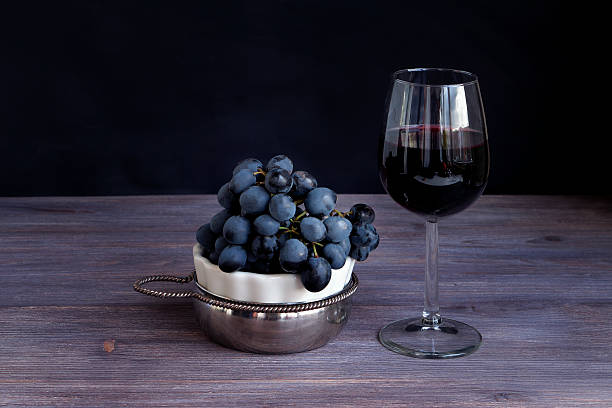
Gevrey-Chambertin: a wine made 100% from Pinot Noir
The Premier and Grand Crus of Gevrey-Chambertin
As explained above, 26 climats are classified as " Premier Cru " within the Gevrey-Chambertin AOC. Among these elite terroirs, there are some very great names such as Clos du Chapitre, Clos Saint-Jacques, Aux Combottes, Combe aux Moines, La Perrière, and Les Cazetiers.
Nevertheless, what truly makes the greatness of the commune are undoubtedly its 9 Grand Crus, the record in the region! Here are a few more details about these exceptional terroirs.
-Chambertin: the soils here are clay-limestone and offer good drainage. Located mid-slope, the exposure is perfect. Considered the "wine of kings," it is powerful and complex, with aromas of black fruits, licorice, and undergrowth. Its palate is dense and balanced, ideal for long aging
-Charmes-Chambertin: the soil here is deep and clay-limestone. This Grand Cru offers round and approachable wines, with aromas of red fruits and a velvety texture.
-Mazoyères-Chambertin: located below Charmes, with similar but slightly more clayey soils. The wines are often smooth and charming, with great depth.
-Chambertin Clos de Bèze: the terroir here is limestone and stony, well-drained, often a bit cooler than Chambertin. Elegant, this wine develops floral and spicy notes, with a silky structure and remarkable length.
-Mazis-Chambertin: the stony and limestone soils are located at the top of the slope. Mazis-Chambertin produces racy, structured wines, combining power and finesse. Notes of black fruits and undergrowth are often present in tasting.
-Griotte-Chambertin: this Grand Cru has soils rich in clay, bringing roundness to the wines. The cuvées produced here are often delicate, charming, with lovely suppleness and aromas of cherry and spices.
-Ruchottes-Chambertin: this Grand Cru has shallow, rocky, and limestone soils, at altitude. It is known for producing wines of great finesse, light and airy, with lovely tension and subtle red fruit aromas.
-Latricières-Chambertin: the terroir here is cold and stony and the whole is exposed southeast. Mineral and sometimes austere in their youth, the cuvées gain elegance and finesse over time.
-Chapelle-Chambertin: a Grand Cru located at the bottom of the slope on rich and more clayey soils. These allow the production of elegant, smooth crus, with notes of ripe red fruits and lovely suppleness.
All these Grand Crus produce wines with great aging potential, representing the very excellence of Pinot Noir.

Map of the Gevrey-Chambertin Climats
What to Eat with Gevrey-Chambertin Wines?
Gevrey-Chambertin pairs brilliantly with characterful dishes. Its vinous aromas enhance game meats, whether feathered or furred, while its rich and velvety structure makes it the ideal companion for a grilled rib of beef, braised lamb, or slow-cooked meats in flavorful brown sauces.
And why not try even bolder pairings? A Gevrey with lightness and finesse will indeed surprise you alongside a fillet of pike-perch or tuna, enhanced by a red wine sauce. An unexpected but memorable combination, not to be missed.
On the cheese side, it excels with local treasures such as Époisses or L’ami du Chambertin, a creamy cow’s milk cheese, emblematic of the region. An original and highly rewarding tasting experience !
To fully appreciate its richness, Gevrey-Chambertin wines are ideally enjoyed at a temperature between 14 to 16 °C.
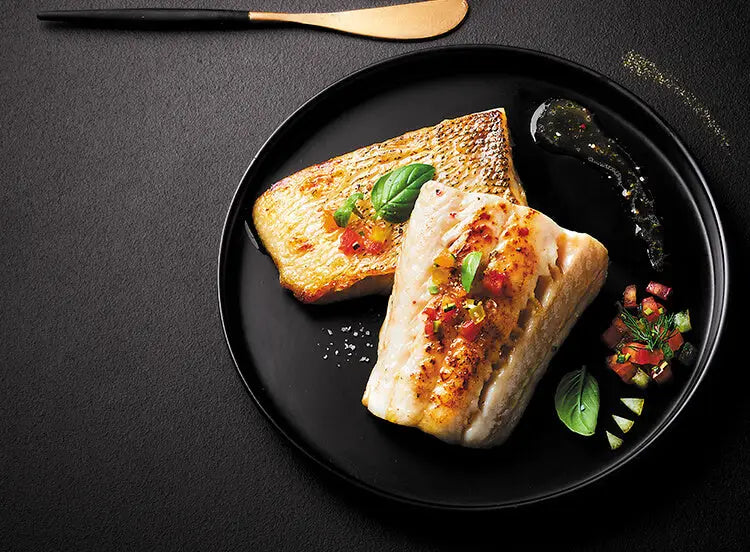
Fillet of pike-perch and Gevrey-Chambertin: a bold and indulgente
The Best Wines of the Gevrey-Chambertin AOC
Many world-renowned estates are present in Gevrey, such as the famous Armand Rousseau, Leroy, Dugat-Py, and Dujac estates.
Nevertheless, La Cave Éclairée recommends you take a close look at Domaine Marchand-Grillot, an address not to be missed! This family estate of 12 hectares produces cuvées on the appellation that display magnificent finesse and great elegance. Qualities that could sometimes even bring them close to the idealized image of a Chambolle-Musigny!
If you love wines with finesse and complexity, go for their range !
You are now a true connoisseur of Gevrey-Chambertin! All that’s left is to put theory into practice. Visit La Cave Éclairée to find your wine treasures!


