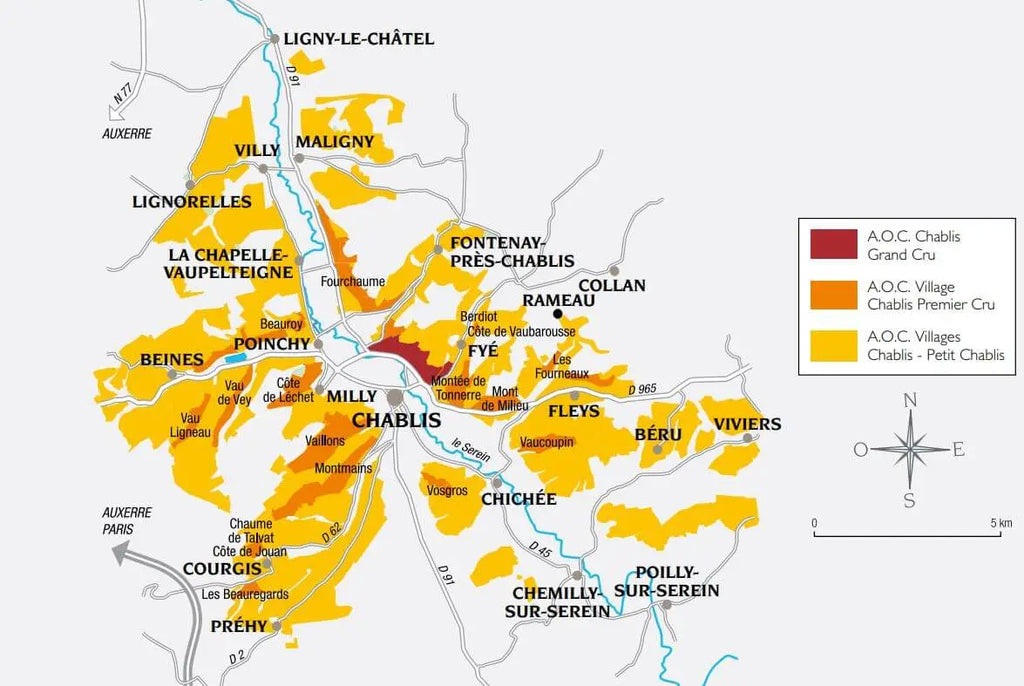
Located near Auxerre and isolated from the rest of the Burgundy vineyard, the Chablis appellation nevertheless enjoys very strong renown, both in France and abroad. Moreover, it is the second largest of the communal appellations in France in terms of area, behind Saint-Émilion and ahead of Châteauneuf-du-Pape.
But then, what are the origins of the Chablis vineyard? What is the one and only grape variety of the appellation? What is the difference between Chablis and Petit Chablis? What should you expect during a tasting? What should you pair with a glass of Chablis? You will find all the answers to your questions thanks to this article.
Enjoy your journey to the land of Chardonnay! (and oops...I have already spoiled).
Summary
Chablis: a millennial history
In 1114, the Cistercian monk Hugues de Mâcon founds a second abbey in Pontigny, north of Chablis. This abbey then receives vineyards as a donation so that it too can ensure a religious service.
From the 15th century onwards, Chablis wines will begin to be exported in France.This is also the time when they arrive on royal tables.
The vineyard thus continues its development until the terrible phylloxera crisis, this insect that devastated the French and European vineyards at the end of the 19th century. Then, while the first half of the 20th century is marked by the official creation of the Chablis AOC (1938) , it is above all the two world wars that will impact vine cultivation, reducing the Chablis vineyard in 1955 to only 550 hectares.
The hard work of the winegrowers will gradually restore the region's winegrowing splendor, mainly from the 1970s onwards, a decade during which Chablis will begin to experience significant qualitative and quantitative growth.
Today, the Chablis vineyard covers more than 5,800 hectares and represents 20% of Burgundy wine production, a spectacular increase! Furthermore, the appellation shines not only in France but also (and especially) abroad. In fact, it exports more than 65% of its wines, with the United Kingdom, the United States, and Canada as its main clients.
Terroir, climate, and grape variety of the Chablis AOC
Located at the very north of Burgundy, Chablis is set on an ancient ocean that left behind numerous sediments. In fact, 150 million years ago, the lands of the region were covered by water.Today, therefore, the vineyard of contains a great many marine fossils from this Kimmeridgian period, making Chablis a vineyard with a typically clay-limestone terroir .
From a climate perspective, the region is characterized as semi-continental and is therefore marked by long, cold winters as well as hot summers. A certain oceanic influence (humidity and precipitation) is also present.
Finally, the only grape used here is Chardonnay. As you will have understood, in Chablis, only white wine is produced! This grape variety, the second most planted in France in its color, adapts wonderfully well to this terroir and climate, producing wines that evoke finesse, purity, and minerality.
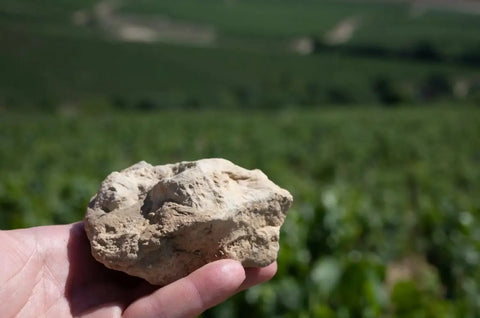
Chablis limestone sample with fossils
Petit Chablis, Chablis, Premier Cru and Grand Cru
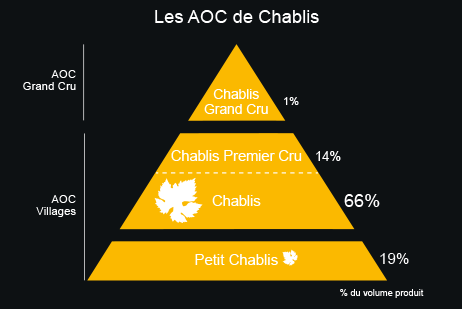
So, how is the Chablis vineyard composed? Well, it's quite simple, there are 4 appellations: Petit Chablis, Chablis, Chablis Premier Cru, and Chablis Grand Cru. These climats (or plots), are categorized this way according to the quality of their terroir. Here are the distinctions to remember.
AOC Petit Chablis & Chablis
Representing 19% of Chablis production, the AOC Petit Chablis is located in the same appellation area as Chablis (66% of the production).
But then, why "Petit" Chablis? Well, quite simply because the vineyard plots of the appellation are facing North and in the past, these lands were considered to be of lower quality as they received less sunlight throughout the year, which did not favor the ripening of the grapes. As a result, the wines produced from these plots are livelier and more taut than average.
This is still the case today but be careful not to generalize! With climate change, the situation has indeed changed in recent years. In fact, the Petit Chablis appellation is now capable of producing excellent wines, sometimes rivaling certain Chablis.
AOC Chablis Premier Cru &and Chablis Grand Cru
At the top of the hierarchy are the plots classified as Chablis Premier Cru (14% of production) and Chablis Grand Cru (the top 1% of production). These are the most prestigious terroirs of the region, where the best wines are produced thanks to sunny exposures that promote optimal ripeness.
Today, there are 17 flagship climates classified as Premier Cru in the Chablis area, with the most renowned plots being Montée de Tonnerre, Fourchaume, Vaillons, and also Montmains.
Finally, there are 7 Grands Crus: Vaudésir, Grenouilles, Les Clos, Blanchot, Bougros, Preuses, and Valmur.These climates, producing the quintessence of wines from the appellation, are located exclusively on the right bank of the Serein, a small river crossing the village of Chablis, and are the best exposed in the vineyard.
Tasting and pairings of Chablis wines
With such a diversity of plots, Chablis is able to offer all the possible nuances of Chardonnay. To help you better categorize the different wines of the vineyard according to their appellation, here are the main markers to remember. However, please note that these characteristics are generalities! Consequently, thousands of nuances exist between wines of the same appellation, and many factors must be taken into account, such as the terroir, the vintage effect, or even the vinification carried out by the estate (stainless steel tanks, large wooden vats, oak barrels, etc.).
- Petit Chablis : a wine offering great tension on the palate and expressing notes of citrus, green apple, white flowers, as well as a beautiful minerality.
- Chablis : while the tension and minerality are still very much present, one generally observes a slightly richer profile than Petit Chablis.Citrus, green apple, peach, and pear notes can be detected on the palate.
- Chablis Premier Cru : the acidity here begins to soften and one enjoys a fuller body. Notes of citrus, peach, pear, and butter appear. An aging potential ranging from 5 to 10 years is generally possible.
- Chablis Grand Cru : the fruit notes here are very ripe, evoking peach and apricot. In addition, the texture is enveloping and the aging potential can be impressive.Nevertheless, the minerality as well as the freshness typical of Chablis never completely disappear, much to our delight!
From a food and wine pairing perspective, the characteristics of Chablis wines allow them to adapt ideally to many situations. Petit Chablis and Chablis, for example, are perfect on their own as an aperitif but can also be paired during a meal with summer salads, seafood, fish, fresh goat cheese, young Comté, or even Saint-Nectaire.
Thanks to their aromatic richness, Chablis Premier Cru and Grand Cru are best enjoyed during a meal. These can be paired in the same way as a classic Chablis, although they can also complement dishes with more powerful flavors.
From a service temperature point of view , Petit Chablis and Chablis are ideally enjoyed between 8-10°C while Premiers and Grands Crus will ideally reveal their flavors when served between 10-13°C.
What are the best Chablis ?
Although it is complex to provide an exhaustive list of the best Chablis, La Cave Éclairée has selected for you a range of choice cuvées from the estate Garnier & Fils. All styles of the appellation are brought together here: from crisp and delightfully mineral whites to Chardonnay that is more generous and endowed with great aging potential. There is something for every taste and budget!
- Domaine Garnier & Fils - Chablis
- Domaine Garnier & Fils - Chablis 1er Cru Mont de Milieu
- Domaine Garnier & Fils - Chablis Grand Cru Les Clos
You are now fully prepared to take on the Chablis vineyard ! All that remains is for you to succumb to the delicious minerality of the region's wines. And above all, do not hesitate to contact La Cave Éclairée if you need advice!