

What wine enthusiast has never heard of Châteauneuf-du-Pape ? This appellation resonates through history, and its papal origins are as deeply engraved in its name as on its prestigious bottle.
Why is it called “the wine of the Popes” ? Which grape varieties are used ? What should you expect during a tasting ? What is the long history of the appellation? Overview.
History of Châteauneuf-du-Pape
Now a flagship of the wine heritage of the Southern Rhône Valley and of France, the history of the region’s vineyard dates back to Antiquity, when vines were very likely already present.
Nevertheless, the true recognition of the local wines only began in the 14th century, when Avignon officially became the residence of the popes. In 1314, Clement V left Rome and its geopolitical instability to settle in France. Avignon was chosen for its strategic location, being at the crossroads of major routes and offering river access connecting northern and southern Europe.
While Clement V was the first pope of Avignon, it was his successor, John XXII, who brought the wines of the area to the renowned table of the Palais des Papes and to the great European courts. From that moment, the rise of Châteauneuf wines continued through the centuries, enduring difficult periods such as the religious wars of the 16th century and regaining their splendor during the 18th century.
The other major turning point came at the beginning of the 20th century, when local winegrowers, eager to protect their wines (sometimes blended with those from other regions), decided in 1923 to implement stricter regulations, unique for the time. With the help of Pierre Baron Le Roy, a renowned winemaker of the appellation and a jurist, they gave birth to the modern concept of the AOC. A few years later, in 1936, the appellation decree was officially published and Châteauneuf-du-Pape became the very first wine AOC in France, alongside Monbazillac, Tavel, Arbois and Cassis.
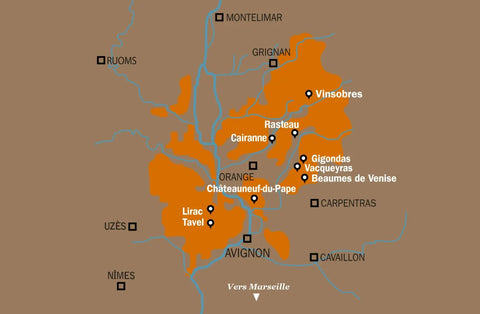
Geography and Terroir
The Châteauneuf-du-Pape vineyard is entirely planted on the left bank of the Rhône. Today, it covers about 3,200 hectares and is spread over 5 communes : Châteauneuf-du-Pape, Bédarrides, Courthézon, Orange, and Sorgues. About 95% of the harvest is vinified as red and 5% as white.
The region’s Mediterranean microclimate is particularly warm, with very high annual sunshine : 3 400 hours (compared to 1 700 hours in Paris…). The vines are generally pruned in goblet style to protect the bunches from wind and sunburn.
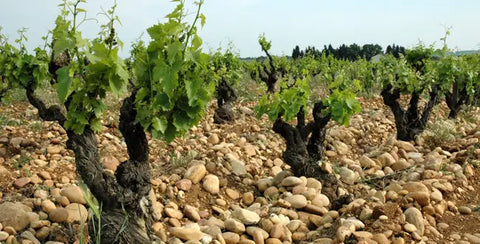 Goblet-pruned vines on soils of rolled pebbles
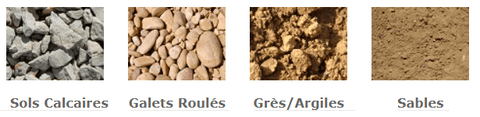
To speak of Châteauneuf-du-Pape is also to mention its famous iconic terroir of rolled pebbles. These stones release at night all the heat they store during the day, thus promoting high ripeness of the grapes. However, Châteauneuf is not limited to this type of soil. The appellation actually has a very varied geological patchwork : red clay, limestone fragments, sandstone, and even sand are also very present. The latter would even represent 30% of the appellation’s soils ! So beware of oversimplifications. Finally, one of the essential characteristics of the AOC is the frequency of the Mistral. This cold, dry wind from the north dries out the vineyard, thus limiting the spread of fungal diseases caused by humidity.
Châteauneuf is also known for its great variety of grape varieties : 13, or 18 if you count the color variations by grape type (picpoul noir/picpoul blanc, clairette blanche/clairette rose, etc.). While a few rare cuvées are made with all the available varieties (like the wine from the iconic Château de Beaucastel), most of the production comes from 3 main grape varieties: Grenache noir (60% of the vineyard), Mourvèdre and Syrah. For whites, Roussanne, Grenache blanc and Clairette make up the majority of the plantings.
Châteauneuf-du-Pape : what types of wines ?
It is impossible to reduce Châteauneuf-du-Pape to a single style ! While under the same sun, the wines will share the common denominator of concentrated berries producing generous and full-bodied wines with intense aromas, within the AOC you will find both very opulent cuvées and models of refinement. Many factors can indeed differentiate the wines produced : the winemaker’s philosophy, the soils, the blend composition, or even the cultivation practices multiply the possibilities.
If we had to generalize, we would describe the red wines as powerful, intense, full-bodied, and offering a wide aromatic palette ranging from ripe black fruits to warm spicy notes. The whites are generally low in acidity and display a beautiful roundness. They, like the reds, are capable of evolving very positively in the bottle over several years or even decades.
Conclusion
Châteauneuf-du-Pape is therefore one of the finest appellations in France and is capable of producing wines that truly represent the world’s elite.
If you absolutely must try the reds, be curious and also dare to try the whites, which may surprise you very positively ! If you are looking for excellent Châteauneuf in both red and white with top value for money, turn to the Pierre Usseglio estate, which will delight you ! Finally, for true enthusiasts, the Château de Beaucastel is a must-try at least once in your life.
Cheers ! 🍷
Anecdote : The first written records of the village of Châteauneuf date back to 1094. At the time, the town was called “ Castro novo ” (New fortified village). In the 13th century, it became Châteauneuf-Calcernier, and it was only in 1893, at the request of the then mayor, Joseph Ducos, that the town took its current name, thus referring to the popes’ place of residence. As for the bottle proudly bearing the town’s coat of arms, it was created in 1937 (one year after the official creation of the AOC) to promote the appellation internationally and is a guarantee of authenticity for the wines. It depicts a papal tiara placed above the keys of Saint Peter.



1 comment
Très interessant et bien documenté