

Located at the gates of the city of Bordeaux, the Pessac-Léognan AOC is one of the most sought-after vineyards in the region. Renowned for the elegance of its red wines and the finesse of its whites, this appellation truly embodies Bordeaux wine excellence.
So, what makes this terroir so unique? Here, we invite you to explore it and discover its history, its cuvées, as well as possible food and wine pairings. Let’s discover the world of Pessac-Léognan together… happy reading!
Summary
History of the Pessac-Léognan AOC
The history of the Pessac-Léognan AOC began about 2000 years ago, a period when the first traces of viticulture in the “Graves” region were revealed. The remains from this era, notably Roman amphorae and tools related to the vine, indeed testify to the early importance of viticulture in the region.
Then, in the Middle Ages, the region’s vineyards developed under the influence of religious orders, who played a key role in maintaining the vines and producing wine. Abbeys and monasteries, such as La Sauve-Majeure, drove the rise of viticulture, while Bordeaux became a trading center thanks to its strategic position on the Garonne. The region’s wines then began to gain notoriety, especially among the English, during the period when Aquitaine was under their rule (1154-1453).
Originally, the Pessac-Léognan region was largely covered by forests and marshes. Located on the lands of the Graves, the region owes its name to the abundance of gravel, deposits of pebbles, gravel, and sand, left by the Garonne and its tributaries. However, these gravelly soils were often covered by wetlands that were difficult to exploit, where dense vegetation made the land hard to develop.
While the Romans were the first to clear certain areas, followed by the monks a few centuries later, it was not until the 17th and 18th centuries that the drainage of the territory of Pessac-Léognan really accelerated thanks to the nobility and bourgeoisie, attracted by the opportunities offered by the wine trade. It was during this period that prestigious estates, such as Château Haut-Brion, began to flourish.
In the 19th century, the 1855 classification of the Grands Crus of the Médoc, carried out at the request of Napoleon III for the Universal Exhibition, highlighted Château Haut-Brion as one of the five First Growths Classified. It is, in this respect, a notable exception as it is the only non-Médoc château to be included !
In the 19th and 20th centuries, the urbanization of Bordeaux began to encroach on the surrounding farmland, including that of Pessac-Léognan. Housing developments, railways, and industrial zones threatened the historic vineyards. However, major wine estate owners fought to preserve the vineyards in the face of urban expansion.
The creation of the Pessac-Léognan appellation in 1987 , driven by André Lurton, marked a key step in this preservation. By defining strict geographical boundaries, this AOC indeed helps protect the wine-growing terroir and highlight its specificities.
Today, the Pessac-Léognan AOC is a symbol of wine excellence and perpetuates a centuries-old heritage where tradition and innovation coexist to produce red wines that are both powerful and elegant, as well as dry whites of great purity. The appellation covers about 1,630 hectares spread over 10 communes, including Pessac and Léognan.
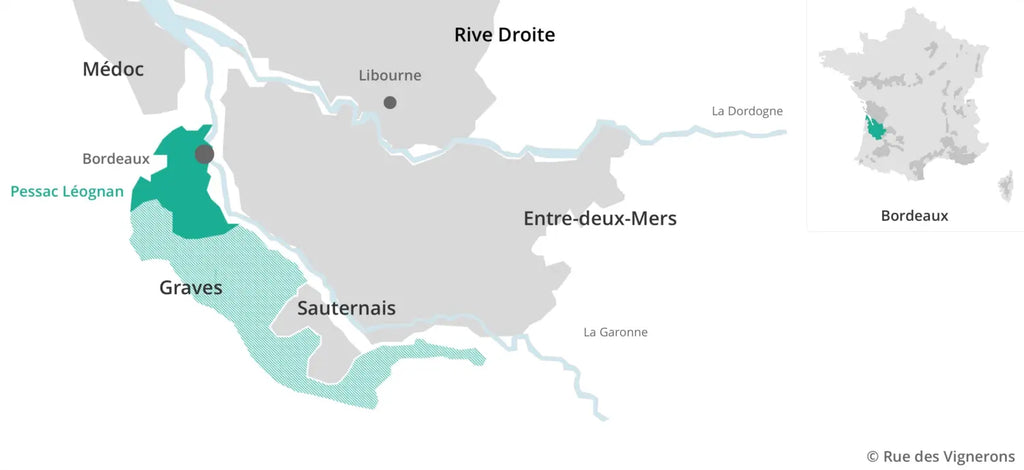
Map of Bordeaux appellations with Pessac-Léognan in the south
Soils and climate of the Pessac-Léognan appellation
As you will have understood, Pessac-Léognan benefits from an exceptional terroir, characterized by soils composed of gravel and pebbles, giving its wines a unique identity. These soils poor in water force the vine roots to sink deep in order to draw the moisture necessary for their proper development. This feature thus promotes an optimal concentration of aromas as well as better quality dried grapes.
The microclimate of Pessac-Léognan also plays a key role in the flourishing of its vineyard. Protected by the Landes forest , the region also benefits from the moderating influence of the Atlantic Ocean, ensuring a mild and temperate climate. Favorable to slow and even ripening, this climate allows the dried grapes to develop complex notes and a beautiful aromatic harmony.
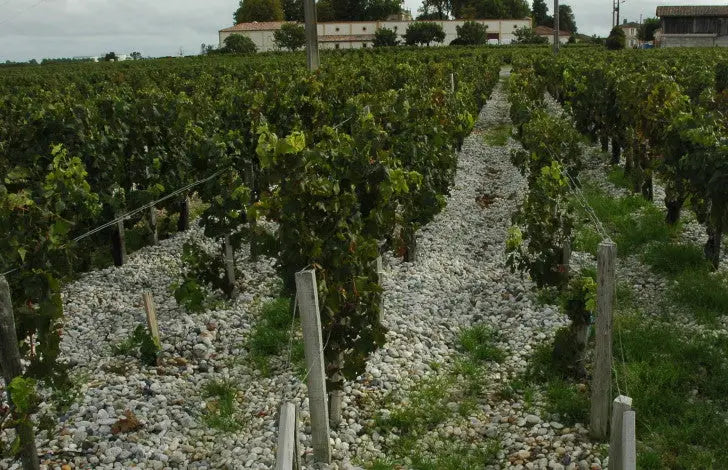
The soils of Pessac-Léognan are mainly composed of pebbles and gravel
The wines of the Pessac-Léognan AOC
The Pessac-Léognan AOC mainly produces red wines (80%) but also dry white wines (20%), each color offering distinct characteristics and unique sensory profiles.
The red wines of Pessac-Léognan
The terroir of Pessac-Léognan, with its well-drained gravelly soils, is particularly suited to red grape varieties such as Cabernet Sauvignon and Merlot, which dominate the blend in red wines. Other varieties such as Cabernet Franc, Carménère, Petit Verdot, or even Malbec (Cot) may also appear in the blends.
The red wines of Pessac are renowned for their aromatic complexity, elegant tannic structure, and great aging potential. On tasting, notes of red and black fruits are revealed to the taster (cherry, blackcurrant, blackberry, plum, etc.), often mingling with a spicy tone (pepper, licorice) as well as a present but fine tannic structure . Barrel aging can also bring to the wines notes of oak, tobacco, vanilla, cinnamon, or even clove.
Most of the red wines of the appellation improve freely for 8 to 10 years in the cellar, while the best bottles can be kept for several decades. You will then enjoy aromas of undergrowth, leather, and mushroom… quite a journey!
We recommend serving these magnificent wines at around 16-18°C to reveal all their subtlety. Also, do not hesitate to decant them for a few hours if you open them while they are young!

Cabernet Sauvignon, the main grape variety of Pessac-Léognan wines
The white wines of Pessac-Léognan
The white wines are, for their part, composed mainly of two grape varieties: Sauvignon Blanc and Sémillon . Other minor varieties such as Sauvignon Gris and Muscadelle are also sometimes present.
The whites of Pessac are dry and are usually characterized by a clear, bright yellow-gold color. On the palate, they present aromas of citrus, white flowers, but also peach, apricot, and sometimes light exotic notes. They too are very largely aged in oak barrels . As a result, a fairly rich texture is often present on tasting, accompanied by notes of oak, vanilla, and butter.
With their beautiful complexity and indulgent balance, the white wines of Pessac-Léognan are decidedly gastronomy-oriented. For ideal tasting, we recommend serving between 11-13°C to reveal their richness.
What to eat with a wine from the Pessac-Léognan AOC?
As you have understood, the reds and whites of Pessac are gastronomic wines. So forget the aperitif and pair them at the table ! Here are some suggestions that will be sure to impress.
With a red Pessac-Léognan
With its fleshy tannins and aromas of red fruits and spices, red Pessac-Léognan pairs wonderfully with grilled or sauced red meats, as well as game dishes such as pheasant or venison.
Poultry (chicken, duck), certain aged cheeses or even a mushroom risotto can also work very well with this type of wine.
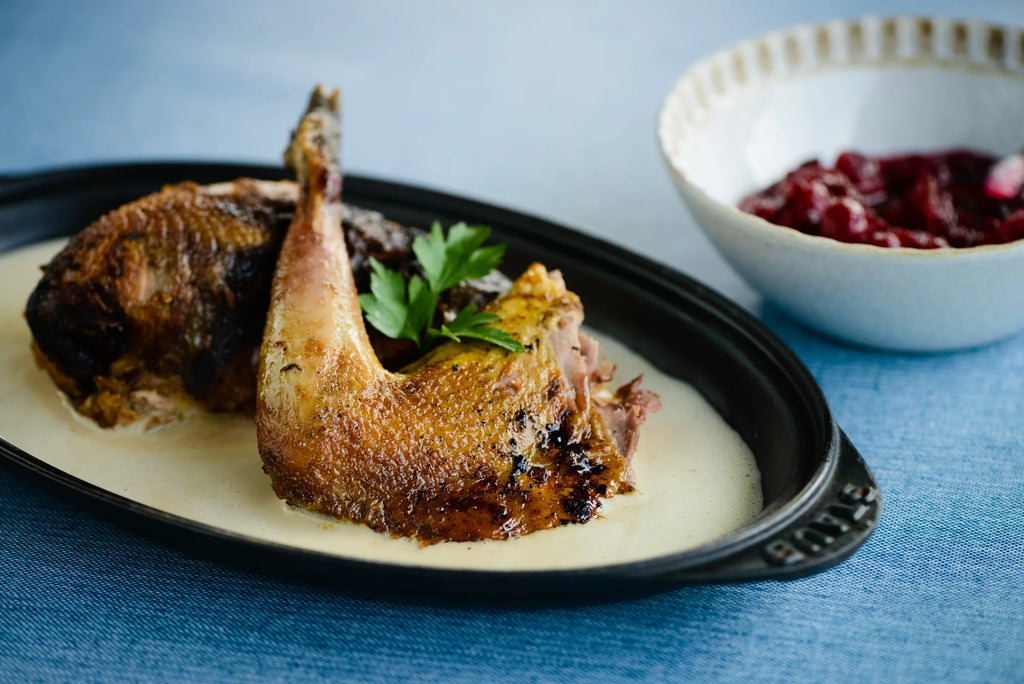
Pheasant and red wine from Pessac-Léognan: a delicious and refined pairing
With a white Pessac-Léognan
The white wine of Pessac-Léognan, for its part, pairs ideally with fresh goat cheeses or hard cheeses (Tomme, Comté, Beaufort, etc.). Its citrus and white fruit notes also combine very well with seafood (oysters, scallops) if the cuvée’s profile is not too oaky.
The lovely roundness of a Pessac also pairs very well with poultry (roast chicken, guinea fowl), a fatty fish such as salmon or even cod with butter sauce. Finally, mild curries and exotic dishes can also work very well.
The best wines of Pessac-Léognan
Among the most prestigious estates of the Pessac-Léognan AOC, Château Smith Haut Lafitte holds a place of choice.
Since 1990, Daniel and Florence Cathiard have managed this absolute reference. While today the estate’s wines are among the very best in the region, the vines were almost abandoned at the time of the couple’s purchase! Having detected the fantastic potential of this gravel terroir, the Cathiards have succeeded in radically transforming the estate. Today, the vineyard covers 80 hectares (68 in red and 12 in white), officially certified organic since the 2019 vintage and producing wines of absolutely magnificent finesse and complexity.
We can only recommend all their bottles !
You are now a true connoisseur of the Pessac-Léognan AOC, with a thorough understanding of its history and the particularities of its wines! If you wish to extend the pleasure, feel free to browse our site La Cave Éclairée to find the bottle that will seduce you and enrich your tasting moments.


