

Above all, Alsace is a land of white wines, home to 51 Grands Crus among the most beautiful wine-growing terroirs in France. The wines from these exceptional sites capture all the richness of their environment and are protected by a single appellation : the Alsace Grand Cru AOC.
Thanks to this article, discover the full diversity of these terroirs. Here, we will discuss their history, the soils, the authorized grape varieties, and we will also give you some tasting suggestions.
Have a good trip to the land of storks!
Summary
The history and recognition of Alsace Grands Crus
The wine history of Alsace begins with the Romans. They indeed introduced vine cultivation to the region after the conquest of Gaul by Julius Caesar (around 58-51 BC).
In the Middle Ages, with the Christianization of the region, the monasteries played a crucial role in the development of the local vineyard. The abbeys, notably those of Ebersmunster and Murbach, then owned vast wine-growing lands and perfected winemaking techniques.
In the 12th and 13th centuries, Alsace became one of the main wine regions in Europe. The wines were exported notably to Switzerland, the Netherlands, and England. At that time, certain hillsides also gained in reputation, heralding the emergence of future Grands Crus.Documents already attest, for example, to the superiority of certain terroirs such as Mambourg, Praelatenberg, or Engelberg.
At the end of the Middle Ages and during the Renaissance, Alsace wine maintained a solid reputation. Nevertheless, the political instability linked to the Wars of Religion (16th century) and the Thirty Years' War (1618-1648) led to a significant decline in viticulture. Alsace, ravaged by the conflicts, then saw its vineyards greatly destroyed and its production reduced.
With the annexation of Alsace by France in 1648 (Treaty of Westphalia), Alsatian wines gradually regained their importance. However, economic upheavals as well as the overproduction of mediocre wines in the 18th century harmed their prestige.
The 19th century was marked by increasing industrialization and the emergence of major viticultural crises, notably with the arrival of phylloxera (an insect attacking vine roots) and downy mildew.
After the annexation of Alsace by the German Empire in 1871, production shifted towards more ordinary wines, intended for mass consumption. Nevertheless, some winegrowers tried to preserve quality production by selecting the best terroirs and replanting noble grape varieties such as Riesling and Gewurztraminer. This period also marked the first in-depth considerations on the need to distinguish the best terroirs of the region.
After the First World War and the return of Alsace to France in 1918, winegrowers organized themselves to protect and better promote their finest wines. It was in this context that the Appellation d’Origine Contrôlée (AOC) Alsace was created in 1945.
In 1975, the official recognition of the region’s finest terroirs also gave rise to the Alsace Grand Cru appellation. At its creation, only 25 plots benefited from this prestigious distinction, a number that has since increased to reach 51 Grands Crus today.
These plots are also strictly regulated: only four grape varieties are considered noble enough to be grown there: Riesling, Gewurztraminer, Pinot Gris, and Muscat. Almost all wines (with rare exceptions) are also vinified as single varietals. 1 Grand Cru is also partially planted with Sylvaner.
Finally, since 2022, Pinot Noir is also permitted on 3 Grands Crus.The Grand Cru of Alsace is therefore no longer entirely focused on white wine, much to our delight!

Riesling, the emblematic noble grape variety of the Alsace Grand Cru AOC
Climate and soils of the Alsace Grands Crus
Alsace has a semi-continental climate. Winters are therefore harsh and summers hot. In addition, the Vosges mountain range blocks oceanic influences coming from the West, thus greatly reducing precipitation (about 500-700 mm per year, one of the lowest levels in France).
In general, the region's vineyards also benefit from generous sunshine as well as a significant temperature range between day and night: ideal conditions to maintain a beautiful freshness in the wines and allow the development of complex aromas.
From a terroir perspective, Alsace and its Grands Crus possess a magnificent diversity of soils. There are 5 main types of terroir.
- Granite soils: these are lands composed of hard, poor rocks, with good drainage. This type of soil produces precise, taut wines, with beautiful liveliness and a vibrant aromatic expression. Perfect for Riesling, which develops an incredible crystalline purity here (example: Grand Cru Schlossberg).
- Marl-limestone soils: terroirs rich in limestone and clay. A winning combination that produces powerful, structured wines with great aromatic richness. These soils often yield opulent Gewurztraminers and complex Pinot Gris (example: Grand Cru Hengst).
- Sandstone soils: these are soils mainly composed of sedimentary rocks and sands. These elements promote the production of subtle and elegant white wines with a beautiful mineral touch (example: Grand Cru Kirchberg de Ribeauvillé).
- Schist soils: these are terroirs of layered rocks that promote good drainage and store heat. The wines produced here are often fine, elegant, with complex aromas and beautiful aging potential (example: Grand Cru Kastelberg).
- Volcanic soils: composed of basaltic rocks of volcanic origin, these soils give the wines smoky notes, great aromatic power, and excellent aging potential (example: Grand Cru Rangen de Thann).
- Limestone soils: terroirs mainly composed of limestone, offering wines that are straight, structured, and with beautiful aromatic precision. Rieslings from these soils often develop remarkable tension and superb minerality (example: Grand Cru Vorbourg).
Of course, infinite nuances exist between the lines of these major terroir categories, which is precisely what makes the Alsace region and its Grands Crus so complex and diverse.
List of the 51 Alsace Grands Crus
So here is the long-awaited moment for those of you who wish to know by heart the 51 Alsace Grands Crus (good luck!). Here you will find their list as well as the grape varieties authorized for each of them.
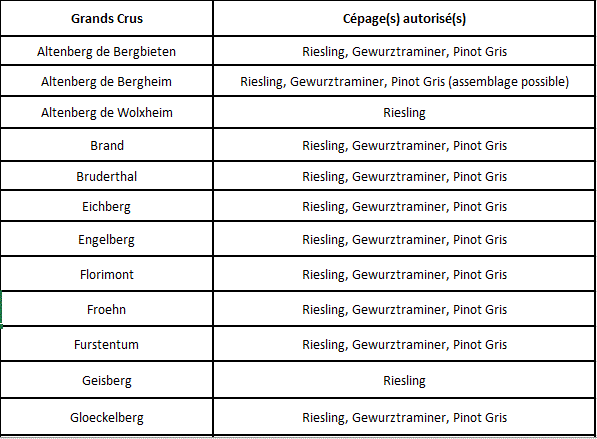
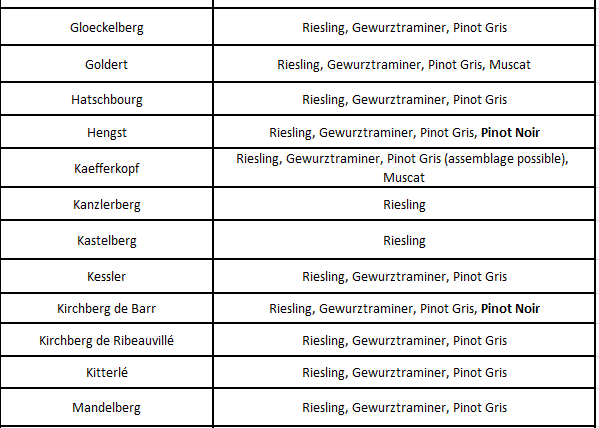
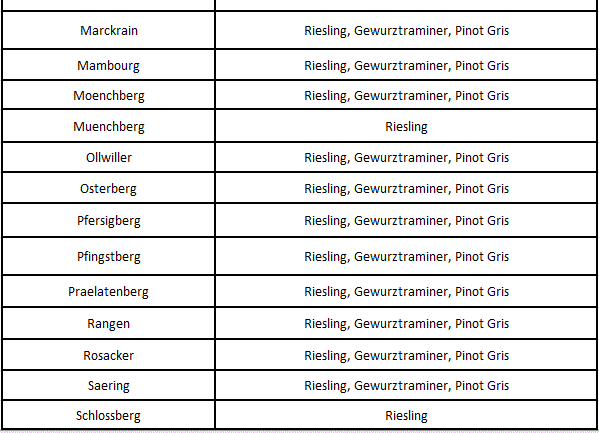
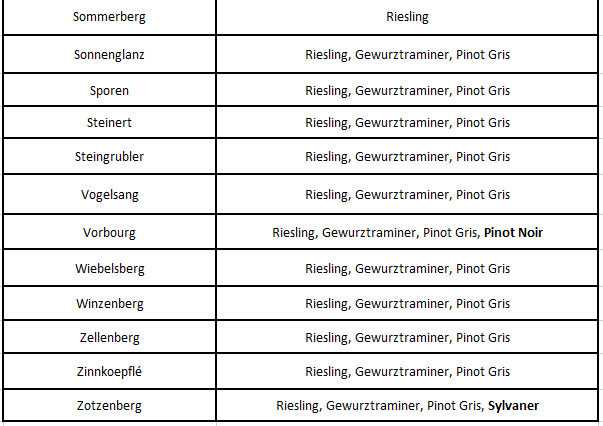
While describing each of these 51 terroirs in detail would probably take us a hundred pages, we still wanted to leave you here with a TOP 10 of the most renowned Alsace Grands Crus.
These ten major terroirs symbolize, in our view, the excellence of Alsace wines. Their unique soils and ideal climatic conditions make it possible to produce exceptional cuvées, particularly in Riesling, Gewurztraminer, and Pinot Gris. Their reputation extends beyond borders, attracting enthusiasts and renowned producers.
- Schlossberg (Kaysersberg-Vignobles) – Highly renowned Grand Cru distinguished by its granitic soil and airy wines. It is mainly planted with Riesling, combining mineral purity and lingering salinity.
Producers: Trimbach, Marcel Deiss, Weinbach…
- Hengst (Wintzenheim) – Arid climate and powerful terroir where Gewurztraminer excels, offering complex, full-bodied wines with great aging potential.
Producers: Josmeyer, Zind Humbrecht, Albert Mann…
- Rosacker (Hunawihr) – Limestone hillsides producing pure and intense Rieslings and Gewurztraminers. The legendary Clos Sainte Hune draws its elegance from here.
Producers: Trimbach, Sipp Mack, Agapé…
- Rangen (Thann and Vieux Thann) – Unique, steep and spectacular volcanic terroir, giving rise to smoky and chiselled wines, revealing their richness over time.
Producers: Zind Humbrecht, Schoffit…
- Brand (Turckheim) – Sunny and rocky terroir promoting wines with beautiful tension, marked by intense salinity and great liveliness.
Producers: Zind Humbrecht, Albert Boxler, Josmeyer…
- Schoenenbourg (Riquewihr) – Gypsum-rich hillsides renowned for rieslings of great breadth, powerful and built for aging, with characteristic smoky notes.
Producers: Bott-Geyl, Marcel Deiss, Hugel…
- Wiebelsberg (Andlau) – Sandy and sloping terroir dedicated to Riesling, producing taut, elegant, and mineral wines that refine beautifully with age.
Producers: Gresser, Kreydenweiss, Boeckel…
- Eichberg (Eguisheim) – Rich, clay soils producing powerful, dense, and structured wines with remarkable aging potential. Producers: Émile Beyer, Paul Ginglinger, Kuentz-Bas…
- Kitterlé (Guebwiller) – Steep volcanic sandstone terraces offering refined and distinguished wines, with mineral elegance and remarkable depth.
Producers: Schlumberger, Dirler-Cadé…
- Geisberg (Ribeauvillé) – Small-sized grand cru, terraced and exclusively planted with Riesling, which captivates with its precision, tension, and remarkable liveliness.
Producers: Trimbach, Kientzler, Kuentz-Bas…
These terroirs are the jewels of the Alsatian vineyard, illustrating its diversity and richness.
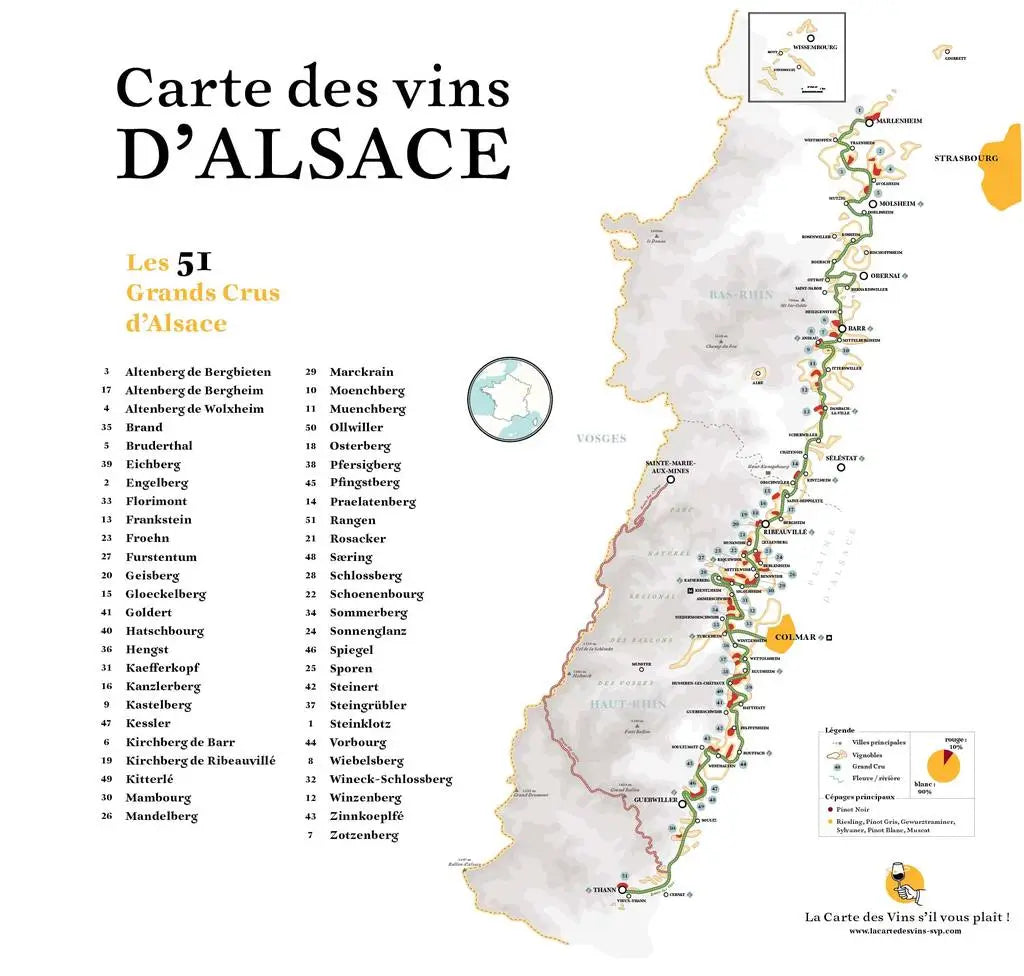
Map of the Alsace Grands Crus
With which dishes should you enjoy the Alsace Grands Crus ?
Wines from the Alsace Grands Crus offer an incredible diversity of profiles (texture, aromas, sweetness, etc.). It is therefore only natural that they pair wonderfully with many gastronomic specialties. Whether it’s seafood, meats, or spicy dishes, these exceptional wines reveal all their complexity when perfectly paired. Here is a brief guide to enhance these Alsatian treasures at the table.
With a Grand Cru Riesling
Generally dry, precise, distinguished, and mineral, Grand Cru Riesling pairs wonderfully with briny flavors. Seafood platters, sushi, or even gratinéed oysters thus find an ideal companion in it. For the more powerful and full-bodied ones, a pairing is also possible with roasted poultry or aged cheeses.

Sushi & Riesling: a subtle and refined pairing
With a Grand Cru Gewurztraminer
With a dry or semi-dry Grand Cru Gewurztraminer, spicy cuisines usually pair well. For example, think of Thai or Indian dishes where the richness of flavors will echo the delicious expressiveness and freshness of the wine.
With a sweet Gewurztraminer, richer dishes will be necessary, such as a lamb tagine with dried fruits or a Moroccan pastilla. The aromatic intensity of this type of wine also makes it ideal with foie gras, whose creaminess it pleasantly balances, as well as with strong cheeses such as Munster or Roquefort, softening their intensity.
With a Grand Cru Pinot Gris
A Grand Cru Pinot Gris, dry and structured, is generally a success when paired with sauced dishes such as veal blanquette, morel risotto, or creamy poultry.
A sweet Pinot Gris will find its place best alongside sweet and savory dishes such as duck à l’orange, poultry tagine with roasted apricots, or caramel pork. Finally, when it reaches even higher levels of sugar concentration, as is the case with Late Harvest wines, Pinot Gris then becomes an exceptional partner for pan-seared foie gras, a fig tart, or desserts with dried fruits.
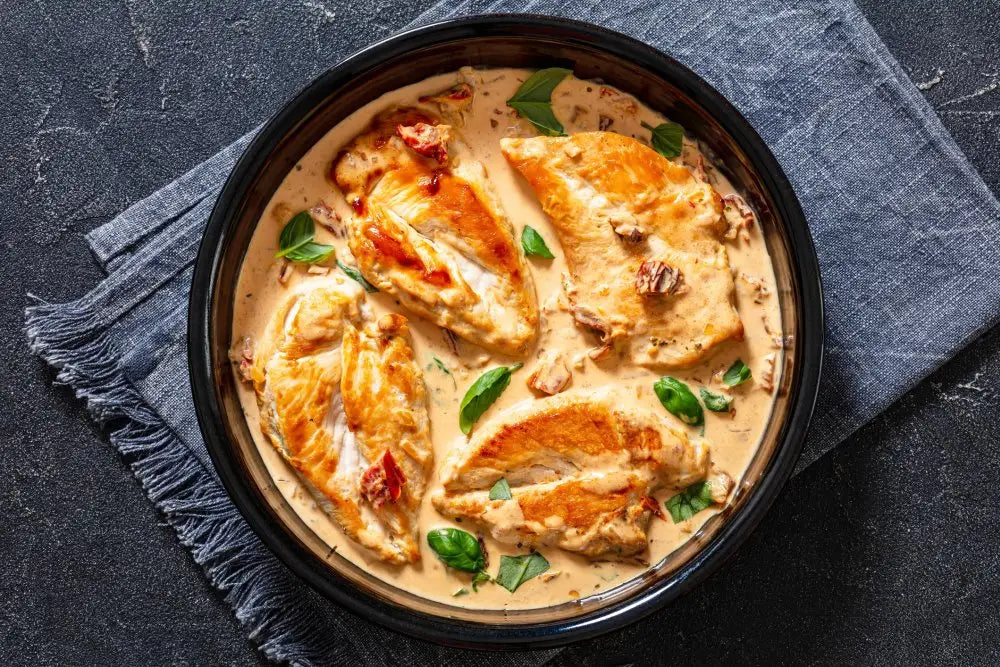
Chicken with creamy sauce, exquisite pairing with an Alsace Pinot Gris
With a Grand Cru Muscat
A Grand Cru Muscat, dry and aromatic, is a wine that lends itself to fresh and springtime pairings. It will therefore perfectly accompany asparagus in all its forms, whether served with mousseline sauce, as a velouté, or in a salad. This type of wine also works very well as an aperitif, with appetizers made from crunchy vegetables or verrines of fresh goat cheese and aromatic herbs.
With a Grand Cru Sylvaner
Subtle and refreshing, the Sylvaner pairs very well with seafood such as oysters, shrimp, and fried calamari. This white grape variety, only authorized and planted on the Grand Cru Zotzenberg, can also be paired with fine charcuterie or a country pâté.
With a Grand Cru Pinot Noir
Elegant and structured, the great Alsace Pinot Noirs pair perfectly with red meats and game, such as duck breast, beef fillet, or a rack of lamb with herbs.This magnificent grape variety also finds its place alongside slow-cooked dishes such as beef bourguignon, coq au vin, or Alsatian baeckeoffe.
There you go, you now have all the keys to organize a magnificent meal with the Grands Crus of Alsace, whether they are white or red, dry or sweet !
The best Alsatian Grands Crus
Are the Grands Crus of Alsace starting to win you over ? Among the myriad of great estates in the region, La Cave Éclairée recommends here some gems you absolutely must discover !
Domaine Barmès-Buecher
Located in Wettolsheim, near Colmar, this family estate was founded in 1985 from the union of the vineyards of Geneviève Buecher and François Barmès. Converted to biodynamics since 1998, the vineyard now covers 18 hectares and is managed by Maxime and Sophie. With a majority of white grape varieties (Riesling, Gewurztraminer, Pinot Gris), planted on a mosaic of Alsatian soils (clay-limestone, marl-sandstone, granite), the Barmès-Buecher estate produces wines of remarkable purity and with excellent aging potential.
Vinification is carried out exclusively with indigenous yeasts and sulfur is reduced to a minimum, ensuring in particular the authentic expression of Grands Crus such as Hengst and Steingrubler, two great terroirs of the Alsace Grand Cru appellation.
Don't miss out on their exceptional cuvées; these are treasures that discerning enthusiasts snap up as soon as they are released!
Domaine Mittnacht Frères
Located in Hunawihr, between Ribeauvillé and Riquewihr, the Mittnacht Frères estate is a vineyard of 11 hectares passionately managed by Marc Mittnacht, his wife Paule, and their son André. A pioneer in biodynamics (certified since 1999), the estate crafts terroir wines of great finesse.
The Rieslings, often characterized by beautiful purity and petrol notes, are accompanied by expressive Gewurztraminers, elegant Sylvaners, and distinguished Pinot Noirs. Here, each vintage is the result of meticulous work in the vineyard and the cellar, ensuring authentic white and red wines. The Grands Crus Rosacker and Osterberg are the estate's great terroirs.
Domaines Schlumberger
The Domaines Schlumberger represent one of the essential benchmarks of Alsatian viticulture. Deeply rooted in and around the village of Guebwiller, this family estate has, for several generations, enhanced the Alsatian terroirs through demanding and respectful viticulture, notably within the Grands Crus Saering, Kitterlé, Kessler, and Spiegel.
The vines are managed with a constant focus on quality and soil expression: adapted pruning, measured interventions, and rigorously selected harvests allow the grapes to reach optimal maturity. Fermentations are often carried out with natural yeasts, and the aging process is managed to preserve the aromatic purity and finesse of the wines. This approach finds its culmination in their Grands Crus, which express depth, complexity, and minerality, while offering distinct profiles according to the exposure and geological nature of each plot.
You now have a great overview of the Alsace Grands Crus! Whether you prefer Riesling, Gewurztraminer, Pinot Gris, Muscat, or Pinot Noir, you are sure to find what you are looking for in Alsace thanks to the magnificent diversity of this incredible region.
If you need more advice, feel free to discover our selection on La Cave Éclairée and let yourself be charmed by the magic of wines from the Alsace Grand Cru appellation. Cheers !


