

When talking about Tuscany and its vineyards, it is impossible to overlook the Chianti. This historic Italian wine is indeed one of the great classics of the wine world. But do you know what really lies behind this iconic name?
Let's set off together to discover this Italian monument and find out what makes Chianti so unique!
Summary
History of Chianti
Long before Chianti, Tuscany was already a land of vineyards, and this since Antiquity. At the time, the Etruscans were already practicing viticulture there. Then, with the Roman Empire, vine cultivation became widespread throughout Italy: wine then became a central element of the economy and daily life, and was exported throughout the Mediterranean basin.
A few centuries later, in the Middle Ages, the monasteries played a key role in the preservation and dissemination of viticultural know-how. The monks then improved cultivation and winemaking techniques.
The term Chianti appeared for the first time in the 13th century, then referring to a wine region as well as an alliance of villages between Florence and Siena. At the time, the wine produced locally was often a blend of red and white grape varieties.
In 1716, the Grand Duke of Tuscany Cosimo III de' Medici decreed that Chianti production be limited to the area between Florence and Siena: the first Chianti "appellation" was born.
It was not until the 19th century that Chianti took on a more modern form, thanks to figures such as Baron Bettino Ricasoli, politician and winemaker, who codified the Chianti blend: a majority of Sangiovese, complemented by Canaiolo and Malvasia grape varieties, thus establishing the first official "recipe".
In 1967, the Chianti DOC (Denominazione di Origine Controllata, the equivalent of a French AOC), was officially created.At the time, the specifications were quite flexible: yields could be very high and white grape varieties were allowed in the blend (Trebbiano, Malvasia).
From 1984, the Chianti DOCG (Denominazione di Origine Controllata e Garantita) was introduced. This imposed stricter rules on winemakers for the time: yield limitations, a higher proportion of Sangiovese, reinforced quality controls, etc.
Today, the Chianti DOCG covers approximately 15,500 hectares of vineyards, and has 8 complementary denominations: Classico, Colli Senesi, Colli Fiorentini, Colli Aretini, Colline Pisane, Montalbano, Montespertoli, and Rùfina. Each year, around 35 million bottles are produced within the entire appellation. At the heart of the region lies the historic and most prestigious area of the vineyard: Chianti Classico. This area covers 6,800 hectares.
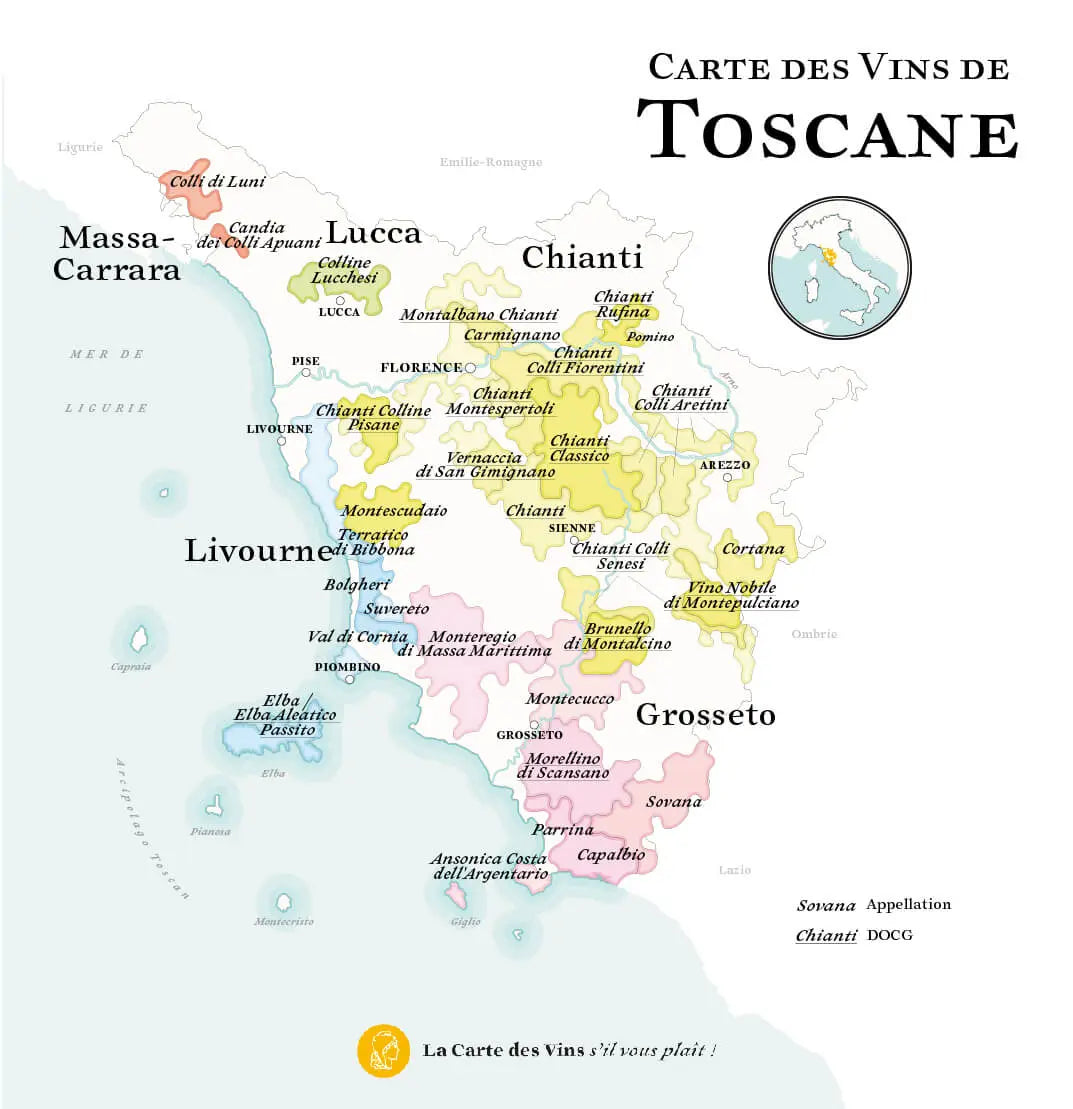
Chianti, at the center of wine production in Tuscany
Soils and climate of the Chianti appellation
The Chianti DOCG stretches over a vast area of 70,000 hectares, within which more than 15,000 hectares of vines are planted. Naturally, the terroirs are therefore very diverse, combining clay-limestone hills, sandy soils, schist, and pebbles.
Within the historic heart of the vineyard (the Chianti Classico area), the terroir is also distinguished by higher hills and soils rich in pebbles, clay, and limestone, as well as optimal sun exposure. These conditions allow Sangiovese, the flagship grape variety of Chianti, to develop more structure and aromatic complexity here than in the other peripheral areas of the appellation.
Finally, the climate of Tuscany is typically Mediterranean, with hot, dry summers and mild winters, promoting regular ripening of the grapes.
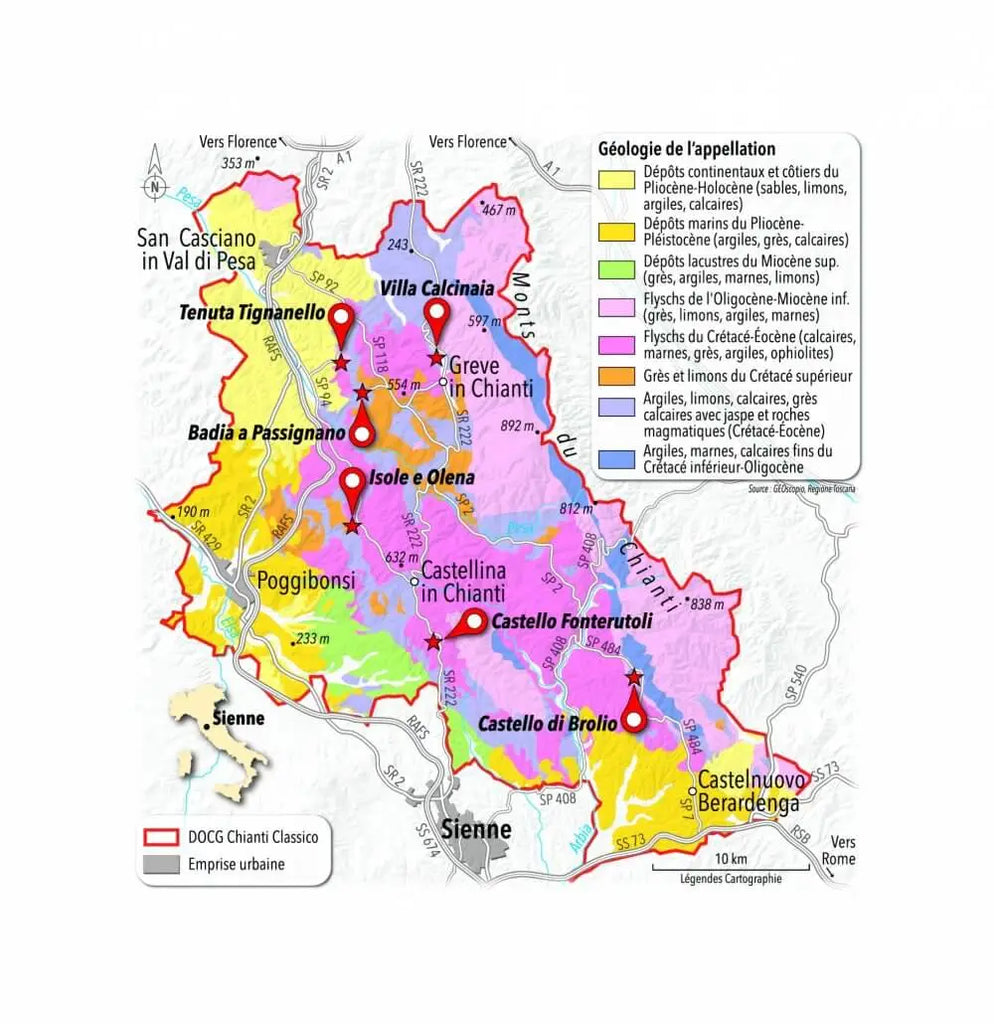
Map of the different terroirs of Chianti Classico
Chianti Classico and the aging indications
Within the vast Chianti DOCG, the quality of the terroirs is not homogeneous. The quality of the wines can therefore also vary greatly depending on the soils, the plant material, or even the winemaker's expertise. In this respect, the historic vineyard area, Chianti Classico, stands out in particular. Furthermore, it is also interesting to understand the aging indications sometimes displayed on the bottles. Here is an overview of the main distinctions to know in order to better select your bottle of Chianti.
Chianti Classico
Located between Florence and Siena, the Chianti Classico DOCG represents the historical birthplace of Chianti. This emblematic area of 6,800 hectares has, as mentioned above, a higher quality terroir compared to other production zones of the appellation. A symbol of the black rooster (Gallo nero) guarantees strict compliance with its specifications: at least 80% Sangiovese, white grape varieties banned since 2006, limited yields, and rigorous quality controls. All these factors allow for the production of higher quality and more structured wines.
For comparison, within the simple Chianti DOCG, Sangiovese must account for at least 70% of the blend, and while the wines can be of good quality, the vast majority tend towards simpler, fruitier, and more accessible profiles. These are wines mainly intended to be enjoyed young!
Chianti Classico Riserva
For Chianti, the mention Riserva indicates a wine that has undergone extended aging, of at least 24 months, with a minimum of 3 months in bottle (compared to a minimum total of 12 months for a Chianti Classico). This additional time allows the wine to gain in structure and aromatic complexity. Chianti Riserva wines are therefore more powerful and better suited for aging than basic Chianti Classico wines.
Chianti Classico Gran Selezione
Since 2013, the designation Gran Selezione has been established at the top of the hierarchy and is reserved for the best cuvées from the estates. The minimum aging period here is 30 months, including at least 3 months in bottle. Sangiovese must also account for at least 90% of the blend (if there is a blend). The result: complex, structured, and elegant wines, with great aging potential.

Chianti DOCG Map
The different styles of Chianti
As you can see, Chianti is therefore plural and many wine styles coexist within the appellation.
Thus, a “basic” Chianti will stand out for its fruity and approachable profile, and will develop aromas of cherry, plum, and violet. The tannins will be supple, making the wines pleasant in their youth. The Sangiovese will often be blended with other varieties such as Canaiolo, Colorino, Merlot, and Cabernet Sauvignon. Sometimes, a small addition of white grape varieties is even made (a practice that is becoming less common).
With a Chianti Classico, a greater complexity appears: characteristic notes of cherry, plum, violet, and sometimes delicately oaked or leathery notes will be present. The tannins will be more pronounced and a “terroir” aspect is also often present. These bottles can improve for several years in the cellar.
With a Chianti Classico Riserva, the difference comes from the extended aging in wood. Thus, beyond the usual aromas of red and black fruits, delicious woody and spicy notes (cinnamon, clove, vanilla, tobacco, etc.) will stand out, adding to the overall complexity. These wines can be kept for many years in the cellar.
Finally, a Chianti Classico Gran Selezione will highlight the Sangiovese even more and will have an intensity, complexity, finesse, and aromatic depth that is even more remarkable. The tertiary aromas (leather, undergrowth, balsamic) will also be much more pronounced. Here too, long aging in the cellar is possible.
What to eat with a Chianti?
Chianti proves to be particularly versatile at the table... but the pairings depend above all on the chosen style.
Thus, a light and fruity Chianti will pair perfectly with simple dishes such as pizzas and cold cuts, offering freshness and liveliness to balance the flavors.
With a Chianti Classico, which is more structured and elegant, roasted meats, grilled dishes, stews, and aged cheeses will be preferable. The fine tannins and complex fruitiness of this type of wine will indeed enhance the flavors of these dishes without overpowering them.
With a Chianti Riserva or a Chianti Gran Selezione, slow-cooked dishes, game, red meats in sauce or even hard cheeses will be the best choices.
Finally, we recommend serving your Chianti at a temperature between 16 and 18°C to fully enjoy its aromatic richness, without masking its flavors.
Enjoy your meal!
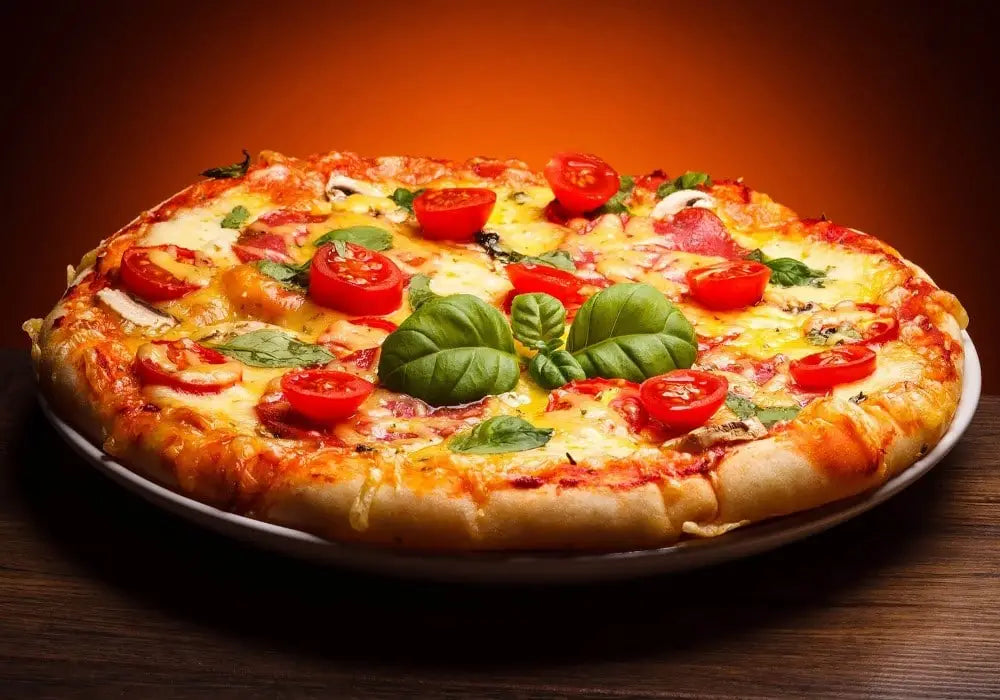
Pizza and fruity Chianti: guaranteed Italian flavors!
The best Chianti
Several historic estates have shaped the reputation of Chianti, such as Barone Ricasoli estate, a pioneer in codifying Chianti in the 19th century, as well as Castello di Ama, and the Fèlsina estate, both producing Chianti Classico and Riserva of the highest quality.
Nevertheless, La Cave Éclairée would like to invite you to discover the best of Chianti through the Ruffino estate. A key reference in the region, it was founded in 1877 and has played a major role in promoting Chianti around the world. The family business was thus one of the first to market quality Chianti on foreign markets, notably in the United States and the United Kingdom, helping to raise awareness of the Sangiovese grape variety as well as the Tuscan terroir beyond Italian borders.
We invite you here to take a closer look at their cuvée Chianti Classico Riserva Ducale Oro Gran Selezione. Created in 1947 as a tribute to the Duke of Aosta, this cuvée, composed predominantly of Sangiovese, benefits from 36 months of aging carried out in concrete vats as well as oak barrels and casks, and is produced only in the best vintages.This is a great Italian wine that captivates with its finesse and elegant aromas of cherry, plum, leather, and spices (pepper, cinnamon, licorice). After a few years of aging, sublime tertiary notes also appear. An iconic wine to enjoy now or to keep in the cellar!
As you will have understood, Chianti is much more than just a simple Italian red wine: it is a true institution, reflecting the Tuscan terroir and the history of Italian winemaking. Thus, whether it is a light and fruity Chianti chosen to accompany simple meals, an elegant Chianti Classico, a structured Riserva, or a complex and refined Gran Selezione, this wonderful appellation offers choices for every price point and every moment in life.See you soon and visit your favorite online wine merchant to perfect your selection of Italian wines!


