

The Arbois AOC is one of the oldest appellations in France. Located in the north of the Jura vineyard, it offers an incredible diversity of wines, ranging from dry whites to the famous vin jaune, as well as elegant reds.
If you are a lover of terroir wines, let yourself be transported to higher altitudes for an exciting journey through all the secrets of this appellation. Enjoy your reading and happy discoveries!
Summary
History and Origins of the Arbois AOC
The first traces of vine cultivation in the Jura date back to Roman times. The limestone soils and well-exposed slopes quickly made this region a prime location for wine production. The name Arbois is also said to come from the Latin Arbores vicus, meaning "village surrounded by trees", thus highlighting the region's natural wealth.
During the Middle Ages, viticulture in Arbois intensified thanks to the influence of the monasteries. The monks developed the vineyards and perfected production techniques. In medieval society, wine became an essential beverage, both for lords and peasants. The town of Arbois developed around its vineyards, and the local wine began to gain a certain reputation.
During the Renaissance, trade intensified, and Arbois wine grew in popularity beyond the borders of Franche-Comté. Production methods continued to improve, and Arbois wine was appreciated by the elites of the time, including at the court of the Dukes of Burgundy. Henri IV (1553-1610), despite his bloody history with the town of Arbois, is even said to have declared: "If I were not King of France, I would want to be Lord of Arbois".
At the end of the 19th century, the vineyard's momentum was interrupted by the phylloxera crisis, a devastating disease that ravaged European vines on a vast scale. However, thanks to the determination of local winegrowers, the vineyard gradually revived over the following decades.
In 1936, Arbois officially obtained its status as Appellation d'Origine Contrôlée (AOC), alongside Châteauneuf-du-Pape and Cassis. Although often described as the "first AOC in France", this title is more anecdotal, linked to an alphabetical ranking.
Today, the Arbois AOC covers around 850 hectares across 12 communes, the most well-known being Arbois and Pupillin. The vineyard also stands out thanks to its indigenous grape varieties as well as its high-quality production of wines in various colors and styles (white, red, rosé, yellow, etc.).

Henri IV, Epicurean King and Great Lover of Arbois Wines
Climate and Soils of the Arbois AOC
Nestled on the western edge of the Jura massif, the Arbois vineyard stretches across rich and varied lands. Here, the vines sink their roots into impressively deep iridescent marls, with a clay dominance, often mixed with limestone scree. These marly soils extend over west-facing slopes, between 250 and 400 meters in altitude, promoting freshness and a lovely acidity in the wines.
There are also clays enriched with "chailles", siliceous nodules, remnants of the dissolution of certain limestone layers. This unique geological combination offers the vines an ideal environment to draw nutrients and produce wines that are both expressive and full of character.
The Arbois region is also marked by a continental climate with cool oceanic influences. This results in a strong temperature range throughout the year. Summers are hot and humid, while winters can be particularly harsh. Rainfall is high, exceeding 1000 millimeters per year.
The vineyard plots are also naturally protected from the north and east winds by the surrounding cliffs, which gives them a certain climatic stability. The natural drainage of the slopes and the maximization of sunlight on the western slopes also ensure ideal conditions for viticulture, even in a sometimes challenging environment.
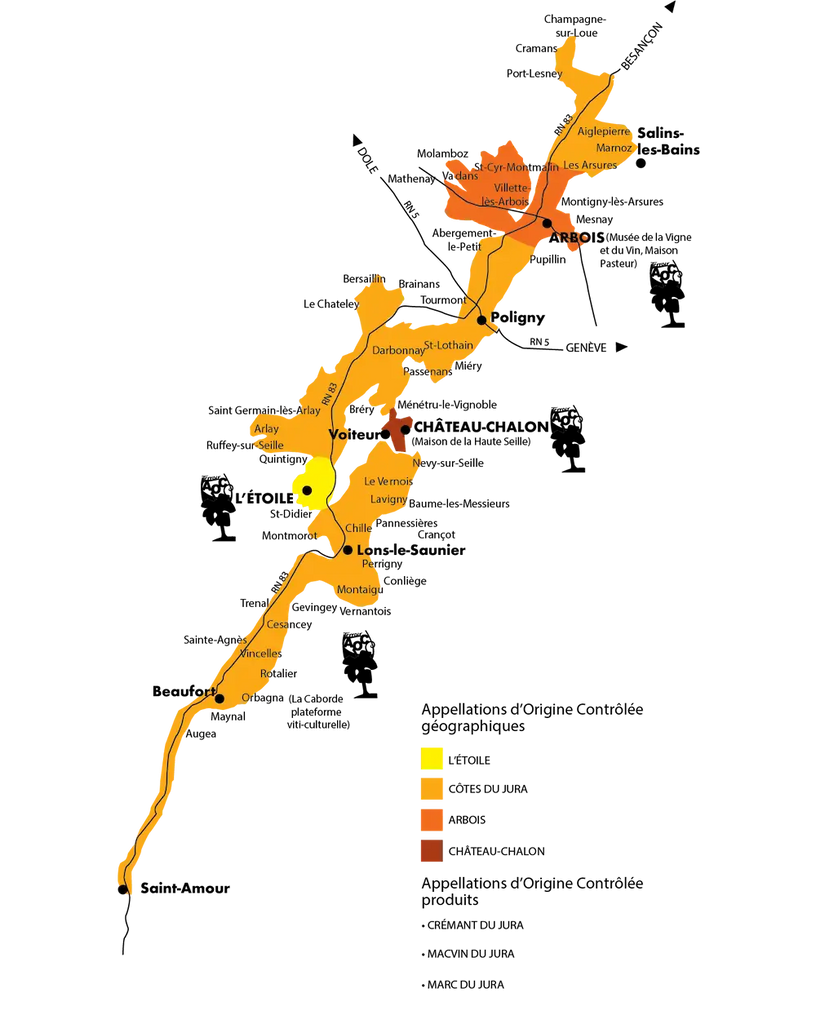
Map of Jura appellations with the Arbois AOC in the north
The wines of the Arbois AOC
The long-awaited moment has finally arrived! It is time to introduce you to the wines of the Arbois AOC ! Whether red, white, yellow, or even vin de paille, each tells a story, reflecting a unique terroir and centuries-old Jura know-how.
The Red Wines of Arbois
The red wines of the Arbois AOC are mainly made from the Trousseau, Poulsard, and Pinot Noir grape varieties and can be produced as single varietals or blends.
Trousseau, an emblematic variety of the Jura region, produces structured and finely tannic wines. With an intense ruby color, wines from this grape often express aromas of ripe red fruits with a touch of spice and have good aging potential, depending, of course, on the terroir and the winemaker's expertise.
Poulsard (or Ploussard locally) produces lighter and more delicate wines distinguished by a pale color. Its aromas of fresh red fruits, such as strawberry and redcurrant, make it a perfect choice for early drinking, generally within 3 to 5 years after bottling.
Finally, Pinot Noir brings a touch of elegance with its finesse and complexity. Wines from this variety also have a paler color and higher acidity than those from Burgundy.
The White Wines of Arbois
The whites of the Arbois AOC are made from the Savagnin and Chardonnay grape varieties (sometimes locally called Melon à queue rouge).
Savagnin, when produced in the topped-up style (classic non-oxidative aging), stands out for its lovely acidity and notes of green apple, white flowers, walnut, and a beautiful minerality. It is a grape variety that generally expresses a lot of personality.
Chardonnay, on the other hand, is often vinified here to preserve its fruitiness and expresses notes of citrus, green apple, and pear. Alternatively, it can benefit from barrel aging, which then gives it more complex aromas, sometimes buttery or slightly nutty.
Once again, these two varieties can be blended by the winemakers or offered as single varietals.
Arbois Vin Jaune
A true Jura gem, vin jaune is a powerful and very complex wine. Its winemaking process involves aging in barrels under a layer of yeast for a minimum of 6 years and 3 months.
Unlike all the other types of wine mentioned above, the aging here is done without topping up, that is, without replenishing the liquid lost to evaporation each year in the barrels (the famous "angels' share"). This unique process allows winemakers to create a controlled oxidation .
This unique expertise gives this wine distinctive aromas of walnut, curry, cinnamon, and almond. Saline and stony notes, due to the typical Jura soils, may also appear, as well as some fruity aromas (green apple, peach, etc.).
Bottled in 62cl clavelins, vin jaune can be kept for decades, and in ideal conditions, it can even reach a longevity of over 100 years!
Note that vin jaune can be produced under the Arbois AOC but also within other Jura appellations such as Côtes-du-Jura, Château-Chalon, and l’Étoile.
Arbois Vin de Paille
Vin de paille can be made from Savagnin, Chardonnay, Poulsard, and Trousseau grape varieties.
The grapes, harvested by hand, are dried on racks, often for several months (at least 6 weeks), in order to concentrate their sugars, acids, and aromas.
The result is a sweet wine with notes of candied fruit, honey, and intense floral aromas.
In good conditions, vin de paille can be kept for many decades.

Grapes dried on racks: the art of making Arbois vin de paille
Other types of wines can also be produced under the Arbois AOC, such as rosés, made from Trousseau, Poulsard, and Pinot Noir grape varieties. These are simple and pleasant wines with light red fruit notes.
Finally, Macvin du Jura (a blend of grape juice and marc) and Crémant du Jura can also be produced within the appellation area. However, these products do not have the Arbois AOC, as their names are already separate appellations.
What to eat with wines from the Arbois AOC?
This is a question that truly deserves your attention! With their unique character and great diversity, the wines of the Arbois appellation lend themselves to a multitude of indulgent pairings that are sure to delight your taste buds.
With the Red Wines of Arbois
The lighter reds of the appellation, especially those made from Pinot Noir or Poulsard, pair divinely well with a fine selection of charcuterie (sausage, rillettes, ham, etc.). Given their low tannins, you can also easily imagine pairing them with cheeses (Saint-Nectaire, fresh goat cheese, Reblochon, etc.) or even vegetarian dishes such as vegetable lasagna.
For the more robust reds of the appellation (Trousseau), opt for white meats (roast chicken, stuffed turkey) or red meats (rib of beef, lamb, etc.).
Note that the reds of the region are generally best enjoyed at a temperature between 14 and 16°C.
With the White Wines of Arbois
With local white wines, how about a beautiful roast poultry or veal in sauce ?
Also consider grilled or baked fish and, for cheese lovers, don't forget to pair Jura whites with goat cheeses or soft cheeses with a bloomy rind such as Comté or Beaufort.
Arbois whites are usually served between 8-10°C for the lighter ones and around 11-13°C for those with more body and structure.
With Arbois Vin Jaune
With its great complexity, vin jaune pairs perfectly with rich dishes, such as Bresse chicken with morels, guaranteeing you a moment of pure gastronomic delight.
Dishes with exotic flavors, such as curries, also pair wonderfully with this wine.
Looking for a cheese pairing? An aged Comté will be the ideal partner to accompany a glass of vin jaune, creating perfect harmony on the palate.
In terms of serving temperature, vin jaune is usually served between 14-16°C to fully appreciate its complexity.

Chicken with morels: a timeless pairing with Jura vin jaune
With Arbois Vin de Paille
To complement the delightful sweetness of a Jura vin de paille, go for pan-fried foie gras, you won't be disappointed !
Of course, fruit-based desserts such as pear tart or tarte tatin will also be divine, as will a fresh fruit salad.
We recommend serving your vin de paille at around 8-10°C to fully enjoy it.
The best wines of the Arbois AOC
The Arbois AOC is home to several wine estates that are well worth a visit. Among them, the Jérôme Arnoux estate stands out without a doubt.
At the head of 17 hectares of vines, Jérôme Arnoux is a leading figure in the Jura, with more than 25 years of experience in winemaking. Formerly in charge of wine production for Château de Chavannes and Caveau de la Reine Jeanne, he has developed an in-depth knowledge of the terroirs of his native region.
Today, Jérôme produces his own wines and offers a unique vision of the Arbois appellation terroirs. The wines produced at this estate are an invitation to savor the Jura in all its forms and to appreciate the expertise of a passionate winemaker. The entire range is highly recommended !
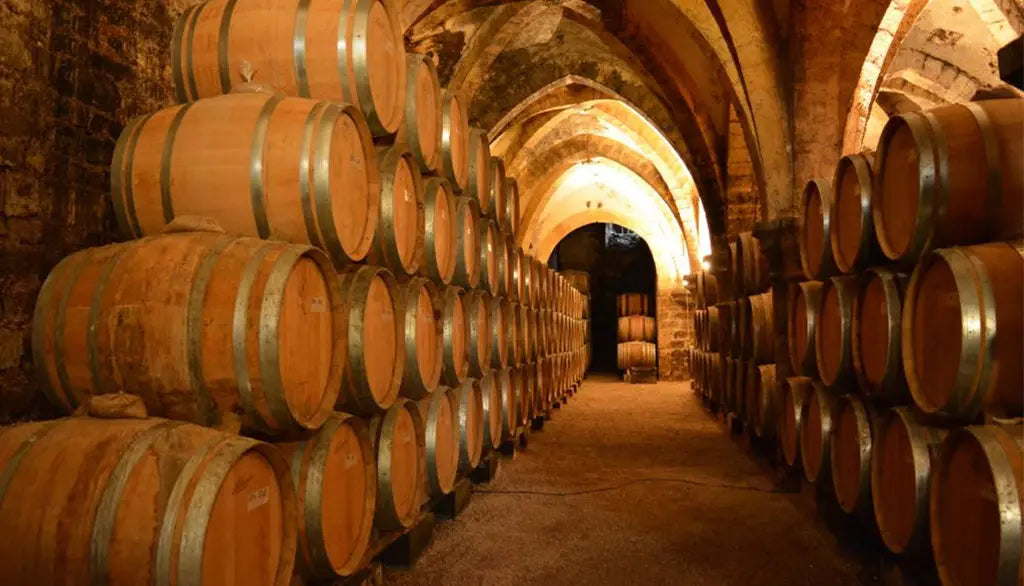
The Cellar of Domaine Jérôme Arnoux, or Cellier des Tiercelines
You are now a true connoisseur of the Arbois AOC and Jura wines! All that remains is to taste these wonderful cuvées to appreciate all the richness of this appellation. So why not take the opportunity to discover our selection of Arbois wines on La Cave Éclairée ? You will find exceptional wines there, carefully selected to accompany your most beautiful tasting moments… Cheers !


