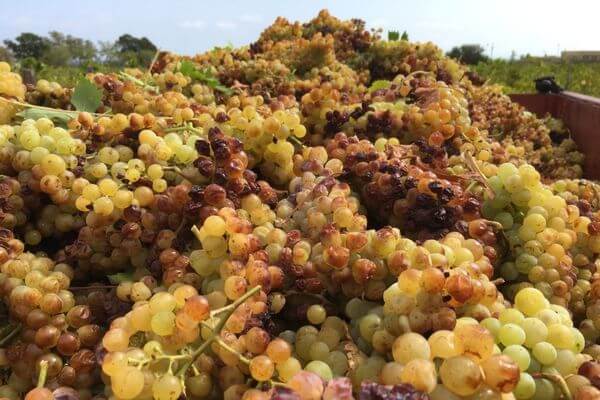
When we talk about Muscat, we often think that it is a single grape variety. In reality,
Muscat is a family of grape varieties comprising
about 200 different varieties, mainly white but also black and rosé! Moreover, while some of these varieties are exclusively dedicated to the table, others are used for the production of wine...and others are just as enjoyable in the glass as they are at the table!
But then, what are the main muscats used to produce wine? What types of wine can it be used to produce? How should they ideally be tasted? Where is it grown?
You will know the answer to all these questions after reading this article!
Origins, growing regions, and varieties of Muscat
The Muscat Blanc à Petits Grains is the first known variety of Muscat. Of Greek origin, it has been cultivated since Antiquity and is believed to have arrived in France under the name Apiena Uva (which translates as "grape attracting bees") thanks to the Romans at the beginning of our era.
Preferring warm climates, it is only natural that it thrives wonderfully well in the Mediterranean basin. Today, there are
7,000 hectares of Muscat in the French vineyard, almost all located within the regions of
Languedoc-Roussillon,
Provence and
Southern Rhône Valley. Worldwide, the Muscat family is present in many countries such as
Italy, Greece, Turkey,
Spain and also Portugal, and covers nearly
45,000 hectares.
Over time, countless varieties of Muscat have developed: Muscat Aviv, Muscat Azos, Muscat Bifère, Muscat Bouschet, etc. Nevertheless, there are 3 main varieties of Muscat used in winemaking:
Muscat Blanc à Petits Grains
As mentioned above, this is the oldest variety. It is also the most widely grown. It is used to produce dry, sparkling, and sweet wines. Its aromatic profile develops into notes of exotic fruits (lychee, mango, pineapple), orange or even rose.
Muscat Blanc d'Alexandrie
Muscat Blanc d'Alexandrie is often used in blends and is mainly used to vinify sweet wines. Its berries are highly aromatic and its aromatic profile develops into notes of peach, pear, mirabelle plum as well as floral aromas.
Muscat Blanc Ottonel
With barely 200 hectares planted in France, it is the least used variety of the three. Essentially found in Alsace, it produces wines that are both dry and sweet (Late Harvest and Selection of Noble Berries). Most of the time, Muscat d'Alsace is a Muscat made from a blend of Muscat Blanc à Petits Grains and Muscat Ottonel. The latter evokes seductive primary aromas of fresh grapes and flowers.
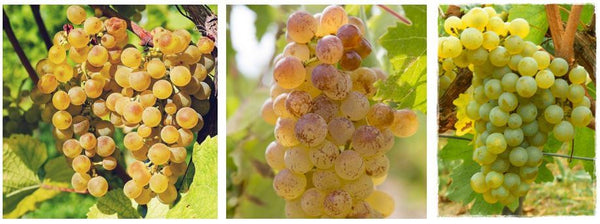
Muscat Blanc d'Alexandrie - Muscat Blanc à Petits Grains - Muscat Ottonel
The brilliant aromatic profile of Muscat
Without a doubt, the success of Muscat is above all due to its rich and exuberant aromatic profile as well as its great versatility.
Indeed, this allows for the production of
dry white wines,
sparkling wines (Clairette de Die, Moscato d'Asti),
orange wines,
sweet wines "classic" but also
Fortified Sweet Wines such as Muscat Beaumes-de-Venise,
Muscat de Rivesaltes, Muscat de Frontignan, or Muscat du Cap-Corse. As a reminder, these latter wines undergo a planned halt in their fermentation thanks to the addition of wine alcohol, allowing for the preservation of the naturally occurring sugars in the final wine.
In any case, all wines from the Muscat family share a similar characteristic: a unique and seductive aromatic profile.
It is indeed relatively easy to blindly identify a bottle made from Muscat because few wines are so aromatic! Fresh grape flavors delicately blend with citrus notes, exotic fruits (lychee, pineapple, mango) as well as floral aromas (rose, linden, jasmine) and sometimes honey. Hard to resist!
Which dishes should be paired with Muscat ?
Since Muscat allows the production of different types of wine, a multitude of food pairings will be possible depending on the style you choose.
Thus, with a dry white Muscat (without residual sugars), one can imagine delicious combinations with asparagus, grilled fish, sushi and sashimi, or even with chicken colombo.
For sparkling Muscats such as Clairette de Die or Moscato d'Asti, pairings with a fresh fruit salad or a fruit tart (apples, pears, strawberries, etc.) will be very successful. You can also imagine a combination with sweet and savory cuisine such as scallops with mango or even a ceviche.
An orange wine made from Muscat will pair divinely well with goat cheeses of varying degrees of maturity, Comté, Abondance, or even Mimolette. Poultry as well as sweet and savory dishes such as duck à l'orange will also be excellent choices with this type of wine.
Finally, for "classic" sweet wines and Vins Doux Naturels, one can easily imagine foie gras, blue-veined cheeses (Bleu, Roquefort), or fruit-based desserts.
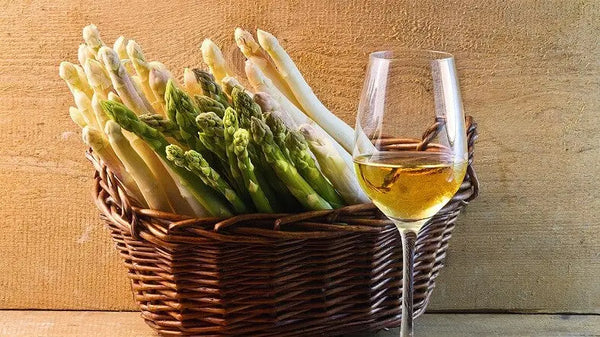
Dry white Muscat and asparagus, a successful pairing
Ideally tasting a Muscat (temperature and storage)
In order to ideally taste your Muscat, you will once again need to take its style into account.
Thus, for a dry white Muscat, a serving temperature between 8 and 10°C will be ideal to reveal all its fruity aromas while enjoying a beautiful freshness. Moreover, it is preferable to enjoy this type of wine in its youth (within the first 5 years) in order to make the most of its vibrant fruity and floral flavors.
Regarding sparkling Muscats, a temperature of 6-8°C will be perfect to enjoy all the freshness these indulgentbubbles offer. Just like for dry white Muscats, fairly quick consumption should be considered here.
For an orange wine made from Muscat, and due to the presence of light tannins, a slightly higher serving temperature will be preferable. Thus, a serving range between 12 and 14°C will be perfect. In terms of aging potential, this type of wine is also best enjoyed in its youth.
Finally, for Muscat-based sweet fortified wines, the ideal temperature will be between 8-10°C in order to balance the significant sugar content.This type of wine can be consumed young to enjoy very intense fruity aromas, but it can also be kept for 10 years or more. In this case, the aromas will evolve towards flavors of orange and candied fruits.
What are the best Muscats ?
Although it is complex to provide you with a list of the best Muscats, La Cave Éclairée offers you a selection of this grape variety from the
Domaine des Schistes.Don't hesitate to discover it, guaranteed pleasure!
All you have to do now is
combine practice with theory and pour yourself a glass! Of course, if you need any advice,
La Cave Éclairée we remain at your full disposal... cheers!
Late harvest Muscat from Corsica