

Imagine a wine with golden highlights awakening all your senses at first glance. As it glides over your palate, this fabulous nectar transports you with its captivating aromas, evoking candied fruits, honey, or even vanilla. You are not dreaming, welcome to the wonderful world of Sauternes!
Here, each bottle embodies centuries of passion, tradition, and unparalleled expertise. Curious to discover this exceptional wine and appellation? Join us on a journey to the heart of Bordeaux !
Summary
History of the Sauternes AOC
The winegrowing history of the Sauternes region begins as early as Antiquity, a period during which the first vines in the region were planted by the Romans. However, sweet wines were not yet intentionally produced at that time. Winemaking techniques were not as advanced, and sweetness in wine was accidental, resulting from overripe grapes left on the vine.
In the Middle Ages, and with the conquest of Aquitaine by the English in the 12th century, the trade of Bordeaux wines exploded. At the time, it was mainly clairet, a light, pale red wine, that was consumed.
From the end of the 16th century and the beginning of the 17th century, the Barsac provostship, including the current communes of the Sauternes AOC, gained in reputation. It was also during this period that most of the current estates were created.
As early as 1741, it is officially documented that the harvest in Sauternes is done "when the grapes are almost rotten" and is carried out "several times to increase their sweetness." In the 19th century, these practices became widespread across all properties and the sweet wine of Sauternes gained popularity throughout Europe. This success led to the famous 1855 Bordeaux wine classification, established by Bordeaux brokers for the Universal Exhibition, at the initiative of Emperor Napoleon III... but we will come back to this !
In 1936, the Sauternes Appellation d’Origine Contrôlée (AOC) was officially created, thus protecting its name and unique production methods.
Today, the Sauternes vineyard covers 1 900 hectares and more than 120 estates, spread over the communes of Barsac, Sauternes, Bommes, Fargues, and Preignac. Its sweet wines are appreciated by enthusiasts for their great aromatic richness as well as their superb aging potential.
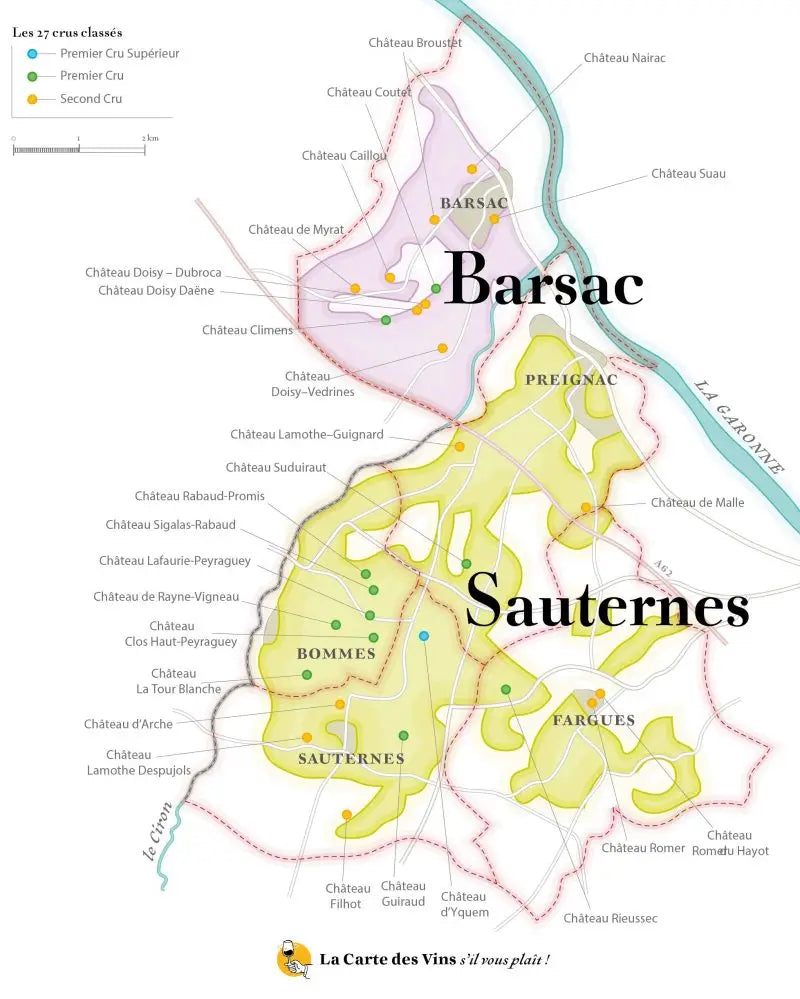 Map of the Sauternes and Barsac vineyards
Soils, Climate and Botrytis Cinerea
Let’s now talk about terroir and climate ! The soils of Sauternes are quite varied and present a combination of gravelly, clay-limestone, and sandy soils, each playing a specific role in the ripening and concentration of the grapes.
The gravelly soils have the ability to store the sun’s heat during the day, then release it at night, thus promoting optimal ripening of the grapes.
The clay-limestone soils, more present at depth, retain water well, which is very beneficial for the vines during periods of drought.
Finally, sands and silts are sometimes found on the surface and allow good drainage, thus limiting the risk of grey rot and promoting the concentration of aromas.
This richness of terroirs, combined with the characteristic influences of the oceanic climate of Bordeaux, allows the production of sweet wines with rich and varied aromatic profiles each vintage. A unique microclimate also exists in Sauternes.
Indeed, in autumn, when the cool waters of the Cirion river meet the warmer waters of the Garonne, a mist phenomenon occurs. These mists, often in the morning and combined with sunnier afternoons, thus promote the development of noble rot (Botrytis cinerea) on the grapes. This microscopic fungus then slightly cracks the berries, promoting the evaporation of water as well as a concentration of sugars, acids, and aromas. It is therefore essential and an integral part of the Sauternes terroir !
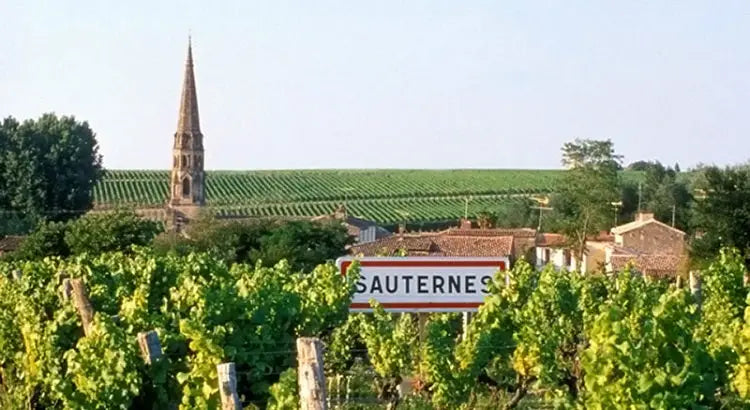
Vineyard within the Sauternes AOC
The Grands Crus Classés of Sauternes & Barsac
The 27 Grands Crus Classés of Sauternes & Barsac are the most prestigious wine estates of these appellations. They were distinguished in 1855 during the Bordeaux wine classification, at the initiative of Emperor Napoleon III for the Paris Universal Exhibition. While this hierarchy mainly included red wines from the Médoc, the estates of Sauternes and Barsac were also included in a separate category.
These renowned châteaux are famous for the exceptional quality of their wines and are divided into three levels : Premier Cru Classé, Deuxième Cru Classé and Troisième Cru Classé.
The “ Premier Cru Classé ” category includes a single and unique estate: the world-famous Château d’Yquem. This estate, at the top of the appellation, stands proudly and produces year after year unique nectars sought after by enthusiasts worldwide.
The Deuxièmes Grands Crus Classés are 11 in number and include several great names such as Châteaux Suduiraut, Climens, Rieussec, and Sigalas-Rabaud.
Finally, the Troisièmes Grands Crus Classés are 15 and also include very prestigious names such as Châteaux Doisy Daëne, Nairac, and Caillou.
The sweet wines of the Sauternes AOC
The sweet wines of the Sauternes AOC are exclusively produced from four grape varieties: Sémillon, Sauvignon Blanc, Sauvignon Gris, and Muscadelle.
Sémillon, largely dominant in the region, is ideal for sweet wines as it is particularly sensitive to Botrytis. It forms the basis of many Sauternes blends and brings roundness, low acidity, and aromas of apricot, peach, pear, and honey.
Sauvignon Blanc very often completes the blend and is highly valued by winemakers for its high acidity and aromas of citrus, peach, exotic fruits and white flowers.
Finally, Muscadelle and Sauvignon Gris are much rarer but also contribute to the aromatic profile when present.
In Sauternes, the harvest is also a very meticulous process requiring skilled pickers : the berries are harvested in several passes (successive selections) to pick them at ideal ripeness. Depending on the vintage, between 30% and 80% of the harvest is generally affected by botrytis.
On tasting, the Sauternes crus stand out for their captivating flavors. On the nose and palate, an incomparable aromatic palette emerges: dried apricot, roasted peach, currants, gingerbread, marmalade, honey, flowers, beeswax, butter, vanilla, and oriental spices are just some of the notes you can enjoy.
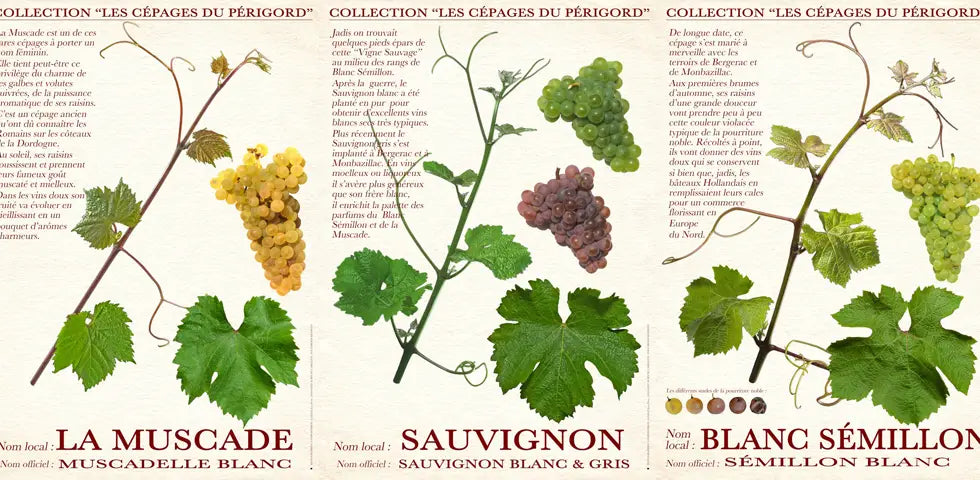
The Grape Varieties of the Sweet Wines of the Sauternes AOC
What to eat with a sweet wine from the Sauternes AOC?
Traditionally enjoyed with dessert, Sauternes has many surprises in store and pairs with a wide variety of dishes. This nectar indeed offers pairing possibilities that are sweet, savory, and even spicy ! Here are a few examples to whet your appetite…
- Foie gras: this is the iconic pairing! The creamy texture and richness of foie gras harmonize with the sweetness and fruity aromas of Sauternes, creating an exquisite combination.
- Blue-veined cheeses: Blue or Roquefort, these cheeses reveal intense nuances alongside Sauternes, playing on a sweet-salty contrast that enhances both the wine and the cheese.
- Poultry and shellfish: roast duck with orange, crayfish tail gratin, or lobster will pair deliciously with the roundness and fruity notes of our sweet wine, for a combination as subtle as it is original.
- Desserts: fruit tart, crème brûlée, or citrus pastries enhance the aromas of candied fruit and honey, ending the meal beautifully.
And above all, don’t forget ! Sauternes is a wine that is best enjoyed chilled, at a serving temperature between 8 and 10°C, so that its complex aromas and sweetness can fully unfold on the palate.
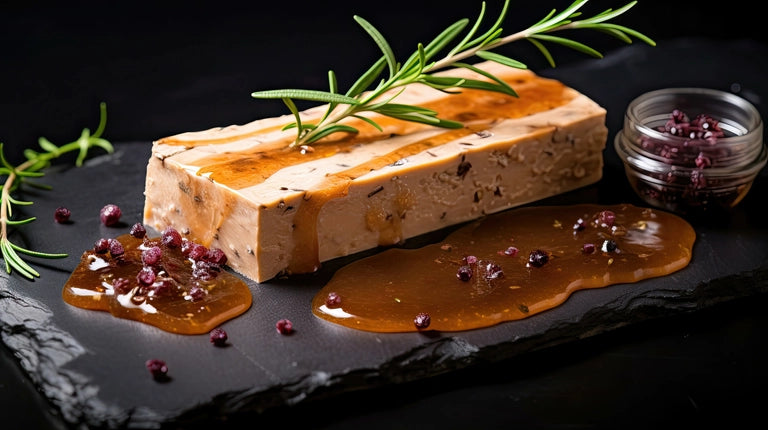
Foie gras and Sauternes: a classic and timeless pairing
The best wines of the Sauternes AOC
The Sauternes region offers an incredible diversity of styles and flavors. Among the high-quality estates, we highly recommend Château Haut Bergeron. This estate stands out for the finesse and complexity of its cuvées.
Managed by the Lamothe family since 1756, the 47 hectares of the estate include a large proportion of old vines and have as illustrious neighbors the vineyards of Châteaux d'Yquem and Suduiraut. Don’t hesitate to try their gems without any hesitation !
As you will have understood, Sauternes is much more than just a sweet wine. The region offers a true sensory experience, where each sip transports you to a unique terroir and expertise. If this article has made you want to know more, feel free to visit our website La Cave Éclairée to explore our selection and learn more about this fascinating world of wine.
So, ready to taste the best of sweet wines?


