

Are you a fan of full-bodied red wine? Then Brouilly may well become your new favorite! With its fruity freshness and legendary finesse, this iconic Beaujolais cru invites you to discover cuvées that are both elegant and full of life.
In this article, we will take you through the secrets of the Brouilly AOC: from its fascinating history, to the perfect food pairings with its wines, and its best estates, you will learn everything!
Summary
History of the Brouilly AOC
The history of Brouilly dates back to Roman times, a period when viticulture began to take root in what would become an exceptional terroir. The term "Brouilly" is thought to originate from the name "Brulius", a Roman army lieutenant who is said to have established a vineyard in the region during the conquest of Gaul.
Then, after the fall of the Roman Empire, the Benedictine and Cistercian monks played a major role in the development of viticulture in the Beaujolais region. In the Middle Ages, the lands of the region, including those of Brouilly, were indeed under the influence of local abbeys and lordships, which encouraged wine production.
In this respect, the seigneury of Beaujeu played a very important role in the development of the vineyard during the Middle Ages and the Renaissance, a period during which Brouilly wines began to gain recognition beyond regional borders.
This golden age lasted until the end of the 19th century, a time when Brouilly was hit by multiple crises such as powdery mildew and phylloxera. This pest, which came from America and is similar to an aphid, endangered production for several decades before a definitive solution was found: grafting local vines onto American rootstocks resistant to this pest.
A few decades later, in 1938, the Brouilly AOC was officially created, establishing the appellation as the southernmost and largest of the Beaujolais crus.
Today, Brouilly remains true to its heritage, while adopting modern and sustainable practices. With more than 1,200 hectares of vines, the appellation remains the largest in Beaujolais and is, of course, exclusively planted with the Gamay grape variety.
Let us now analyze the terroirs and climate of the appellation.
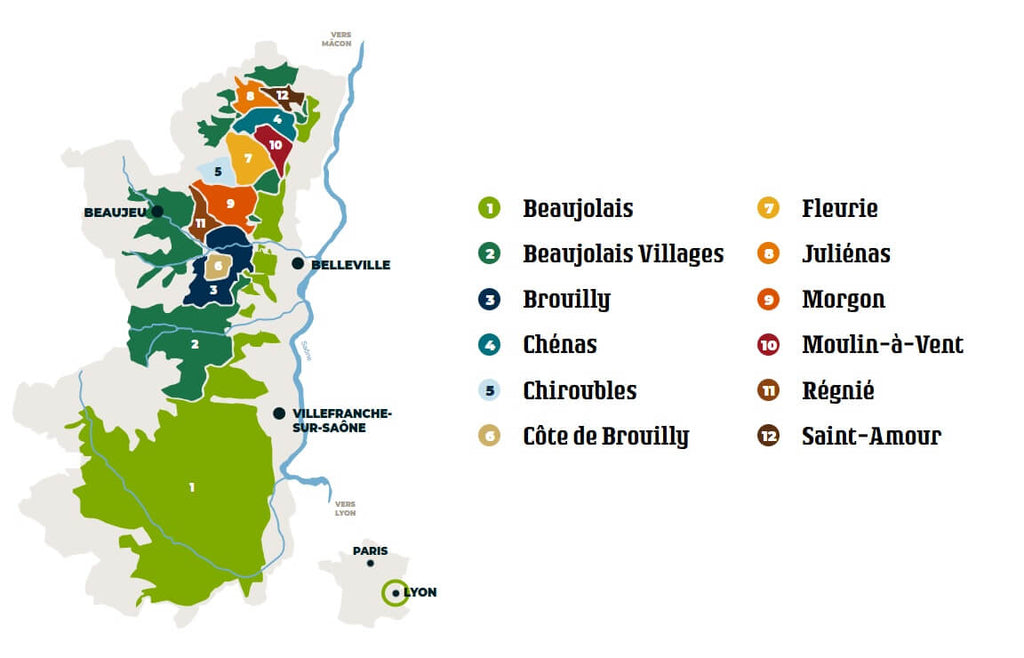
Map of the Beaujolais appellations
Soils and climate of the Brouilly appellation
The Brouilly appellation extends around Mont Brouilly, in the heart of the Beaujolais vineyards. It is one of the ten iconic crus of this region, alongside Saint-Amour AOC, Chénas, Juliénas, Moulin-à-Vent, Chiroubles, Fleurie, Morgon, Régnié and Côte de Brouilly.
What makes Brouilly so unique is above all the richness and diversity of its soils.
Pink granite makes up the majority of the AOC’s terroirs and covers nearly 47% of its territory, mainly in the northern and central half of the AOC. These are poor and well-drained soils, ideal for the Gamay grape.
The foothills, with about 34% of the AOC’s area, are another important soil type for Brouilly. These are gently sloping hillsides, located between the highest parts (granites of Mont Brouilly) and the plains. The soil here is a mix of decomposed granite, sand, and silt, with occasional deposits from the erosion of the upper slopes.
Other more minor soils also exist within the AOP, such as colluvium (about 9% of the terroir). Located at the bottom of slopes, these are deposits of sediment and rock fragments from the erosion of the upper granite slopes.
Finally, there are also smaller areas with sedimentary rocks (5%), blue stones - metamorphic rocks - (4%), or even clays (1%).
As for the climate, Beaujolais benefits from a clever mix of influences. Mainly semi-continental, the southern location of the Brouilly vineyard also brings oceanic and Mediterranean touches. This combination ensures the vines enjoy mild springs, hot summers, and autumns conducive to optimal grape ripening.
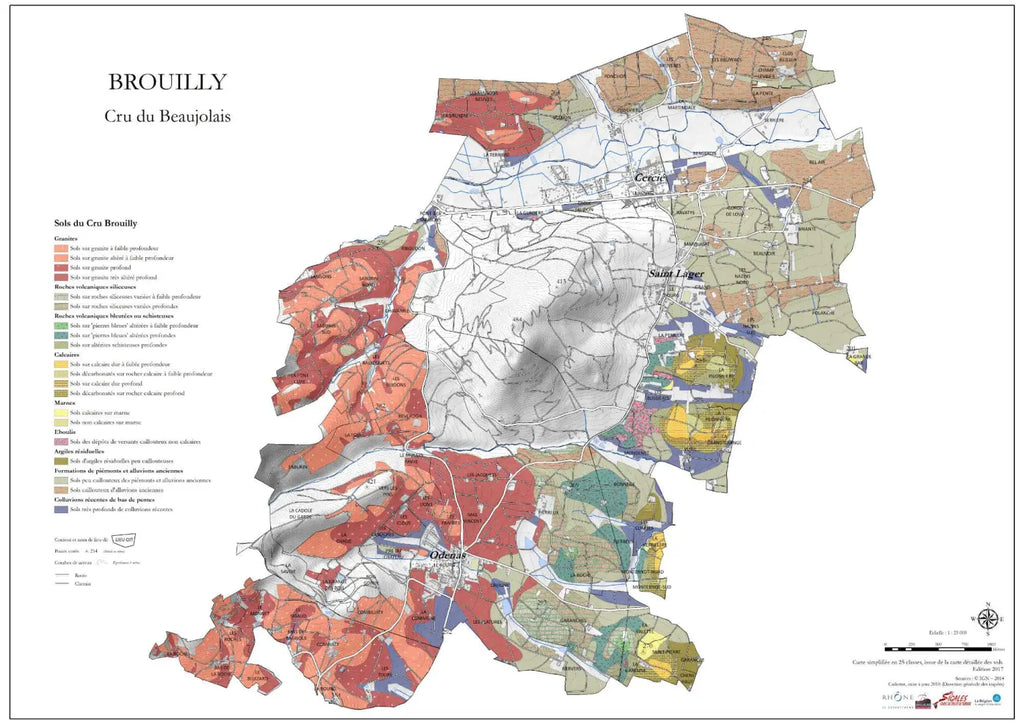
Soil map of the Brouilly appellation
The wines of the Brouilly appellation
Made exclusively from the Gamay Noir grape variety, the wines of the Brouilly AOC are full-bodied reds. Typical of Beaujolais, this grape is appreciated for its freshness, supple character, and intense fruity aromas. Gamay is a thin-skinned variety, producing mostly light wines, but with great expressiveness.
The wines of Brouilly are thus characterized by their vivid fruitiness. Expect an explosion of fresh red fruit flavors, such as strawberry, raspberry, or cherry, giving a indulgente touch on the palate.
On the palate, this Lyon wine also stands out for its lightness and finesse. Brouilly red wines are often described as supple, offering a silky texture and a well-balanced palate. Their freshness makes them perfect for young consumption, although many bottles can also improve with age.
However, be aware that this very general description does not hide the great diversity of cuvées within the appellation, thanks in particular to very different terroirs, as well as the passion and know-how of local winemakers. There is not just one Brouilly, but many!
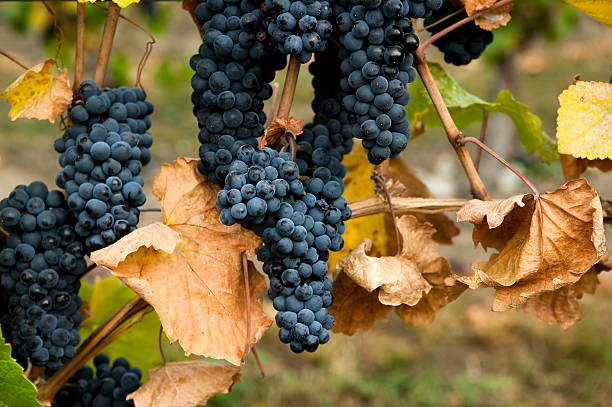
The wines of Brouilly draw their essence from the Gamay Noir grape variety
What to eat with a wine from the Brouilly AOC?
Now that you have a good overview of the typical characteristics of wines from the Brouilly appellation, it is time to move on to food pairings! With its light tannic structure and natural freshness, Brouilly lends itself to a multitude of gastronomic combinations. Here are some suggestions to enhance your meals with this delicious Beaujolais red wine.
- White meats and poultry : your Brouilly Gamay will pair wonderfully with a roast chicken, a tender turkey, or calf’s liver ! Its supple and fruity structure will perfectly complement the delicacy of these white meats.
- Pasta dishes: a classic! Homemade lasagna or spaghetti bolognese are also perfect companions for a Brouilly. The fruity aromas of the latter pleasantly accompany the sauces, creating a beautiful harmony on the palate.
- Lyonnaise charcuterie: impossible to miss the region’s must-haves. Rosettes, sausages, and any other local charcuterie pair perfectly with indulgentise with this Lyon wine. A 100% indulgent aperitif to enjoy with friends or family!
- Cheeses: Brouilly also stands out for its ability to enhance creamy or soft cheeses, such as a fresh goat cheese or a Brie. With their melting texture and mild flavors, these pair perfectly with the finesse of this Lyon red wine.
Tip: to bring out all its qualities, serve your Brouilly slightly chilled, between 14-16°C. This temperature will allow your wine to reveal all its freshness and balance!
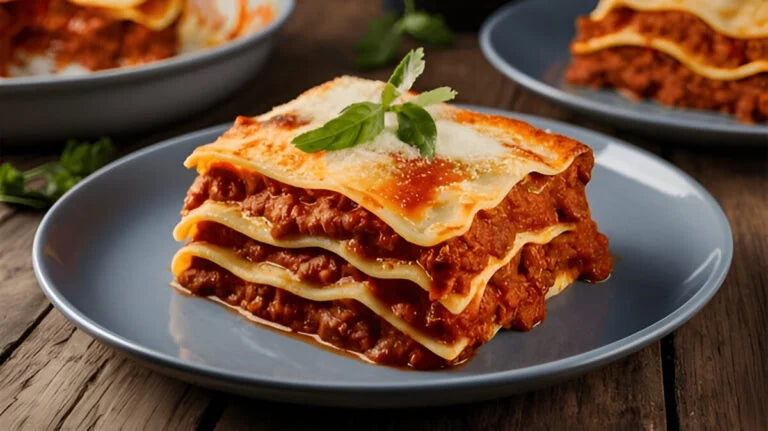
Brouilly and homemade lasagna: a classic but always irresistible pairing
The best wines of the Brouilly AOC
You are surely wondering where to find the best wines of the Brouilly AOC? The good news is that this appellation is full of interesting estates. If you are looking for a must-try reference and excellent value for money, La Cave Éclairée warmly recommends the Brouilly from Domaine Coudert.
A winemaker since 1967, the Coudert family is a reference in the Beaujolais region. Since 1984, Alain Coudert has taken over the dreams of the estate, thus perpetuating the family heritage. The family vineyard covers 14 hectares, and although most of the production is on the Fleurie appellation with the Clos de la Roilette estate, a few hectares are also dedicated to the Brouilly AOC, allowing them to offer a wine of great finesse.
In terms of winemaking, Alain favors the traditional method and skillfully ages his wines, preferring maturation in old foudres, thus giving the cuvées a beautiful texture and lovely aromatic depth. Their Brouilly is also characterized by a beautiful expression of the terroir, with fruity aromas and a supple structure. In short, go for it without hesitation!
You are now a true connoisseur of the Brouilly appellation. To extend your experience and deepen your knowledge of the wines of this magnificent Beaujolais appellation, we now invite you to visit our website La Cave Éclairée, where you will find a carefully selected range of refined crus from the region... and beyond!
Feel free to share your feedback with us and see you soon for more tastings!


1 comment
Une coquille s’est glissée dans votre texte de présentation du Brouilly : “Cette période d’or durera jusqu’à la fin du XIXe siècle, moment DURENT lequel Brouilly fut frappé (…)”, à votre service, et merci à vous pour les éclaircissements à propos du Brouilly !
Cordialement,