

Have you ever heard of Barolo ? This great Italian wine, source of national pride, comes from the hills of Piedmont where it is sometimes called “the king of wines, wine of kings". Behind this prestigious title lies a rich history, an exceptional terroir, and an iconic grape variety: the Nebbiolo.
Ready to learn more? Let’s embark together on a delicious journey to the heart of the Barolo appellation!
Summary
History of the Barolo appellation
The history of Barolo began long before it became one of the most famous Italian wines in the world. In the Middle Ages, in the hills of Piedmont, the monks were already cultivating Nebbiolo and harvesting it late due to its slow ripening. At that time, it produced sweet wines that were very different from the Barolos we know today.
However, the real turning point came in the 19th century. It is indeed during this period that the history of modern Barolo truly begins, thanks to the vision of Camillo Benso, Count of Cavour. Passionate about viticulture, he called upon the French oenologist Louis Oudart. Thanks to their work on hygiene, fermentation, and barrel aging, they greatly contributed to the transformation of Barolo into a dry, structured, and age-worthy red wine.
This "modern" Barolo quickly won over the Turin nobility as well as the House of Savoy. The wines of this era, already considered exceptional products, were served at grand occasions and became symbols of prestige and refinement.
During the 20th century, Barolo continued to establish itself as one of the jewels of Italian wine. In 1980, it officially received its designation, the Barolo DOCG (Denominazione di Origine Controllata e Garantita), a recognition that placed it at the top of the Italian wine hierarchy.
Today, Barolo continues to fascinate wine enthusiasts. Its vineyard covers more than 1,700 hectares exclusively dedicated to Nebbiolo, and each bottle produced reflects a deep heritage, combining tradition, terroir, and the expertise of Piedmont’s producers.
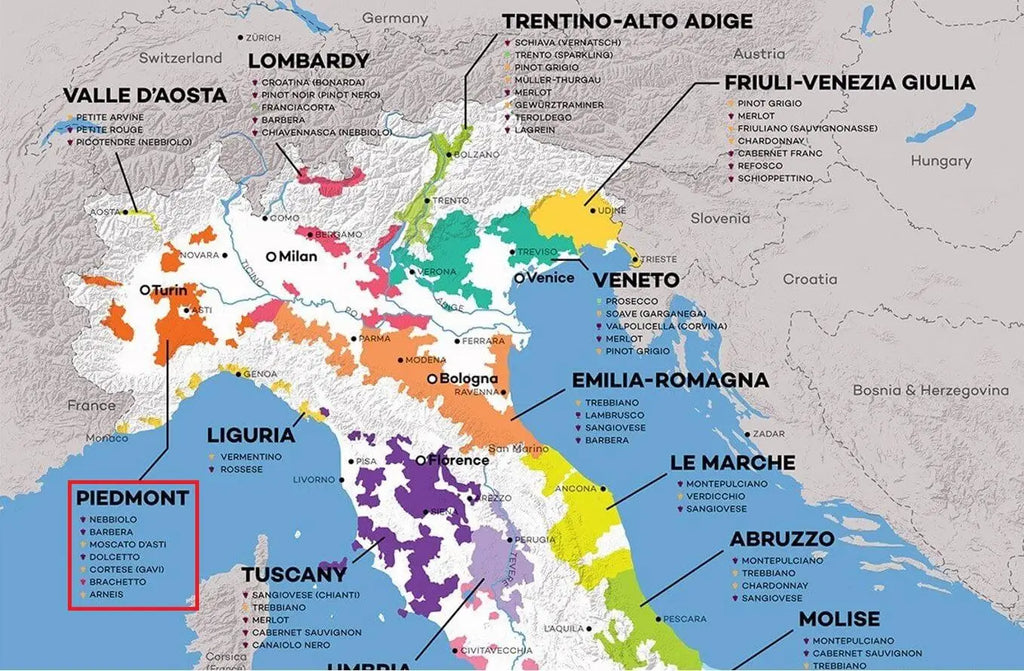
Wine map of Italy, focus on Piedmont
Piedmont: ideal climatic conditions for Nebbiolo
The secret of Barolo lies first and foremost in its grape variety, the Nebbiolo. This grape is, however, particularly temperamental to produce, ripens slowly, and requires constant attention from the winegrowers. Nevertheless, this patience is rewarded when it is cultivated with care. The grapes then develop intense aromas of red fruits, flowers, and sometimes even truffle or licorice, making Barolo a great wine of character appreciated worldwide.
The unique terroir of its adopted region, Piedmont, is also a key element in the quality of Barolo wines. The hills surrounding Alba, a village at the heart of the appellation, indeed offer rich and varied soils composed of a mixture of limestone, clay, and marl. This combination creates a perfect environment for Nebbiolo, which expresses itself here with great aromatic complexity. Each plot subtly influences the taste of the wine, making each bottle a unique product.
Finally, the continental climate of Piedmont also plays a key role. Summers here are hot and sunny, allowing for full maturation of the Nebbiolo, while cold winters slow the vegetative cycle and preserve the freshness of the grapes. The variations in altitude and exposure add an extra richness to the wines, and the presence of fog, emblematic of the Langhe hills, also plays a decisive role in the late ripening of Nebbiolo. This climatic phenomenon indeed contributes to the tannic finesse, complexity, and the great aging potential of Barolo.

Map of the Barolo DOCG and its 11 communal MGAs
Traditional Barolo vs. Modern Barolo
Barolo, the king of Italian wines, is mainly expressed in two major styles, reflecting the choices and traditions of local winemakers.This distinction, however, remains a simplification, as there are many nuances between these approaches.
Classic (or traditional) Barolo
Classic Barolo relies on patience and echoes tradition. Here, macerations are long and the wine is generally aged in large oak casks, allowing it to develop complex aromas without being marked by dominant oakiness. On the palate, the tannins are pronounced, offering a solid mouthfeel, sometimes austere, as well as a slow evolution in the bottle that will reward the most patient enthusiasts. This is the historical and traditional style of Barolo.
Modern Barolo
Modern Barolo, on the other hand, appeals with its softer and more accessible approach. The tannins are softened thanks to shorter macerations, and the use of French oak barrels is predominant for aging. The result? Wines that are fruitier, more aromatic, and ready to drink sooner, while still retaining the elegance and complexity typical of Nebbiolo.
You just have to taste these two styles to determine which approach suits you best!
Single-vineyard Barolo and MGAs
Beyond the modern or traditionalist approaches to winemaking, there is also a Barolo with a terroir-focused vision.
The Barolo appellation thus includes more than 170 MGAs (Menzioni Geografiche Aggiuntive), each corresponding to a specific area or to a recognized historic plot.There are 11 communal MGAs (La Morra, Castiglione Falletto, Serralunga d’Alba, Monforte d’Alba, Barolo, Novello, Verduno, Grinzane Cavour, Diano d'Alba, Cherasco, Roddi) as well as numerous historic plots well known to producers and enthusiasts, such as Cannubi, Brunate, Bussia, and Vigna Rondia.
A single-vineyard Barolo therefore corresponds to a specific terroir and allows one to discover, through tasting, the subtlety of the appellation's soils.

Nebbiolo, the king grape of Barolo
What to eat with a Barolo?
Thanks to its power and finesse, Barolo pairs wonderfully with a wide variety of dishes, whether hearty or more refined.
Red meats
For lovers of hearty dishes, Barolo will perfectly accompany red meats. A slow-cooked osso buco or a beef risotto will indeed allow the Nebbiolo to fully express its aromatic potential. The wine’s tannins will finely structure the dish and create a harmonious balance on the palate.
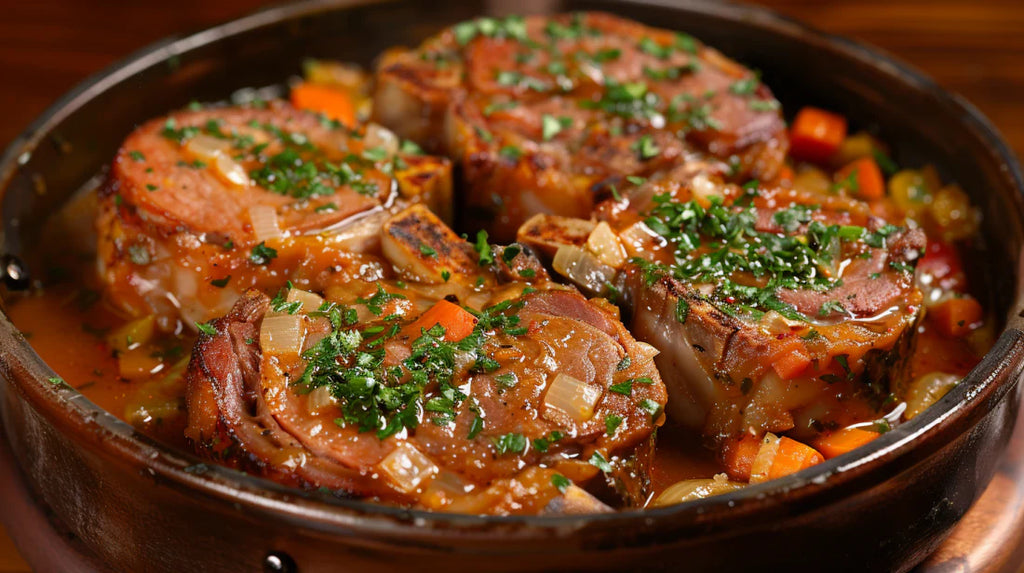
Osso buco, perfect indulgent partner for Barolo
Game
Game meat is another ideal companion for Barolo. A venison stew, a wild boar daube, or any other rich, saucy dish will reveal the complexity of the wine and bring out its woody, fruity, and spicy notes.
Aged cheeses
Hard or blue-veined cheeses also pair very well with Barolo. An aged parmesan, a gorgonzola, or any other matured cheese will intensify the wine’s aromas and offer a delicious contrast.
Vegetarian options
Vegetarian dish lovers are not forgotten: a mushroom risotto, pasta with white truffles, or even dishes based on grilled vegetables are also perfect choices with Nebbiolo. Barolo will express itself here with finesse and elegance, revealing the floral and fruity notes characteristic of Nebbiolo.
To conclude our good advice, and to fully enjoy Barolo wines, we recommend serving them at a temperature between 16 and 18°C. This will allow your wine to release all its aromas and reveal its tannic structure without it being too astringent.
The best Barolo wines
Among the emblematic producers of the appellation, the Parusso estate, located in Monforte d’Alba, stands out for its expertise and the remarkable quality of its wines.
Founded in 1901 by Gaspare Parusso, the family estate is now managed by Marco Parusso and his sister Tiziana. Since 2019, the fifth generation has also joined the business. Thus, Giulia and Francesco, daughter and son of Tiziana and Marco respectively, ensure the continuity of the family know-how.
The estate produces Barolos of great finesse, combining elegance and depth.Among them, the PerArmando vintage stands out in particular with its fine tannins and subtle aromas of red fruits, rose, and cedar. This wine beautifully incorporates the modern approach within the appellation and will gain in complexity after a few years of aging. A favorite that you absolutely must discover!
So, ready to discover Barolo in practice? Visit our website La Cave Éclairée to explore our selection of Italian wines and share your experiences with us in the comments!


