

Little known to the general public, the Cornas appellation nevertheless offers red wines of exceptional power and finesse. This small vineyard in the Rhône Valley, planted exclusively with Syrah, benefits from a unique terroir and a thousand-year-old history, allowing for the production of truly great wines. Spanning around a hundred hectares of vines planted on steep slopes, Cornas certainly deserves much greater visibility.
Let’s discover it together. Follow the guide!
Summary
History of the Cornas appellation
The history of Cornas dates back to Antiquity, a period during which the Romans planted the first vines on steep hillsides benefiting from a favorable climate. The name "Cornas" is said to come from Celtic and means "burnt land", in reference to the steep, sun-drenched slopes where the vineyard is planted.
In the Middle Ages, viticulture developed thanks to the monks and local lords. The first written mentions of vines in Cornas thus date back to the 9th century, highlighting the already very important role of wine in the life of the time. During the Renaissance, the region's wine continued to gain prestige among the nobility and notable figures.
In the 19th century, the phylloxera crisis struck Cornas. Like the rest of France and the Rhône Valley, the local vineyard was greatly decimated by this parasite attacking the roots of the vine.Nevertheless, the vines are gradually replanted over the following decades, restoring the vineyard to its former size. At the time, Cornas was in fact just behind Hermitage in terms of reputation in the northern Rhône Valley.
Finally, in 1938, the Cornas AOC was officially created, recognizing the quality and uniqueness of its wines. Today, while Cornas remains a small appellation in terms of area, it is truly one of the most iconic and appreciated in the Northern Rhône Valley.
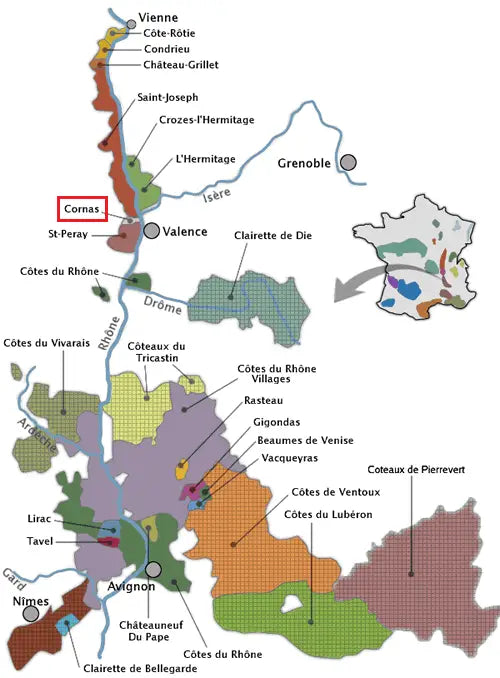
Map of the Rhône Valley showing the location of the Cornas appellation
Soils and climate of the Cornas appellation
The strength of Cornas lies both in its terroirs and its climate. The local vines indeed cling to the steep slopes of the granite massif stretching from Saint-Péray in the south to Saint-Joseph in the north, and benefit from an optimal exposure to the sun.
These soils, mainly granite-based therefore, are sometimes called “gore”. As it breaks down, the granite also creates a perfectly draining terrain, forcing the roots to penetrate deeply in search of water and nutrients. Some hillsides, meanwhile, feature more stony or sandy areas, bringing a slight variation in the texture and finesse of the wines.
The true charm of Cornas therefore lies in its unique terroirs.Planted on steep hillsides and granite soils, the vines offer the Syrah grape variety ideal conditions to express itself between power and finesse. Each plot thus gives rise to concentrated grapes, rich in aromas and substance, which translate into savory and complex notes on the palate.
The diversity of terroirs also allows the vineyard to produce cuvées with varied profiles : some are immediately accessible and enjoyable, while others (the majority), more structured, require a few years of aging to fully reveal their potential. The price of the bottles thus reflects this great variety, ranging from affordable discoveries to rarer and more sought-after cuvées.
For its part, the climate of Cornas combines continental and Mediterranean influences, with hot summers, sunny autumns, and significant temperature variations between day and night, preserving the acidity and freshness of the grapes.
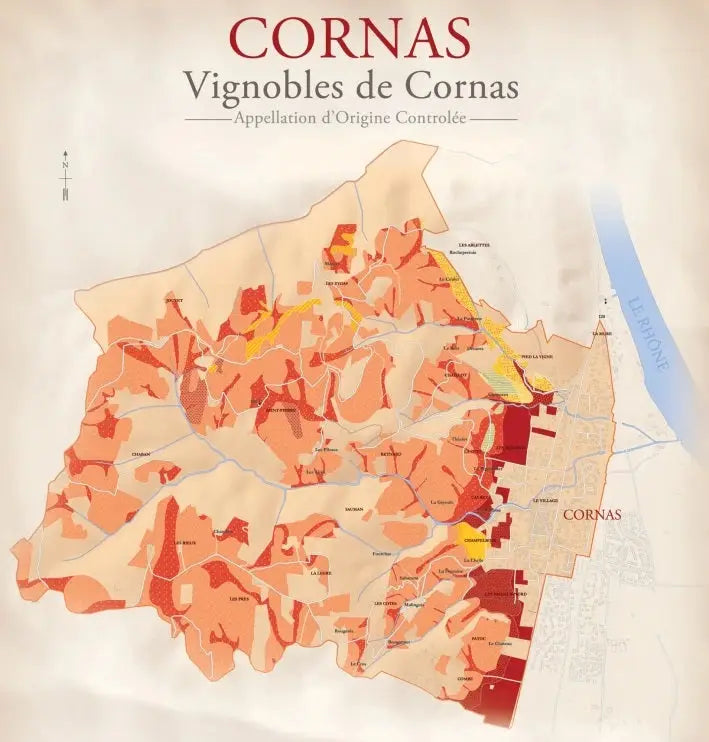
Map of the Cornas appellation
The wines of the Cornas AOC
On the Cornas terroir, Syrah reigns supreme. The appellation produces exclusively sun-drenched red wines, powerful and tannic revealing the purity and unique character of this emblematic grape variety of the Rhône Valley.
Here even more so than in Côte Rôtie or in Hermitage, the cuvées develop aromas of ripe black fruits (sometimes even jammy), accompanied by spicy notes (pepper, licorice), and sometimes floral notes (violet). After a few years of cellaring, Cornas wines gain in complexity. It then becomes common to detect aromas of leather, game, truffle, and undergrowth during tasting, all these notes enriching the aromatic bouquet. Thus, in general, young Cornas wines surprise with their intensity and power, while older cuvées reveal elegance and complexity, the signature of the terroir.
The price of a bottle of Cornas can vary greatly depending on the estate, the vintage, or even the quality of the wine.Some cuvées offer an accessible way to discover the appellation and its terroir, while others, from old vines or prestigious estates and vintages, are more suited to experienced enthusiasts.
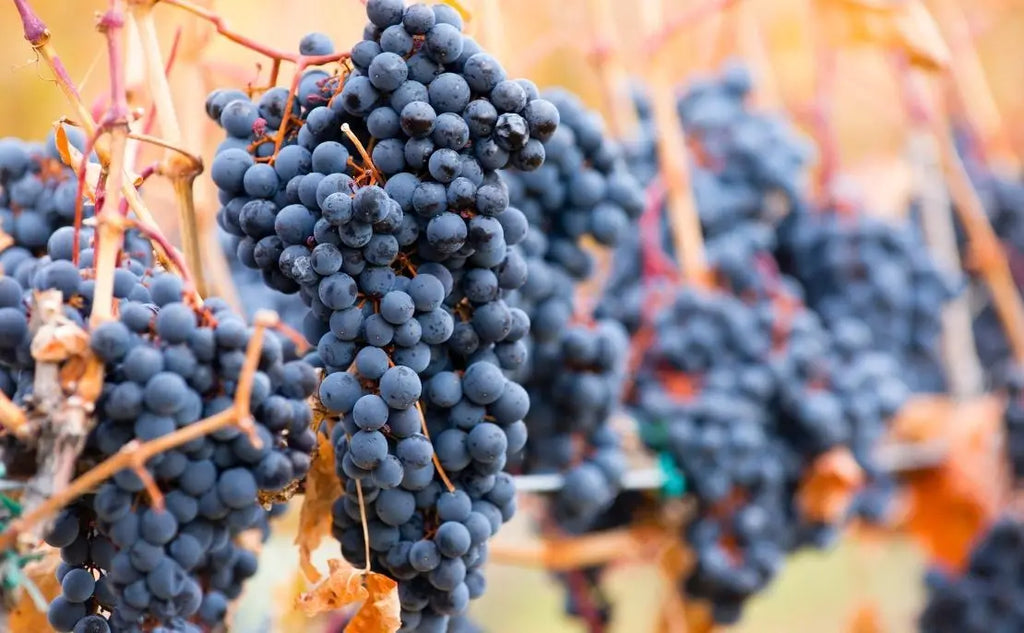
Syrah: the signature grape variety of Cornas wines
What to eat with a wine from the Cornas AOC?
As you have understood, Cornas wine is above all gastronomic and therefore meant for the table. To ideally pair your bottle, the choice of dishes is therefore crucial.
In this respect, red meat pairs particularly well with Cornas Syrah.A beautiful rare rib of beef or a leg of lamb roasted with herbs, for example, will provide a delicious balance with the robust tannins as well as the intense aromas of your cuvée.
Game is also an ideal companion for a Cornas wine. Wild boar, venison, or royal-style hare therefore combine very harmoniously with the full-bodied structure of a Cornas. Slow-cooked dishes (beef bourguignon, duck stew, coq au vin, etc.) are also another type of successful pairing.
Finally, aged cheeses are a great alternative to extend the pleasure after the main course. A very mature Comté or an old Cantal can indeed stand up to the structure of an old Cornas and create an interesting pairing.
To fully enjoy your bottle of Cornas, we also recommend serving your wine between 16 and 18°C. This temperature will allow the aromas to fully express themselves, while preserving the elegance of the tannins.
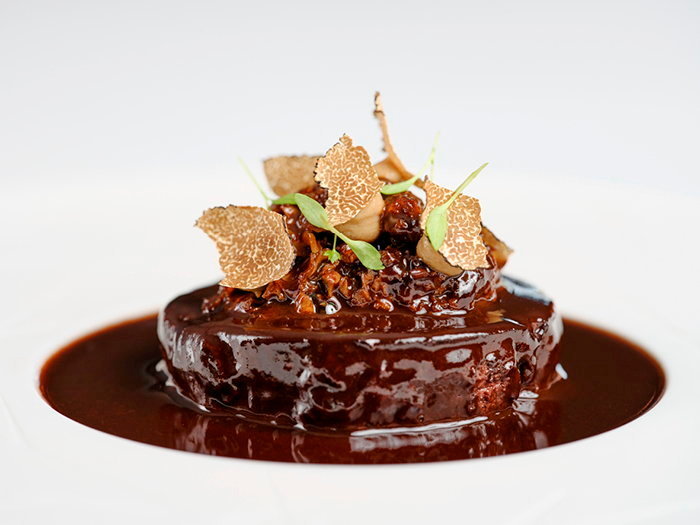
Hare à la royale and Cornas: a marriage of intense flavors
The best wines of the Cornas AOC
Several estates contribute to the fine reputation of the Cornas AOC. In this regard, we could mention Domaine Alain Voge, a leading figure in Cornas and Saint-Péray, as well as Auguste Clape. Nevertheless, at La Cave Éclairée, we are absolutely fans of the Famille Boel France estate and we therefore wish to highlight their wonderful wines!
Located in the Ardèche department, Nelly and Arnaud produce here marvelous Côtes-du-Rhône and Saint-Joseph, as well as a superb Cornas called Ars Magirica, all in biodynamics! Taken from vines planted on steep granite hillsides, this magnificent Syrah seduces from the very first nose with its richness and charm, balancing elegance and power.
On the palate, its velvety texture reveals aromas of blackberry, black cherry, and blackcurrant, subtly accompanied by spicy notes of pepper, licorice, and garrigue. A chocolatey touch and a hint of black olive punctuate this grand tasting experience. The whole is tasty, perfectly balanced, and deserves to be kept for a few years in the cellar in order to be enjoyed at its peak. In short, go for it without any hesitation!
As you will have understood, Cornas is not a wine like the others: vines planted on steep slopes, powerful cuvées full of character, tannins that soften over time… all of which invite discovery!
To find out more or to discover other Rhône appellations, feel free to visit our website La Cave Éclairée, your next great discoveries as well as superb value for money are waiting for you there!


