

You are surely familiar with the great classics of Burgundy such as Gevrey-Chambertin or Nuits-Saint-Georges. But what about the Marsannay AOC ? Less publicized, this appellation located at the northern tip of the Côte de Nuits, at the gates of Dijon, still has much to offer: diversity of soils, expressive wines in red, white, and rosé, all with remarkable value for money.
So let's discover together this gem of the Côte de Nuits and explore its wines and terroirs. Happy reading!
Summary
History of the Marsannay AOC
The Marsannay vineyard traces its roots back to Antiquity. As early as the Gallo-Roman period, the hillsides of this sector of the Côte de Nuits, located south of Dijon, were already recognized for their ability to produce quality wine. The first written records relating to the Marsannay vineyard actually date back to the 6th and 7th centuries AD.
Then, during the Middle Ages, the development of the Burgundy vineyard (and thus Marsannay) intensified under the influence of the Cistercian monks, major players in the history of winemaking in France. They structured the plots, perfected cultivation techniques, and laid the foundations for traditions that still endure today.
In the 13th and 14th centuries, the creation of "climats" (strictly defined and named plots) began in Burgundy and continued over the following centuries. Thus, a climat such as Le Clos du Roy, located north of Marsannay and Chenôve, is mentioned as early as the 13th century as an enclosed vineyard belonging to the Dukes of Burgundy.
In the 19th century, as in several other areas of the Côte dijonnaise and Burgundy, the Marsannay vineyard underwent a profound transformation. During this period, Gamay was in fact extensively planted in place of Pinot Noir in order to meet the demand for more affordable wines intended for the working class.
This economic choice deeply influenced the image of the local vineyard, and it was not until the 20th century and the 1920s that a gradual return of Pinot Noir was seen in the region. From 1960 onwards, it had almost completely replaced Gamay and was accompanied by a small amount of Chardonnay for the production of white wines.
In 1987, Marsannay officially obtained its Appellation d'Origine Contrôlée (AOC), finally allowing the local Pinot Noir and Chardonnay to break free from the generic Burgundy label.
Today, the appellation covers approximately 265 hectares, planted with more than 80% red varieties. Furthermore, the Marsannay AOC does not yet have any Premier Cru classified vineyards, although a classification project is underway.
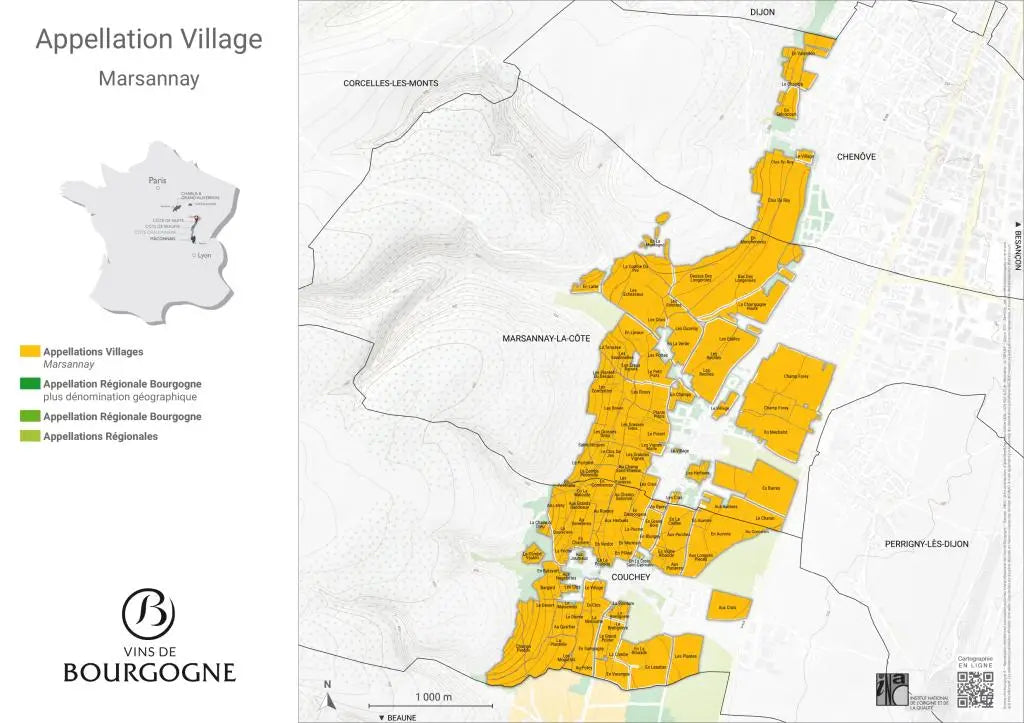
Map of the Marsannay appellation and its vineyards
Soils and climate of the Marsannay appellation
The Marsannay vineyard is located at the northern end of the Côte de Nuits and extends over the typical clay-limestone soils of Burgundy, composed of limestone marls, clays, and gravel, offering excellent natural drainage. The vines are also often oriented to the southeast, ensuring good sunlight exposure.
The climate is semi-continental and is characterized by cold winters, moderately warm summers, and a significant temperature difference between day and night: ideal conditions for slow and gradual ripening of the grapes. This climate indeed allows Pinot Noir, the sole grape variety used for red and rosé wines, to develop a beautiful aromatic complexity while maintaining freshness and elegance.
The wines of the Marsannay AOC
Marsannay is a unique appellation in the landscape of Burgundy wines. In fact, it is the only AOC in the region to produce wines in three colors: red, white, and rosé. This diversity makes it a true oenological curiosity, and the AOC is appreciated both for the quality of the cuvées offered by the winemakers and for the more accessible prices compared to other neighboring appellations (Gevrey-Chambertin, for example).
Red wines: the elegance of Pinot Noir
Red wines from Marsannay represent around 70% of the appellation's production and are made from the region's flagship grape variety: Pinot Noir. They offer an expressive and indulgent nose focused on red fruits (notes of cherry, raspberry, redcurrant), sometimes accompanied by more complex notes such as sweet spices. On the palate, they are often delicate and supple, offering a beautiful finesse of tannins.
Often compared to more prestigious crus such as those from Gevrey-Chambertin, Marsannay reds stand out for their pronounced freshness and greater accessibility (both in taste and price), which appeals to Burgundy wine lovers seeking authenticity.The reviews are, in any case, unanimous: Marsannay should be better known to the general public!
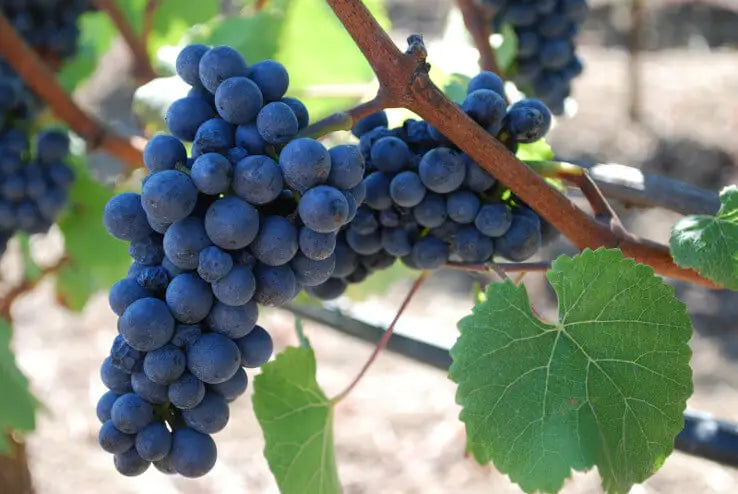
Pinot Noir: the signature of Marsannay reds
Whites: freshness and minerality
Marsannay also produces very fine white wines (about 20% of the AOC's production) made from the Chardonnay grape variety. These are characterized by a beautiful mineral tension, floral aromas as well as citrus and white fruit notes. Often aged in oak barrels, woody, buttery, and spicy notes then appear.
The aromatic purity and freshness of Marsannay's white wines demonstrate the often underestimated potential of this AOC.
Rosé: the Burgundian exception
Finally, Marsannay is one of the rare appellations in Burgundy to produce rosé wines (about 10% of the production). Also made from the Pinot Noir grape variety (as with the reds), Marsannay rosé typically offers fresh red fruit aromas such as strawberry, raspberry, as well as delicate floral notes. The color is often a lovely bright pink, rather more intense compared to other Burgundian rosés.
On the palate, the wines are indulgent and possess a refreshing acidity, making them very pleasant to taste.
What to eat with a wine from the Marsannay AOC?
Because a good wine truly comes into its own at the table, pairings with bottles of Marsannay deserve to be chosen with care. Whether red, white, or rosé, this Burgundy wine indeed offers great gastronomic versatility thanks to its finesse and character.
With a Marsannay red
The red wines of the Marsannay AOC display a beautiful structure, full of finesse. Their aromatic palette of red fruits, as well as their suppleness and elegance, make them perfect to accompany:
- Roasted white meats, such as free-range chicken or veal with mushrooms.
- Fine charcuterie, such as Burgundy parsley ham.
- Soft-ripened cheeses with bloomy rind: brie, camembert, reblochon.
- Vegetarian dishes based on lentils or mushrooms, which will highlight the earthy character of these reds.
With a white Marsannay
The white wines of Marsannay, made from Chardonnay, combine tension, minerality, and floral aromas. These are elegant whites, typical of the vineyards of the Côte de Nuits, which pair wonderfully with:
- Fish, whether grilled or in sauce: sea bass, trout, cod.
- Seafood, such as scallops or oysters.
- Poultry with cream, classics of Burgundy cuisine.
- Fresh or pressed cheeses: young Comté, mountain Tomme.
With a Marsannay rosé
Marsannay rosé is a rarity in Burgundy. Its liveliness makes it a wine of character that pairs perfectly with friendly and sunny cuisine:
- Tapas, mezze, summer grills.
- Flavourful fish: red mullet, salmon tartare.
- Mixed salads and crunchy vegetables.
- Savory tarts, such as a quiche Lorraine or a pissaladière.
- Asian-inspired dishes that are lightly spiced.
To fully enjoy your glass of Marsannay, we recommend serving the red wines of the appellation at around 14-16°C, the whites between 10-12°C, and the rosés between 8 and 10°C. These temperatures will allow you to reveal all the nuances of your bottles.

Red mullets & Marsannay rosé: a superb pairing
The best wines of the Marsannay AOC
It is impossible to talk about Marsannay wines without mentioning a few iconic estates such as Bruno Clair, Bart, or Sylvain Pataille. Among them, the Huguenot estate also stands out as a key reference for the appellation.
Located in Marsannay-la-Côte, this family-run estate pays particular attention to expressing Pinot Noir. The resulting red wines are of great finesse, marked by ripe red fruit aromas, an elegant structure, and a silky mouthfeel. They perfectly embody the style of Marsannay: approachable in their youth, but with a nice aging potential of 8 to 10 years.
The estate's white wines, meanwhile, accurately express the mineral freshness of the northern Burgundy terroirs. Their balance between tension and roundness is particularly appealing.
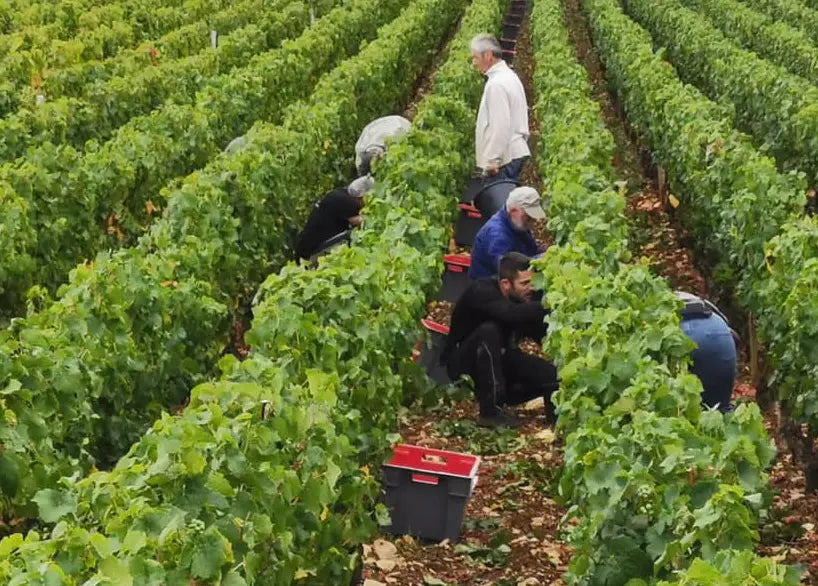
Harvest in the vineyards of Marsannay
As you will have understood, the Marsannay appellation is a concentration of the best of Burgundy: refined reds, elegant whites, and even characterful rosés are all on offer, all at still reasonable prices for the region! So don't hesitate to discover the selection of the best wines from this appellation and from all of Burgundy at your online wine merchant La Cave Éclairée !
-
Domaine Huguenot - Marsannay - Héritage rouge 2022
Usual price 27,20€Usual priceUnit price par32,00€promotional price 27,20€Deal

BLOG : LES ARTICLES ASSOCIÉS

The Fixin appellation: hidden gem of the Côte de Nuits
L'appellation Fixin est un trésor discret de la Côte de Nuits à absolument découvrir. Histoire, terroirs, vins : vous saurez tout sur Fixin après...

Everything you need to know about Pinot Noir
Cultivated all over the world, Pinot Noir is one of the most appreciated grape varieties among wine enthusiasts, notably for its ability to produce...

Burgundy wine classification explained: how wines are ranked
Beyond grape varieties and winemaking methods, one of the keys to understanding the winegrowing success of Burgundy is to be found in its unique...

Exploration of the Gevrey-Chambertin appellation
Welcome to Gevrey-Chambertin, one of the most renowned appellations of Burgundy and the Côte de Nuits! Here, every plot tells a story and every bottle...
- Choosing a selection causes the entire page to refresh.
- Opens in a new window.