

Cognac and Armagnac are two French eaux-de-vie aged in oak barrels (with the exception of Blanche d’Armagnac) and made from the same raw material, white grapes. Nevertheless, each of them has its own unique identity and a very rich centuries-old history.
Here is a summary to help you better understand the uniqueness of these two spirits.
Summary
Location, organization & climate
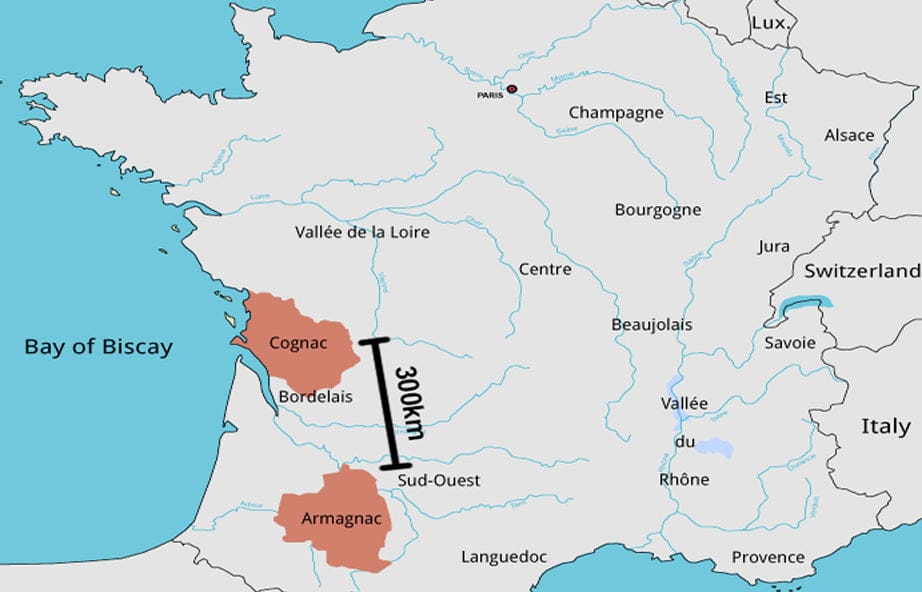
300 kilometers separate Cognac and Armagnac. Indeed, if the latter is produced in the Southwest of France, Cognac on the other hand originates from the North of Bordeaux, mainly from the departments of Charente and Charente-Maritime.
This difference in location implies a climatic difference: Cognac enjoys a particularly oceanic climate (rather high rainfall, low annual temperature variations) whereas Armagnac benefits from a more continental area (lower rainfall, greater annual temperature variations).
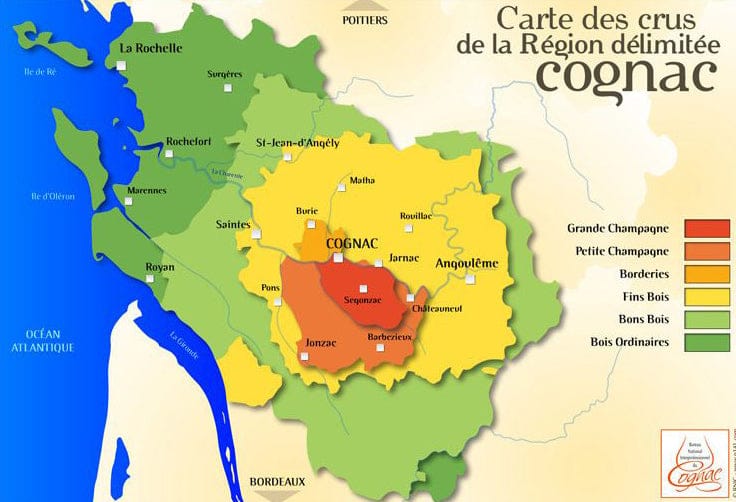
From an organizational point of view, the Cognac AOC is divided into 6 crus : Grande Champagne, Petite Champagne, Borderies, Fins Bois, Bons Bois, and Bois Ordinaires. The most sought-after crus are those located around the city of Cognac: Grande Champagne & Petite Champagne.
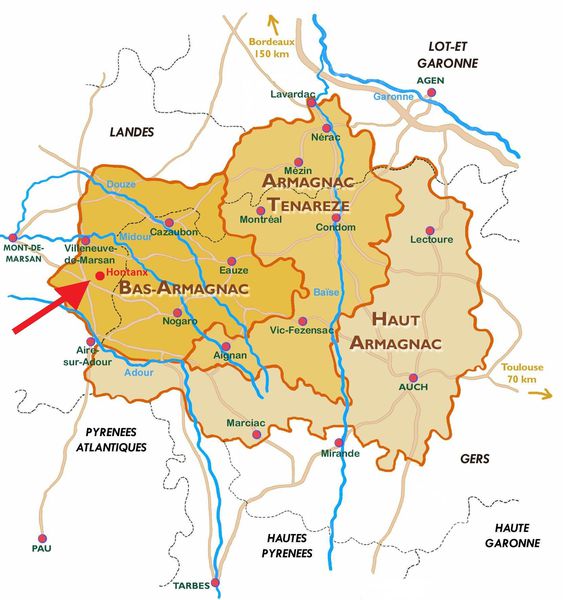
The Armagnac AOC, on the other hand, is made up of 3 sub-regions: Bas Armagnac, Haut Armagnac, and Armagnac Ténarèze.
These distinctions were created due to slight differences in terroir as well as the quality of the eaux-de-vie produced. However, be careful not to generalize too much, as the quality of the final product depends more on the quality of the vineyard and the distiller's expertise than on any particular notion of cru.
Numerical comparisons
Comparing the Armagnac and Cognac markets is a bit like comparing David and Goliath.
Indeed, while the Cognac wine-growing area covers 75,000 hectares, Armagnac covers only 15,000, five times less. Furthermore, the Cognac market represents approximately 3.5 billion euros in revenue for nearly 200 million bottles. In comparison, Armagnac seems quite small with an artisanal production of 6 million bottles (30 times less) and a revenue of 40 million euros (85 times less). Finally, while Cognac is a market resolutely focused on export (98% of its volumes), France still represents 50% of the Armagnac market.
However, the differences between these two spirits cannot be reduced to a numbers game.Indeed, each of these spirits has a unique history, a distinct distillation process, as well as different terroirs and taste markers.
History of Cognac and Armagnac
Cognac : From the 15th century onwards, and thanks to the Charente River, Dutch ships regularly came to stock up on wines from the region. However, these wines did not withstand long sea journeys well. To solve this problem, the Dutch decided to distill these wines. They first did this in Holland and called the product "brandwijn" (burnt wine), which would later become "brandy", wine eau-de-vie. They would later install stills in Charente, which allowed the product to travel in the form of an unalterable eau-de-vie.
In the 18th century, the market began to organize itself and it was during this period that most of the major houses were created: Martell (1715), Rémy Martin (1724), Hennessy (1765), etc. In 1860, under the impetus of Napoleon III and thanks to the signing of a trade agreement between France and England, Cognac began a meteoric rise.
Historically, Cognac has therefore always been an export product : first for the Dutch, then for our English friends. Even today, its production is exported to 160 countries, with the United States as the number one customer. Moreover, unlike Armagnac, Cognac is a very concentrated market: the top 4 trading houses (Martell, Rémy Martin, Hennessy, Courvoisier) represent 90% of the market!
Armagnac : From a historical perspective, Armagnac is older than Cognac. The spirit is actually considered the oldest in France thanks to writings dating back to 1310. It was then called "Aygue Ardente" (which simply means eau-de-vie).
While the 15th century marks the beginning of its commercialization, it was in the 18th century that the market began to grow. At that time, the Dutch (yes, them again!) sailed up the Garonne and signed their first contract with winegrowers from Gers to purchase wines.Fearing competition, the people of Bordeaux intercept the convoys going down the river on the pretext that no wine other than Bordeaux can be transported by waterway. If wine is prohibited, spirits are not , and this is how large-scale distillation of wines began in the Gascogne region. The Dutch then buy large quantities of alcohol in Armagnac to enrich and stabilize the wines they supply to the peoples of Northern Europe. Armagnac then becomes a true commercial product, subject to the fluctuations of good and bad years. To smooth out the quality, it was decided to store the spirit in wooden casks. The benefits of aging were then discovered: color, roundness and aromas.
Terroir & grape varieties
The Cognac soils are known for being very chalky while the Armagnac terroir is more diverse: mainly sandy, some areas are also clay-limestone and clay-siliceous.
In terms of grape varieties, Ugni Blanc represents 98% of the Cognac vineyards. It has high acidity and a low sugar content, which meets the criteria sought for distillation. It can be complemented by other grapes such as Colombard, Folle Blanche, and a few other very minor varieties.
Armagnac, on the other hand, has a more varied composition: while Ugni blanc is also very present (55%), 9 other grape varieties can be used, including Baco (35%) as well as Folle Blanche and Colombard. This diversity is due to the winegrowing tradition of the region, which also produces tasting wines, whereas the Cognac region produces only wine intended for distillation.
Distillation
To obtain a cognac, double distillation in copper pot stills (called Charentais stills) is mandatory.
If Armagnac can also use this method, the distillers in the region overwhelmingly use short column stills allowing for continuous single distillation.
We will not go into overly technical details here, but it is important to remember that no method can be considered superior in quality to the other. Indeed, when it comes to obtaining a quality eau-de-vie, the key elements remain above all the quality of the grapes and the distiller's expertise.
Taste markers & age statements
If markers exist for these two spirits, it can nevertheless be complex for tasters (even professionals) to distinguish a Cognac from an Armagnac in a blind tasting, particularly for those that have undergone long aging in oak barrels. So there is no shame if you have ever confused the two!
Cognac is generally identified by aromas of raisins or violet. For Armagnac, prune and more pronounced floral aromas can help with its identification. The older these eaux-de-vie get, the more they tend toward common aromatics of candied fruit and orange peel.
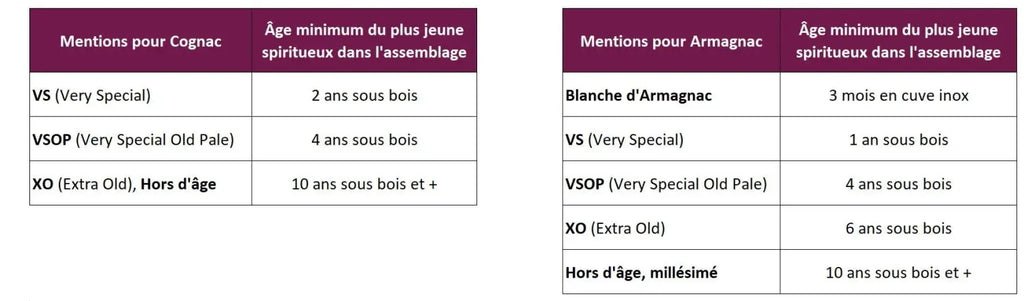
Finally, while it is common to produce vintage Armagnacs (bearing the mention of a specific harvest year), this is much less common for Cognac. It should also be noted that each of the eaux-de-vie may bear indications guaranteeing a certain number of years of aging:
What to choose ?
While several elements bring Cognac and Armagnac together, many differences also characterize them, allowing us to enjoy two eaux-de-vie with unique character, representing French expertise around the world.
Some may appreciate perhaps an XO Cognac with a rich and complex aromatic profile. Others will prefer the floral, spirited, and fragrant aspect of a young Armagnac. There is only one way to know what you like: tasting.
For these spirits, La Cave Éclairée works with two exceptional houses: the Cognacs Guy Lhéraud as well as the Armagnacs Baron Gaston Legrand.
Do not hesitate to use our services for advice!


2 comments
Merci pour cet article simple d’accès et très complet !
le dossier sur l’armagnac et le cognac est très instructif.
bravo et merci