

Are you an enthusiast or passionate about spirits? Then, you have undoubtedly already encountered a Scottish whisky during your tastings! Whether you are a seasoned aficionado or simply curious, this legendary drink invites us on a journey through its magnificent island, where centuries-old traditions and artisanal know-how meet.
So, pour yourself a glass, make yourself comfortable, and let La Cave Éclairée reveal to you all the secrets of Scottish whisky. Health and safe travels!
Summary
The history of Scotch whisky
The history of whisky is rather nebulous. Nevertheless, to trace its origins, we must first discuss the birth of distillation.
The oldest traces of distillation date back to the 2nd millennium BC, in China and Mesopotamia. However, at that time, it was not used for the production of alcohol, but only to create perfumes and cosmetic balms.
Over the centuries, the techniques improved, notably thanks to the Arabs. In fact, it was they who brought this technique to the West around the 10th and 11th centuries AD.
From the 12th century onwards, the distillation of spirits from grapes and cereals gradually spread throughout Europe, notably under the influence of monks. At that time, proto-whiskies were already being produced, especially in Ireland.
The first written reference to "whisky" appeared in Scotland in the 15th century, more precisely in 1494 : "eight balls of malt to Friar John Cor wherewith to make aquavitae". The term aquavitae (eau-de-vie) is referred to as "uisge beatha" in Gaelic; over time, the expression evolved into "ooshki" and then "whisky".
Nevertheless, it should be noted that by the 15th century, barley distillation was already widespread in Scotland, apparently due to the dissemination of this knowledge by Irish monks a few centuries earlier. This is, moreover, a broad topic of debate between the Irish and the Scots, with both peoples claiming the parentage of whisky !
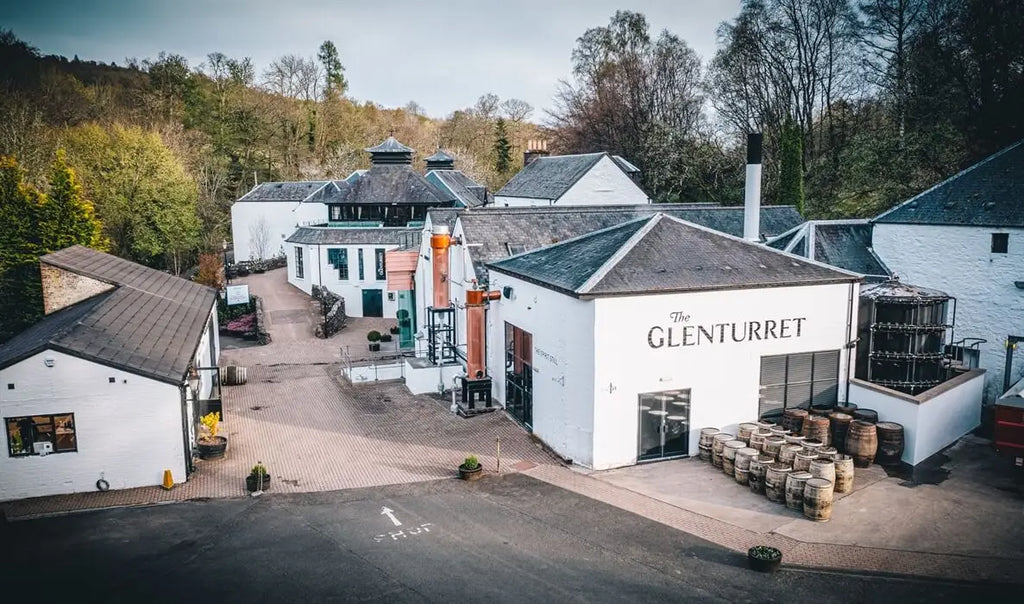
It was also during this period that the first major distilleries were established, notably Glenturret (1717), Bowmore (1779), Jura (1810), and Glenlivet (1824).
Two centuries later, in 1988, the Scotch Whisky Act was created, thereby defining precise regulations for "Scotch Whisky". Thus, to be considered a scotch, a whisky must be produced and aged in Scotland for at least three years in oak casks and have a minimum alcohol content of 40%.
In 2009, new regulations were added, specifying labeling and marketing standards, thereby strengthening the reputation of Scotch Whisky as a global benchmark for quality.
Today, nearly 700 million bottles of Scotch whiskies are produced each year and about 90% of the production is intended for export. The United States, France, India, and Germany are the most important markets for Scotch whisky.
What are the Scotch whisky production regions ?
One of the fascinating features of Scotch whisky is its diversity of flavors, influenced by the regions where it is produced. Each region thus offers a unique style, although some distillers like to break traditional codes. Let’s now take a look at the main production regions.
The Lowlands
Located in the south of the island, this region is renowned for its light and subtle whiskies. The Glenkinchie and Auchentoshan distilleries, for example, stand out for their smooth and often floral malts.
Perfect for lovers of delicate and refined flavors, and a great way to discover whisky in general!
The Highlands
The Highlands are the largest whisky-producing region in Scotland and cover a vast area from the center to the north of the country. Given its size, the whiskies produced here are very diverse in nature. The aromas often evoke fruity notes as well as honey or even heather.
Distilleries such as Glenmorangie and Glengoyne perfectly illustrate this richness, offering whiskies ranging from light to intense.
Speyside
Initially a sub-region of the Highlands, Speyside is now considered the heart of Scotch whisky and a region in its own right. And this is quite logical: the area has almost half of the active distilleries in the country !
Iconic brands such as Glenfiddich, The Macallan, and The Glenlivet notably come from Speyside. The whiskies here are elegant and complex and feature sweet aromas and fruity, sometimes with notes of nuts or honey.
Islay
The island of Islay is synonymous with peated whiskies as well as smoky, briny, and peppery notes. The region is therefore highly appreciated by enthusiasts of powerful whisky with strong character. However, some distilleries such as Bunnahabhain prefer rounder styles, offering a beautiful variety of flavors.
Laphroaig, Ardbeg, Lagavulin, and Bowmore are the most well-known distilleries in the region.
Campbeltown
Once the whisky capital, Campbeltown now has only three distilleries. However, these produce unique, maritime and fruity whiskies.
Springbank is undoubtedly the most famous distillery in this region, the other two being Glen Scotia and Glengyle.
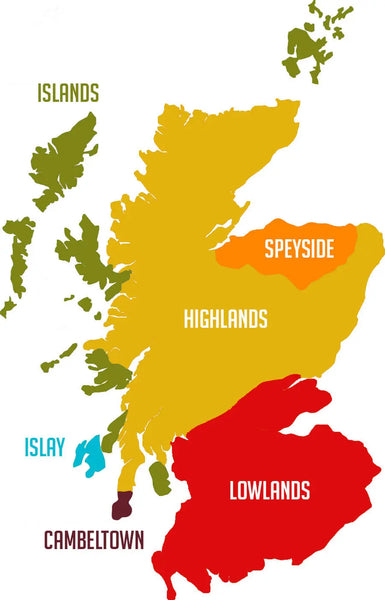
Each region of Scotland produces whiskies with unique character
The making of Scotch whisky
The making of Scotch whisky is an art passed down from generation to generation. It is based on four main stages, each playing a crucial role in developing the final taste.
Malting
It all begins with malting. The barley is soaked here to germinate, a process that transforms the starch in the grain into sugar, which is essential for the upcoming fermentation. Then, once germinated, the barley is dried.
If the distillery wishes to create a peated whisky, peat is then burned under the barley during this stage, bringing smoky notes to the malt.
Mashing and fermentation
Then, the dried barley is ground into grist, a type of powder obtained using special mills. This type of flour is then mixed with hot water to dissolve the sugars and create a sweet liquid called wort (the wort).
This liquid is then fermented in large vats called washbacks, where yeast is added to convert the sugars into alcohol
A fermented liquid is then obtained, the wash, with an alcohol content of 6 to 8% and a consistency similar to beer. The fermentation generally lasts between 48 and 72 hours.
Distillation
The wash is finally distilled in stills, the latter being unique to each distillery.
A first distillation is then carried out, resulting in a raw liquid called "brouillis". Then, a second distillation is performed to purify this initial result. In general, Scotch whisky undergoes a double distillation, unlike Irish whiskey which is often distilled three times.
Aging in casks
After distillation, the whisky is still transparent and has a rather pronounced barley taste.It is ultimately only during aging in oak barrels that the spirit acquires its golden color and develops refined aromas reminiscent of wood, vanilla, cinnamon, or even hazelnut.
The type of barrels used, weather conditions (heat, humidity, etc.), the location of the distillery, and of course the aging period all play a crucial role in the development of flavors.
Note also that in Scotland, whisky loses 1 to 2% of its volume each year due to evaporation, a phenomenon known as the “angel’s share”.
There you go, now you know how a Scottish whisky is made!
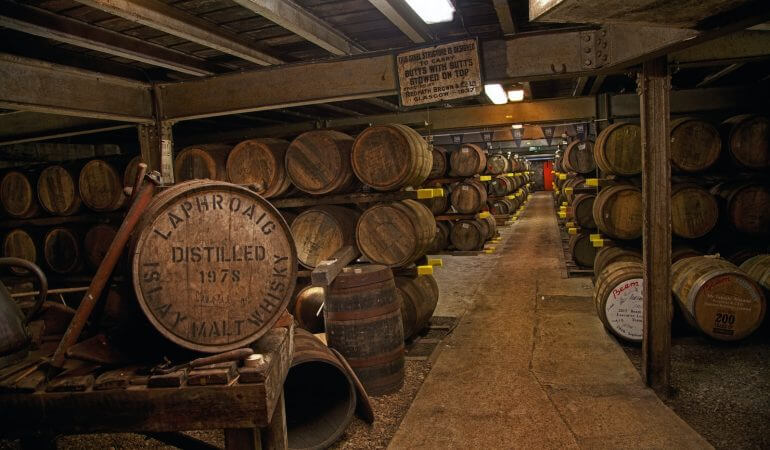
Scottish whiskies are crafted in distilleries that combine tradition and centuries-old expertise
How to taste Scottish whisky ?
Tasting a Scottish whisky is a unique experience. It's not just about drinking, but about savoring each sip with all your senses.
- Choose the right glass : use a tulip-shaped glass, called a Glencairn glass, to concentrate the aromas and allow for a better perception of flavors.
- Observe the color : the shade of a whisky can tell you a lot about its age or type of aging. Younger whiskies are indeed often lighter, while older whiskies, aged in sherry (Jerez) or bourbon casks, will have deep amber colors. However, be aware that caramel may be added as a coloring agent ! In this case, analyzing the color of your whisky is of no interest.
- Appreciate the aromas: Even before tasting, smell the whisky. Take the time to detect the different layers of aromas, from fruity notes to spicy touches.
- Taste slowly: Let the whisky linger in your mouth for a few seconds before swallowing. You will be surprised by all the flavors that can be revealed!
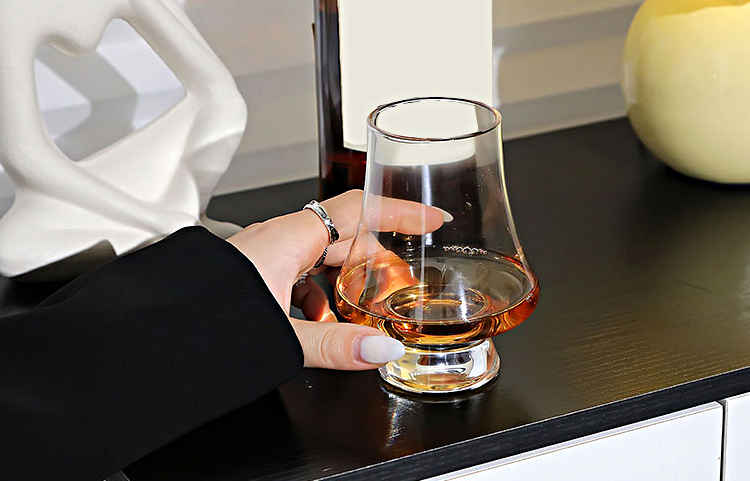
Serve your Scotch whisky in a Glencairn glass to ensure a proper tasting experience
What are the best Scotch whiskies?
It is never easy to make a list of the best Scotch whiskies ! The country actually has more than 150 distilleries and there is something for every taste !
Every whisky enthusiast has their own preferences, whether it is for a peated single malt or a lighter blend. However, a few examples stand out for their quality and reputation. Here are some names that truly deserve your attention.
Kilchoman Distillery
The Kilchoman distillery, located on the Isle of Islay in Scotland, is one of the few to master the entire process, from barley cultivation to malting and bottling. Founded in 2005, it produces typically peated single malts, combining finesse, complexity, and maritime influence.
With its iconic whiskies combining smoky aromas, ripe fruits, and briny notes, Kilchoman embodies the authenticity and traditional know-how of Islay, appealing to both enthusiasts and connoisseurs.
The Ultimate Whisky Company
Since 1994, this Dutch family business carefully selects the best casks throughout Scotland.The Ultimate is indeed a renowned independent bottler known for its transparency and precision. The whiskies, for example, are bottled here without chill filtration in order to preserve all the original flavors.
Whether you prefer younger or older whiskies, this house offers exceptional bottles from all Scottish regions.
Of course, these examples only scratch the surface of the diversity of Scottish whisky, but they do illustrate the richness of flavors that Scotland has to offer. In any case, you are now better equipped to understand and appreciate Scottish whisky in its entirety.Whether you are a fan of peated whisky or looking for a light and fruity whisky, there is sure to be a Scotch Whisky for you!


