

Bourbon has something magnetic. Its aromas of toasted barrels, its smooth notes of vanilla and grains, this warm roundness that caresses the palate… everything evokes the plains of Kentucky, family distilleries stacking barrels, or those convivial evenings where people remake the world over a comforting glass.
Whether you are a whisky enthusiast or simply curious to discover what makes bourbon one of the most appreciated spirits in the United States and around the world, you are in the right place ! Settle in comfortably, pour yourself a glass (in moderation), and let yourself be guided on a journey to the heart of the soul of bourbon, this great American whisky with a unique trajectory.
Contents
History of Bourbon
The history of bourbon begins at the end of the 18th century, in the heart of emerging America. At that time, Scottish, Irish, and French settlers settled in Kentucky. These pioneers bring with them their expertise in distillation, particularly of whisky. Nevertheless, local conditions change the game.
Corn, easier to grow than barley in this fertile region, quickly becomes the foundation of agricultural production. It is therefore only natural that the locals experiment and adapt their distillation practices, using this grain as a base as well as heavily charred oak barrels for aging. Unknowingly, they are in the process of creating a new type of whiskey : bourbon.
Legend attributes the creation of the first bourbon to Elijah Craig, a Baptist pastor from Kentucky, around 1789. While it is difficult to confirm this parentage, his name remains closely associated with the birth of modern bourbon. The aging process in new toasted barrels will become the spirit's signature, giving it its amber color and its highly recognizable aromas. As techniques are refined, family distilleries multiply, gradually laying the foundations of a tradition now perpetuated by iconic houses such as Wild Turkey, Maker’s Mark, and Buffalo Trace.
The name "Bourbon" is said to come from Bourbon County, a region of Kentucky named in honor of the French dynasty of the same name. It is here that the first barrels of this spirit were marked "Bourbon Whiskey" before being shipped by boat on the Ohio River. Quickly, the distinctive taste of this amber liquid won over consumers.
At the end of the 19th century, American whiskey market suffered from numerous counterfeits. In order to protect producers, the government adopted in 1897 the Bottled-in-Bond Act, the first major regulation setting the criteria for authentic bourbon: a single distiller, a single season and aging for at least four years under federal supervision. This foundational text then established the reputation of a superior quality bourbon.
Over time, bourbon became a true national symbol. In 1964, the United States Congress even officially proclaimed it America’s Native Spirit, making bourbon a national and cultural symbol in its own right. Then, the 1980s marked a turning point. The emergence of small batch and single barrel bourbons ushers in a new era focused on superior quality, attracting a generation of connoisseurs in search of artisanal flavors.
Today, bourbon is exported worldwide and is a great ambassador of American expertise in spirits: a story of tradition, patience, and passion.

The differences between Bourbon and Whisky
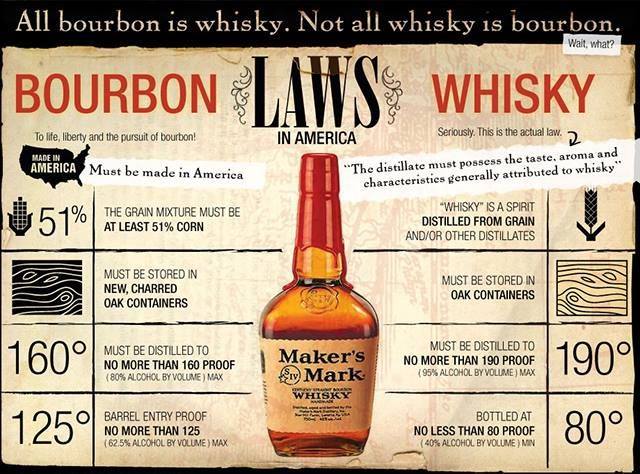
All bourbons are whiskies, but not all whiskies are bourbons.
To qualify as Bourbon, a whiskey must indeed be produced in the United States, be made from grains containing at least 51% corn, and be distilled at less than 80% alcohol. The alcohol must then be aged in new charred American oak barrels and barreled at a maximum strength of 62.5%, before finally being bottled at at least 40%. Furthermore, no additives, colorings, or flavors are allowed: all the richness of the taste comes from the grain, the water, and the wood !
Conversely, Scotch whisky is distilled from malted barley, often twice, and usually aged in barrels that have previously contained bourbon or sherry. The cooler climate of Scotland also results in less porosity for the wood, meaning the spirit requires more time to absorb the aromas from it. Furthermore, unlike bourbon, whisky can legally contain a small amount of caramel coloring (E150a) to harmonize the shade between batches.
From a taste and aromatic perspective, bourbon is distinguished by its roundness and smoothness, its vanilla, caramelized, and spicy notes. Generous and warm, it embodies richness and strength. On the other hand, a whisky is drier, and can be slightly fruity, maritime, smoky, or peaty, depending on its region and country of origin.
Whisky and Whiskey
The difference in spelling between whisky and whiskey does not refer to two distinct products, but to two traditions. In Scotland, Japan, Canada, or even France, it is written whisky without an "e", in accordance with the Scottish root of the word.
On the other hand, Ireland and the United States use the form whiskey, inherited from an old desire of Irish distillers to distinguish themselves from their Scottish counterparts. Today, this distinction remains purely geographical and each country continues its own traditions.
The key elements of Bourbon production
The magic of bourbon lies as much in the simplicity of its recipe as in the precision of its production. Three fundamental elements come into play here: grains, water, and wood.
Grains
Corn dominates the blend (at least 51%), which partly explains the characteristic roundness of bourbon. Rye (often used between 10 and 35% by distilleries) is also very often used, bringing a spicy note, while wheat, used in certain recipes, brings a certain aromatic smoothness on the palate.Finally, the barley malt, used in small quantities, activates fermentation thanks to its natural enzymes. These enzymes convert the starch in corn and other grains into fermentable sugars, which will in turn be transformed into alcohol through the fermentation process.
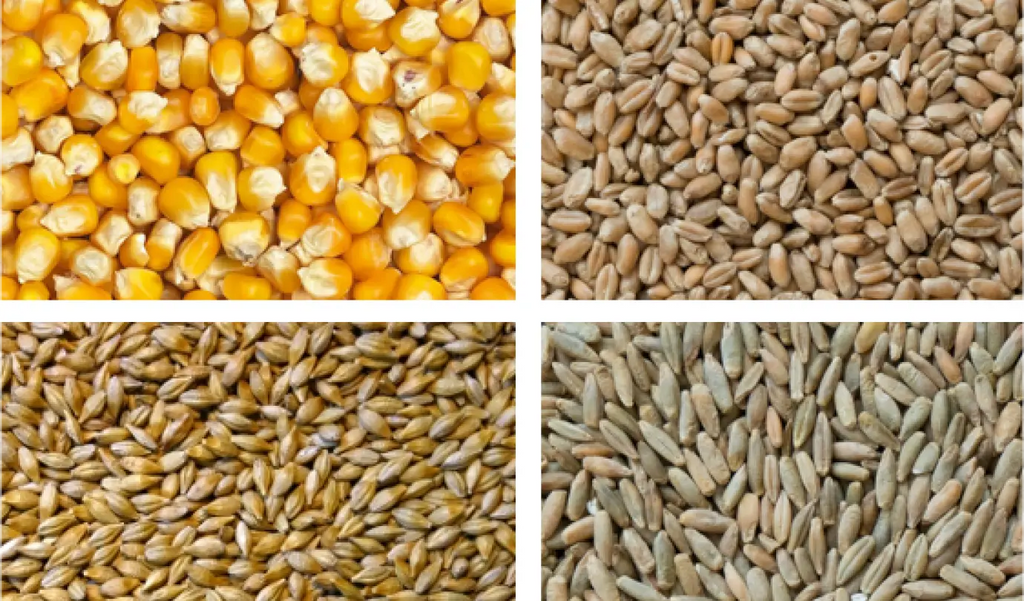 Corn, rye, wheat, barley: the essential grains of bourbon
Water
Kentucky is renowned for the purity of its water, naturally filtered through layers of limestone. Low in iron, it thus preserves all the aromatic integrity of the whiskey. An often underestimated element, in the production of great American whiskeys.
The distillation process
The mash, obtained by mixing the crushed grains with hot water, is fermented thanks to yeast. After a few days, a liquid equivalent to a kind of un-hopped beer is obtained. This is then distilled in pot stills or column stills in order to concentrate the alcohol and aromas. For bourbon, distillation must not exceed 80% alcohol in order to retain a high concentration of aromatic compounds.
Aging in barrels
Once distillation is complete, the resulting clear liquid is then transferred into new charred American oak barrels, that is, heavily burned on the inside. This prolonged contact completely transforms the product: the wood releases aromatic compounds (vanilla, caramel, coconut, spices) and gives the bourbon its amber color.
Moreover, the warm and humid climate of Kentucky accelerates this process: the bourbon literally "breathes" through the wood, absorbing and releasing aromas throughout the seasons. While no aging period is required by law, a bourbon labeled Straight Bourbon must be aged for at least 2 years. If it is aged less than 4 years, the aging period must then be explicitly indicated on the label.
Nevertheless, the vast majority of good bourbons are aged in wood for 4 to 8 years, with some going up to 10, 12, or even 20 years for special and premium editions !
Which cocktails to prepare with Bourbon ?
Although neat Bourbon tastings are a true delight, our American spirit also allows for the creation of magnificent cocktails. Thanks to its smoothness and vanilla notes, it indeed enables the preparation of many iconic cocktails and pairs easily with a wide variety of ingredients. Here is an overview of some essential classics.
Old Fashioned
A piece of brown sugar soaked with a few drops of Angostura bitters, a 6 cl measure of bourbon, one or two ice cubes, and an orange zest. Simple, effective, and timeless, this great classic highlights the spicy, woody, vanilla, and caramelized notes of bourbon.
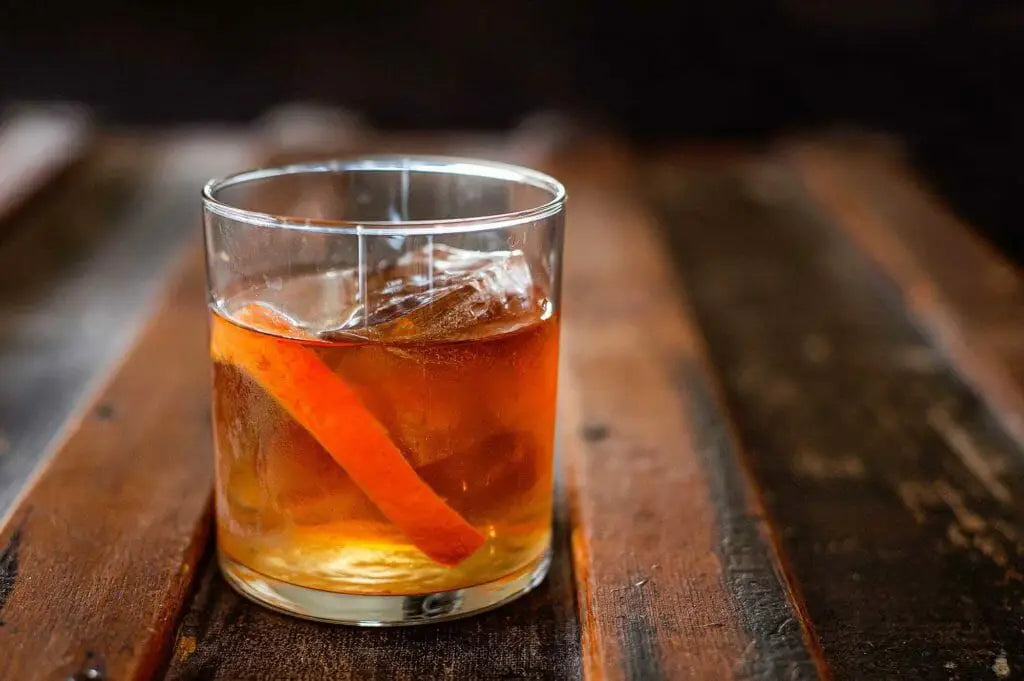 Old fashioned, the iconic American cocktail
Whiskey Sour
Mix 6 cl of bourbon, 3 cl of fresh lemon juice, 2 cl of sugar syrup, and one egg white for texture. Shake once without ice to create a nice foam, then shake again with ice cubes and serve well chilled. A tangy, enveloping, balanced, and refreshing cocktail.
Mint Julep
The legendary drink of the Kentucky Derby. Muddle 8 to 10 fresh mint leaves with 1 cl of sugar syrup (or add a little brown powdered sugar), fill with crushed ice, then pour in 6 cl of bourbon. Stir gently and garnish with mint. A refreshing, aromatic, and typically Southern cocktail.
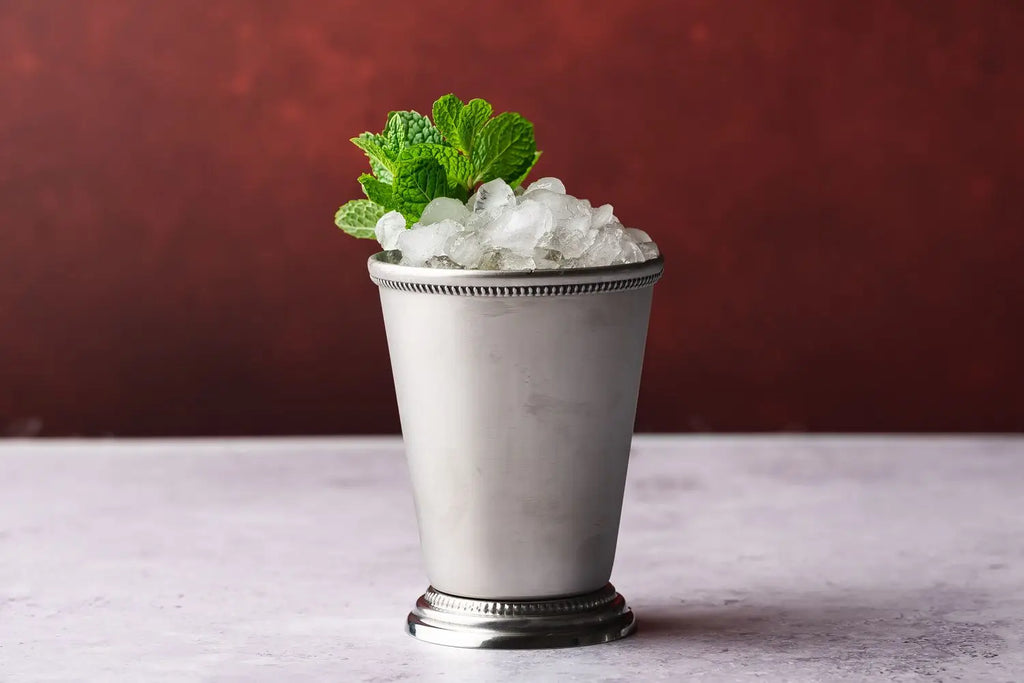 Mint Julep, an elegant blend of fresh mint, sugar, and bourbon
Boulevardier
The American cousin of the Negroni. Mix 3 cl of bourbon, 3 cl of red vermouth, and 3 cl of Campari in a mixing glass filled with ice cubes. Stir and strain into an old fashioned glass. More rounded and warm than the Italian Negroni, it perfectly expresses the richness of bourbon!
What are the best Bourbons ?
Providing a list of the best bourbons is inevitably subjective, as this spirit comes in a variety of styles and characters. However, certain distilleries stand out as essential references, recognized for their expertise and the consistent quality of their production.
Woodford Reserve
Located in the heart of Kentucky, the Woodford Reserve distillery embodies the art of bourbon in its most refined form. Crafted from a meticulously balanced blend of corn, rye, and malted barley, this bourbon is triple-distilled in pot stills, a rare process in the United States.
The result is an aromatic profile of great complexity, where vanilla, caramel, dried fruits, sweet spices, and a delicate woody note mingle. A bourbon of remarkable elegance, as enjoyable neat as in a perfectly executed Old Fashioned.
Four Roses
Icon of American bourbon, Four Roses stands out for its fully controlled production. The distillery combines two mash recipes and five distinct yeast strains, thus offering a great diversity of aromatic profiles. This method allows the creation of cuvées of remarkable finesse, notably the Small Batch, renowned for their elegance, fragrant richness, and subtle balance between vanilla sweetness and spicy notes.
The other essential references
It would of course be impossible not to mention here the brand Jack Daniel’s, often associated with the Bourbon category, although it is actually a Tennessee Whiskey. Its distinctive style, characterized by charcoal filtration before barreling, gives it a particularly velvety texture and an immediately recognizable aromatic signature.
Among the other major references, Maker’s Mark stands out for its round and indulgent profile, with pastry notes, resulting from a blend dominated by corn (70%), complemented by wheat (16%) and malted barley (14%).
On its side, Buffalo Trace, a true Kentucky institution, stands out for the depth and consistency of its vintages. Bulleit Bourbon asserts a spicier and more dynamic style thanks to a high proportion of rye, while Wild Turkey embodies an authentic tradition through powerful and generous expressions.
So many iconic houses that perfectly illustrate the diversity of American bourbon, combining power, roundness, and timeless elegance.
As you will have understood, bourbon is not a whisky like the others. Each sip of this magnificent spirit tells a story of terroir, people, grains, and barrels that shape its unique taste. Whether you enjoy it neat, on the rocks, or in a cocktail, this delicious American spirit will always reveal warm aromas and a beautiful aromatic richness. To further explore this world and discover bourbons and whiskies that leave a lasting impression, dive into our selection on La Cave Éclairée.
Enjoy your tasting and see you soon for new discoveries !


